| Urial | |
|---|---|
| |
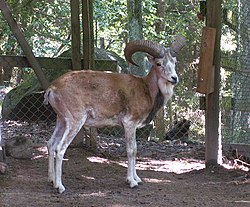
| Bukhara urial (Ovis vignei bochariensis) at Nordens Ark, Sweden | |
Scientific classification 
| |
| Kingdom: | Animalia |
| Phylum: | Chordata |
| Class: | Mammalia |
| Infraclass: | Placentalia |
| Order: | Artiodactyla |
| Family: | Bovidae |
| Subfamily: | Caprinae |
| Genus: | Ovis |
| Species: | O. vignei
|
| Binomial name | |
| Ovis vignei | |

| |
| The range of Urial | |
| Synonyms | |
|
Ovis orientalis vignei | |
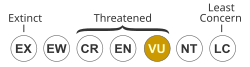
The urial (/ˈʊəriəl/ OOR-ee-əl; Ovis vignei), also known as arkars, shapo, or shapu, is a wild sheep native to Central and South Asia. It is listed as Vulnerable on the IUCN Red List.1
Taxonomy
Ovis vignei was the scientific name proposed by Edward Blyth in 1841 for wild sheep in the Sulaiman Mountains.2 The specific name honours Godfrey Vigne (1801–1863).3
The vignei subspecies group consists of six individual subspecies:
- Ladakh urial (Ovis vignei vignei): northern India (Ladakh), northern Pakistan (Gilgit-Baltistan)
- Transcaspian urial (Ovis vignei arkal): Ustjurt-Plateau (Turkmenistan, Uzbekistan, northern Iran) and western Kazakhstan
- Blanford's urial or Baluchistan urial (Ovis vignei blanfordi): Pakistan (Balochistan)
- Bukhara urial (Ovis vignei bochariensis): Uzbekistan, Tajikistan, Turkmenistan, Afghanistan
- Afghan urial or Turkmenian sheep (Ovis vignei cycloceros): southern Turkmenistan, eastern Iran, Afghanistan, Pakistan (north Balochistan)4
- Punjab urial (Ovis vignei punjabiensis): Pakistan (Punjab)5
Characteristics

Urial males have large horns, curling outwards from the top of the head turning in to end somewhere behind the head; females have shorter, compressed horns. The horns of the males are up to 100 cm (39 in) long. The shoulder height of an adult male urial is between 80 and 90 cm (31 and 35 in).
Distribution and habitat
The urial is native to montane areas in the Pamir Mountains, Hindu Kush and Himalayas up to an elevation of 4,500 m (14,800 ft). It is distributed from northeastern Iran, Afghanistan, Turkmenistan, Tajikistan, Uzbekistan and southwestern Kazakhstan to northern Pakistan and Ladakh in northwestern India. It prefers grassland, open woodland and gentle slopes, but also inhabits cold arid zones with little vegetation.1
Population
The Punjab urial is endemic to Kala Chitta Range and Salt Range in northern Punjab.5 A 2024–25 survey estimated 532 Punjab urials at Kalabagh Game Reserve with an average density of 8.9 animals/km sq.6 An earlier survey in 2021 estimated 3,484 Punjab urials in the wider area of 7,953 km2 (3,071 sq mi), with an average density of 0.4 animals/km sq.7 The Ladakh urial is found in Gilgit-Baltistan, Pakistan and Ladakh, India. A 2024–25 survey by the Government of Gilgit-Baltistan counted 229 individuals in five districts of Gilgit-Baltistan.8 In Ladakh, a 2018 survey estimated 686 individuals.9 The population of Baluchistan urials in Khuzdar and Lasbela over a four year period in 2019–2022 was found to have decreased from 860 individuals in 2019 to 534 in 2022.10
Behaviour and ecology
Urials are sexually dimorphic. The mating season begins in November. Rams select four or five ewes, which give birth to a lamb, or less often two, after a gestation of five months in April to June.1
References
References
- Michel, S & Ghoddousi, A. (2021) [errata version of 2020 assessment]. "Ovis vignei". IUCN Red List of Threatened Species. 2020 e.T54940655A195296049. doi:10.2305/IUCN.UK.2020-2.RLTS.T54940655A195296049.en. Retrieved 16 January 2022.
- Blyth, E. (1841). "An Amended List of the Species of the Genus Ovis". The Annals and Magazine of Natural History; Zoology, Botany, and Geology. 7 (44): 248–261.
- Beolens, Bo; Watkins, Michael; Grayson, Michael (November 18, 2009). The Eponym Dictionary of Mammals. JHU Press. ISBN 978-0-8018-9533-3 – via Google Books.
- "Green Pioneers - Chapter 13". Archived from the original on 2008-07-03. Retrieved 2009-03-15.
- Bajwa, Amna Arshad; Shehzad, Wasim; Islam, Saher; Imran, Muhammad; Ashraf, Kamran; Khan, Arman; Zahoor, Muhammad Yasir; Rashid, Muhammad Imran; Khan, Waseem Ahmad; Rehman, Habib Ur; Orozco‐Terwengel, Pablo (2023). "Demographic history of the Punjab urial and implications for its management". The Journal of Wildlife Management. 87 (6). doi:10.1002/jwmg.22426. ISSN 0022-541X.
- Hanif, Rizwan; Akhtar, Mumtaz; Ch, Muhamad Iqbal; Hassan, Manzoor Ul; Muhammad, Mian (2025). "An estimation of population density of Punjab urial (Ovis vignei punjabiensis) at Kalabagh game reserve in district Mianwali, Punjab, Pakistan". Zoo Botanica. 3 (2): 285–292. doi:10.55627/zoobotanica.003.02.1387. ISSN 3007-2050.
- Suleman, S; Khan, W.A.; Anjum, K.M.; Shehzad, W; Hashmi, S.G.M. (2021). "Gps-based Distribution and Population Estimation of Punjab Urial (Ovis Vignei Punjabiensis) in Pakistan". The Journal of Animal and Plant Sciences. 31 (4): 1187–1196. doi:10.36899/JAPS.2021.4.0317.
- Ali, Hussain; Faizan Dukhi; Abbas, Khadim (2025). "Rut Season Survey Report 2024–25: Astor Markhor (Capra falconeri falconeri) & Ladakh Urial (Ovis vignei vignei) in Gilgit-Baltistan, Pakistan". Parks & Wildlife Department, Gilgit-Baltistan.
{{cite web}}: CS1 maint: multiple names: authors list (link) - Khara, Abhirup; Khanyari, Munib; Ghoshal, Abhishek; Rathore, Devika; Pawar, Udayan Rao; Bhatnagar, Yash Veer; Suryawanshi, Kulbhushansingh Ramesh (2021). "The forgotten mountain monarch? Understanding conservation status of the Vulnerable Ladakh urial in India". European Journal of Wildlife Research. 67 (4): 62. doi:10.1007/s10344-021-01492-4. ISSN 1439-0574.
- Ullah, Najeeb; Basheer, Irum; Rajpar, Muhammad Nawaz; Minghai, Zhang; Rehan, Muhammad; Rehman, Faiz Ur (2025). "Population Dynamics of Balochistan Urial (Ovis vignei blanfordi) in South Eastern Balochistan, Pakistan". Pakistan Journal of Zoology. 57 (5). doi:10.17582/journal.pjz/20230913153624.
Bibliography
- Nowak R. M.: Walker's Mammals of the World, Sixth Edition. The Johns Hopkins University Press, Baltimore, London, 1999.
- Namgail, T., van Wieren, S.E., Mishra, C. & Prins, H.H.T. (2010). Multi-spatial co-distribution of the endangered Ladakh urial and blue sheep in the arid Trans-Himalayan Mountains. Journal of Arid Environments, 74:1162-1169.
- Lingen, H.: Großes Lexikon der Tiere. Lingen Verlag, Köln.
- Prater, S. H.: The Book of Indian Animals, Oxford University Press, 1971.
- Menon, V.: A Field Guide to Indian Mammals, Dorling Kindersley, India, 2003
- CITES Instruktion für den grenztierärztlichen Dienst
- Proposal about subspecies of Urial
- Yahya M. Musakhel et al. 2006: Identification of Biodiversity Hot Spots in Musakhel District balochistan Pakistan.
External links
External links
- Images of asiatic wild sheep subspecies Archived 2007-07-06 at the Wayback Machine
- Wild sheep of Asia, including urial
- INTERNATIONAL OVIS Photos of mountain sheep, including several urial species