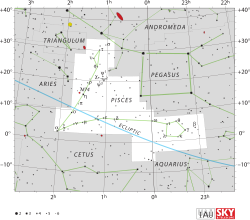
  | |
| Observation data Epoch J2000.0 Equinox J2000.0 (ICRS) | |
|---|---|
| Constellation | Pisces1 |
| Right ascension | 01h 19m 27.99289s2 |
| Declination | +27° 15′ 50.6155″2 |
| Apparent magnitude (V) | 4.7523 |
| Characteristics | |
| Evolutionary stage | main sequence4 |
| Spectral type | A3 V4 |
| U−B color index | +0.103 |
| B−V color index | +0.033 |
| Astrometry | |
| Radial velocity (Rv) | +5.8±2.75 km/s |
| Proper motion (μ) | RA: +22.982 mas/yr Dec.: −11.122 mas/yr |
| Parallax (π) | 10.59±0.25 mas2 |
| Distance | 308 ± 7 ly (94 ± 2 pc) |
| Absolute magnitude (MV) | −0.131 |
| Details | |
| Mass | 2.246 M☉ |
| Radius | 4.366 R☉ |
| Luminosity | 1076 L☉ |
| Surface gravity (log g) | 3.516 cgs |
| Temperature | 8,8926 K |
| Metallicity [Fe/H] | +0.00±0.057 dex |
| Rotational velocity (v sin i) | 914 km/s |
| Age | 4618 Myr |
| Other designations | |
| υ Psc, 90 Piscium, BD+26°220, FK5 45, HD 7964, HIP 6193, HR 383, SAO 746379 | |
| Database references | |
| SIMBAD | data |
Upsilon Piscium is a solitary,10 white-hued star in the zodiac constellation of Pisces. It is faintly visible to the naked eye, having an apparent visual magnitude of +4.75.3 Based upon an annual parallax shift of 10.59 mas as seen from Earth,2 it is located about 308 light years from the Sun. The star is drifting further away with a heliocentric radial velocity of +6 km/s.5
This is an ordinary A-type main sequence star with a stellar classification of A3 V.4 It is 4618 million years old – about 98% of the way through its main sequence lifetime4 – and is spinning with a projected rotational velocity of 91 km/s.4 The star has 2.2 times the mass of the Sun, about 4.4 times the Sun's radius, and is radiating 107 times the Sun's luminosity from its photosphere at an effective temperature of 8,892 K.6
Naming
υ Piscium is the Bayer designation for this star, which is Latinized as Upsilon Piscium. It has the Flamsteed designation 90 Piscium.9
In Chinese, 奎宿 (Kuí Sù), meaning Legs (asterism), refers to an asterism composed of υ Piscium, η Andromedae, 65 Piscium, ζ Andromedae, ε Andromedae, δ Andromedae, π Andromedae, ν Andromedae, μ Andromedae, β Andromedae, σ Piscium, τ Piscium, 91 Piscium, φ Piscium, χ Piscium and ψ¹ Piscium. Consequently, the Chinese name for υ Piscium itself is 奎宿十三 (Kuí Sù shí sān, English: the Thirteenth Star of Legs.)11
References
References
- Anderson, E.; Francis, Ch. (2012). "XHIP: An extended hipparcos compilation". Astronomy Letters. 38 (5): 331. arXiv:1108.4971. Bibcode:2012AstL...38..331A. doi:10.1134/S1063773712050015. XHIP record for this object at VizieR.
- van Leeuwen, F. (2007), "Validation of the new Hipparcos reduction", Astronomy and Astrophysics, 474 (2): 653–664, arXiv:0708.1752, Bibcode:2007A&A...474..653V, doi:10.1051/0004-6361:20078357, S2CID 18759600.
- Johnson, H. L.; et al. (1966), "UBVRIJKL photometry of the bright stars", Communications of the Lunar and Planetary Laboratory, 4 (99): 99, Bibcode:1966CoLPL...4...99J.
- Zorec, J.; Royer, F. (January 2012), "Rotational velocities of A-type stars. IV. Evolution of rotational velocities", Astronomy & Astrophysics, 537: A120, arXiv:1201.2052, Bibcode:2012A&A...537A.120Z, doi:10.1051/0004-6361/201117691, S2CID 55586789.
- de Bruijne, J. H. J.; Eilers, A.-C. (October 2012), "Radial velocities for the HIPPARCOS-Gaia Hundred-Thousand-Proper-Motion project", Astronomy & Astrophysics, 546: 14, arXiv:1208.3048, Bibcode:2012A&A...546A..61D, doi:10.1051/0004-6361/201219219, S2CID 59451347, A61.
- Stassun, Keivan G.; et al. (2019). "The Revised TESS Input Catalog and Candidate Target List". The Astronomical Journal. 158 (4): 138. arXiv:1905.10694. Bibcode:2019AJ....158..138S. doi:10.3847/1538-3881/ab3467.
- Morossi, C.; et al. (September 2002), "Metallicity Determinations from Ultraviolet-Visual Spectrophotometry. I. The Test Sample", The Astrophysical Journal, 577 (1): 377–388, Bibcode:2002ApJ...577..377M, doi:10.1086/342144.
- David, Trevor J.; Hillenbrand, Lynne A. (2015), "The Ages of Early-Type Stars: Strömgren Photometric Methods Calibrated, Validated, Tested, and Applied to Hosts and Prospective Hosts of Directly Imaged Exoplanets", The Astrophysical Journal, 804 (2): 146, arXiv:1501.03154, Bibcode:2015ApJ...804..146D, doi:10.1088/0004-637X/804/2/146, S2CID 33401607.
- "ups Psc". SIMBAD. Centre de données astronomiques de Strasbourg. Retrieved 2017-07-24.
- Eggleton, P. P.; Tokovinin, A. A. (September 2008), "A catalogue of multiplicity among bright stellar systems", Monthly Notices of the Royal Astronomical Society, 389 (2): 869–879, arXiv:0806.2878, Bibcode:2008MNRAS.389..869E, doi:10.1111/j.1365-2966.2008.13596.x, S2CID 14878976.
- (in Chinese) AEEA (Activities of Exhibition and Education in Astronomy) 天文教育資訊網 2006 年 5 月 19 日 Archived 2016-03-03 at the Wayback Machine