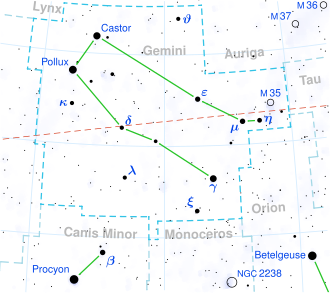
  | |
| Observation data Epoch J2000.0 Equinox J2000.0 (ICRS) | |
|---|---|
| Constellation | Gemini |
| Right ascension | 07h 35m 55.35001s1 |
| Declination | +26° 53′ 44.6802″1 |
| Apparent magnitude (V) | 4.042 (4.04 - 4.083) |
| Characteristics | |
| Spectral type | M0 III4 |
| U−B color index | +1.962 |
| B−V color index | +1.542 |
| Variable type | suspected3 |
| Astrometry | |
| Radial velocity (Rv) | −21.61±0.195 km/s |
| Proper motion (μ) | RA: −32.841 mas/yr1 Dec.: −106.002 mas/yr1 |
| Parallax (π) | 12.8761±0.2288 mas1 |
| Distance | 253 ± 5 ly (78 ± 1 pc) |
| Absolute magnitude (MV) | −0.536 |
| Details | |
| Mass | 1.527 M☉ |
| Radius | 39.62+0.74 −0.768 R☉ |
| Luminosity | 369.6±18.58 L☉ |
| Surface gravity (log g) | 1.05 cgs |
| Temperature | 4,019±388 K |
| Metallicity [Fe/H] | 0.177 dex |
| Rotational velocity (v sin i) | 5.95 km/s |
| Age | 3.537 Gyr |
| Other designations | |
| υ Gem, 69 Geminorum, BD+27°1424, FK5 1196, HD 60522, HIP 36962, HR 2905, SAO 79533.9 | |
| Database references | |
| SIMBAD | data |
Upsilon Geminorum, Latinized from υ Geminorum, is a star in the constellation Gemini. It has an apparent visual magnitude of 4.04,2 which is bright enough to be seen with the naked eye. Based upon an annual parallax shift of 12.88 mas,1 it is around 253 light years from the Sun. There is a visual companion: a magnitude 13.20 star located at an angular separation of 55.20″ along a position angle of 40°, as of 2008.10
This is an evolved red giant star with a stellar classification of M0 III.4 It is estimated to have 1.527 times the mass of the Sun, but has expanded to 408 times the Sun's radius. The star is spinning with a projected rotational velocity of 5.9 km/s5 and is about 3.537 billion years old. Upsilon Geminorum is radiating 370 times the solar luminosity from its outer atmosphere at an effective temperature of 4,019 K.8
Based upon the motion of this star through space, Upsilon Geminorum is a member of the Wolf 630 moving group. This is a set of stars centered on Wolf 630 that are moving nearly in parallel and have an age of around 2.7±0.5 billion years. They may be former members of a dissolved open cluster.11
References
References
- Vallenari, A.; et al. (Gaia collaboration) (2023). "Gaia Data Release 3. Summary of the content and survey properties". Astronomy and Astrophysics. 674: A1. arXiv:2208.00211. Bibcode:2023A&A...674A...1G. doi:10.1051/0004-6361/202243940. S2CID 244398875. Gaia DR3 record for this source at VizieR.
- Mermilliod, J.-C. (1986), "Compilation of Eggen's UBV data, transformed to UBV (unpublished)", Catalogue of Eggen's UBV Data, SIMBAD, Bibcode:1986EgUBV........0M.
- Samus, N. N.; Durlevich, O. V.; et al. (2009). "VizieR Online Data Catalog: General Catalogue of Variable Stars (Samus+ 2007-2013)". VizieR On-line Data Catalog: B/GCVS. Originally Published in: 2009yCat....102025S. 1. Bibcode:2009yCat....102025S.
- Morgan, W. W.; Keenan, P. C. (1973), "Spectral Classification", Annual Review of Astronomy and Astrophysics, 11: 29, Bibcode:1973ARA&A..11...29M, doi:10.1146/annurev.aa.11.090173.000333.
- Massarotti, Alessandro; et al. (January 2008), "Rotational and Radial Velocities for a Sample of 761 HIPPARCOS Giants and the Role of Binarity", The Astronomical Journal, 135 (1): 209–231, Bibcode:2008AJ....135..209M, doi:10.1088/0004-6256/135/1/209.
- Anderson, E.; Francis, Ch. (2012), "XHIP: An extended hipparcos compilation", Astronomy Letters, 38 (5): 331, arXiv:1108.4971, Bibcode:2012AstL...38..331A, doi:10.1134/S1063773712050015, S2CID 119257644.
- Luck, R. Earle (September 2015), "Abundances in the Local Region. I. G and K Giants", The Astronomical Journal, 150 (3): 23, arXiv:1507.01466, Bibcode:2015AJ....150...88L, doi:10.1088/0004-6256/150/3/88, S2CID 118505114, 88.
- Baines, Ellyn K.; Thomas Armstrong, J.; Clark, James H.; Gorney, Jim; Hutter, Donald J.; Jorgensen, Anders M.; Kyte, Casey; Mozurkewich, David; Nisley, Ishara; Sanborn, Jason; Schmitt, Henrique R.; Van Belle, Gerard T. (2021). "Angular Diameters and Fundamental Parameters of Forty-four Stars from the Navy Precision Optical Interferometer". The Astronomical Journal. 162 (5): 198. arXiv:2211.09030. Bibcode:2021AJ....162..198B. doi:10.3847/1538-3881/ac2431.
- "ups Gem". SIMBAD. Centre de données astronomiques de Strasbourg. Retrieved 2016-12-08.
{{cite web}}: CS1 maint: postscript (link) - Mason, B. D.; et al. (2014), "The Washington Visual Double Star Catalog", The Astronomical Journal, 122 (6): 3466–3471, Bibcode:2001AJ....122.3466M, doi:10.1086/323920.
- Bubar, Eric J.; King, Jeremy R. (August 2010), "Spectroscopic Abundances and Membership in the Wolf 630 Moving Group", The Astronomical Journal, 140 (2): 293–318, arXiv:1005.1205, Bibcode:2010AJ....140..293B, doi:10.1088/0004-6256/140/2/293, S2CID 118455341.
External links
External links
- Kaler, James B. (March 2, 2012), "Upsilon Geminorum", Stars, University of Illinois, retrieved 2016-12-08.