| Unit Weibull |
|---|
|
Probability density function 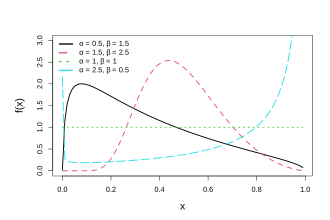 |
|
Cumulative distribution function 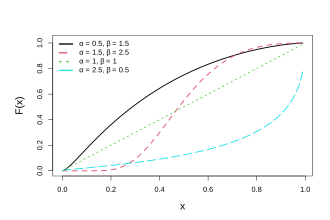 |
| Parameters |
 (real) (real)
 (real) (real) |
|---|
| Support |
 |
|---|
| PDF |
![{\displaystyle {\frac {1}{x}}\,\alpha \,\beta \,(-\log x)^{\beta -1}\exp \left[-\alpha \,(-\log x)^{\beta }\right]}](/api/ext/img?url=https%3A%2F%2Fwikimedia.org%2Fapi%2Frest_v1%2Fmedia%2Fmath%2Frender%2Fsvg%2Ff023f2e6858c3dd1ed0322f50e3f74dabc86ac68) |
|---|
| CDF |
![{\displaystyle \exp \left[-\alpha \,(-\log x)^{\beta }\right]}](/api/ext/img?url=https%3A%2F%2Fwikimedia.org%2Fapi%2Frest_v1%2Fmedia%2Fmath%2Frender%2Fsvg%2Fee3b20cffcd10eac02244968aead0f5717d196f2) |
|---|
| Quantile |
![{\displaystyle \exp \left[-\left({\frac {-\log p}{\alpha }}\right)^{\frac {1}{\beta }}\right],\quad 0<p<1}](/api/ext/img?url=https%3A%2F%2Fwikimedia.org%2Fapi%2Frest_v1%2Fmedia%2Fmath%2Frender%2Fsvg%2Ffff885d5b8b54e7b6726f255e27ec20c8585fc8b) |
|---|
| Skewness |
 |
|---|
| Excess kurtosis |
 |
|---|
| MGF |
 |
|---|
The unit-Weibull distribution (UW) is a continuous probability distribution with domain on  . Useful for indices and rates, or bounded variables with a domain. It was originally proposed by Mazucheli et al1 using a transformation of the Weibull distribution.
Definitions
Probability density function
Its probability density function is defined as:
![{\displaystyle f(x;\alpha ,\beta )={\frac {1}{x}}\,\alpha \,\beta \,(-\log x)^{\beta -1}\exp \left[-\alpha \,(-\log x)^{\beta }\right]}](/api/ext/img?url=https%3A%2F%2Fwikimedia.org%2Fapi%2Frest_v1%2Fmedia%2Fmath%2Frender%2Fsvg%2F7daf29b715f75c50f51b5f4d769abb770870a9da)
Cumulative distribution function
And its cumulative distribution function is:
![{\displaystyle F(x;\alpha ,\beta )=\exp \left[-\alpha \,(-\log x)^{\beta }\right]}](/api/ext/img?url=https%3A%2F%2Fwikimedia.org%2Fapi%2Frest_v1%2Fmedia%2Fmath%2Frender%2Fsvg%2F2d883db07be40a06badffc0e9a7d5cf450255076)
Quantile function
The quantile function of the UW distribution is given by:
![{\displaystyle Q(p)=\exp \left[-\left({\frac {-\log p}{\alpha }}\right)^{\frac {1}{\beta }}\right],\quad 0<p<1.}](/api/ext/img?url=https%3A%2F%2Fwikimedia.org%2Fapi%2Frest_v1%2Fmedia%2Fmath%2Frender%2Fsvg%2Fdcf2a62a26d61376948b3c8eecf91a09067c0639)
Having a closed form expression for the quantile function, may make it a more flexible alternative for a quantile regression model against the classical Beta regression model.
Properties
Moments
The  th raw moment of the UW distribution can be obtained through:

Skewness and kurtosis
The skewness and kurtosis measures can be obtained upon substituting the raw moments from the expressions:

Hazard rate
The hazard rate function of the UW distribution is given by:
![{\displaystyle h(x;\alpha ,\beta )={\frac {f(x;\alpha ,\beta )}{1-F(x;\alpha ,\beta )}}={\frac {\alpha \beta \,(-\log x)^{\beta -1}\exp \left[-\alpha (-\log x)^{\beta }\right]}{x\left(1-\exp \left[-\alpha (-\log x)^{\beta }\right]\right)}},\quad 0<x<1.}](/api/ext/img?url=https%3A%2F%2Fwikimedia.org%2Fapi%2Frest_v1%2Fmedia%2Fmath%2Frender%2Fsvg%2Fa7aec0e6433ee9f5158154ccde4905a9db28850a)
Parameter estimation
Let  be a random sample of size
  from the UW distribution with probability density function defined before. Then, the log-likelihood function of
  is:
is:

The likelihood estimate  of
of  is obtained by solving the non-linear equations

and

The expected Fisher information matrix of based on a single observation is given by
![{\displaystyle \mathbf {I} ({\boldsymbol {\theta }})=[I_{ij}]={\begin{pmatrix}{\frac {1}{\alpha }}&{\frac {1}{\alpha \beta }}(1-\gamma -\log \alpha )\\{\frac {1}{\alpha \beta }}(1-\gamma -\log \alpha )&{\frac {1}{\beta ^{2}}}\left[{\frac {\pi ^{2}}{6}}+(1-\gamma -\log \alpha )^{2}\right]\end{pmatrix}},}](/api/ext/img?url=https%3A%2F%2Fwikimedia.org%2Fapi%2Frest_v1%2Fmedia%2Fmath%2Frender%2Fsvg%2F1ff0b77a680e3e26b218e7ba86d9019513187bfc)
where  and
and  is the Euler’s constant.
When  ,
,  follows the power function distribution and the th raw moment of the UW distribution becomes:

In this case, the mean, variance, skewness and kurtosis, are:


The skewness can be negative, zero, or positive when  . And if
  , with , follows the standard uniform distribution, and the measures becomes:

For the case of  , follows the unit-Rayleigh distribution, and:

where

Is the complementary error function. In this case, the measures of the distribution are:
![{\displaystyle \mu =1-{\frac {\sqrt {\pi }}{2{\sqrt {\alpha }}}}\,e^{1/\alpha }\,\mathrm {erfc} \left({\frac {1}{2{\sqrt {\alpha }}}}\right),\sigma ^{2}=1-{\frac {\sqrt {\pi }}{\sqrt {\alpha }}}\,e^{1/\alpha }\,\mathrm {erfc} \left({\frac {1}{\sqrt {\alpha }}}\right)-\left[1-{\frac {\sqrt {\pi }}{2{\sqrt {\alpha }}}}\,e^{1/\alpha }\,\mathrm {erfc} \left({\frac {1}{2{\sqrt {\alpha }}}}\right)\right]^{2}.}](/api/ext/img?url=https%3A%2F%2Fwikimedia.org%2Fapi%2Frest_v1%2Fmedia%2Fmath%2Frender%2Fsvg%2F24d2e1f363754f2c582d6788fb393c6c8bd81898)
Applications
It was shown to outperform, against other distributions, like the Beta and Kumaraswamy distributions, in: maximum flood level, petroleum reservoirs, risk management cost effectiveness,2 and recovery rate of CD34+cells data.
See also
See also
References
References