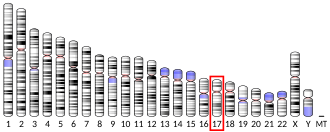



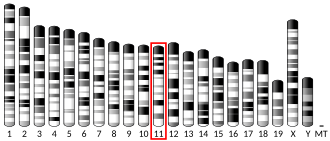

Protein unc-13 homolog D, also known as munc13-4, is a protein that in humans is encoded by the UNC13D gene.5
Function
Munc13-4 is a member of the UNC13 family, containing similar domain structure as other family members but lacking an N-terminal phorbol ester-binding C1 domain present in other Munc13 proteins. The protein appears to play a role in vesicle maturation during exocytosis and is involved in regulation of cytolytic granules secretion.
Clinical significance
Mutations in the UNC13D gene are associated with hemophagocytic lymphohistiocytosis type 3.5
References
References
- GRCh38: Ensembl release 89: ENSG00000092929 – Ensembl, May 2017
- GRCm38: Ensembl release 89: ENSMUSG00000057948 – Ensembl, May 2017
- "Human PubMed Reference:". National Center for Biotechnology Information, U.S. National Library of Medicine.
- "Mouse PubMed Reference:". National Center for Biotechnology Information, U.S. National Library of Medicine.
- "Entrez Gene: unc-13 homolog D (C. elegans)".
Further reading
Further reading
- Marcenaro S, Gallo F, Martini S, et al. (2006). "Analysis of natural killer-cell function in familial hemophagocytic lymphohistiocytosis (FHL): defective CD107a surface expression heralds Munc13-4 defect and discriminates between genetic subtypes of the disease". Blood. 108 (7): 2316–23. doi:10.1182/blood-2006-04-015693. PMID 16778144.
- Gurgey A, Unal S, Okur H, et al. (2008). "Neonatal primary hemophagocytic lymphohistiocytosis in Turkish children". J. Pediatr. Hematol. Oncol. 30 (12): 871–6. doi:10.1097/MPH.0b013e31818a9577. PMID 19131769. S2CID 25882775.
- Saxena SK, Horiuchi H, Fukuda M (2006). "Rab27a regulates epithelial sodium channel (ENaC) activity through synaptotagmin-like protein (SLP-5) and Munc13-4 effector mechanism". Biochem. Biophys. Res. Commun. 344 (2): 651–7. doi:10.1016/j.bbrc.2006.03.160. PMID 16630545.
- Neeft M, Wieffer M, de Jong AS, et al. (2005). "Munc13-4 is an effector of rab27a and controls secretion of lysosomes in hematopoietic cells". Mol. Biol. Cell. 16 (2): 731–41. doi:10.1091/mbc.E04-10-0923. PMC 545907. PMID 15548590.
- Ménager MM, Ménasché G, Romao M, et al. (2007). "Secretory cytotoxic granule maturation and exocytosis require the effector protein hMunc13-4". Nat. Immunol. 8 (3): 257–67. doi:10.1038/ni1431. PMID 17237785. S2CID 25330412.
- Santoro A, Cannella S, Trizzino A, et al. (2008). "Mutations affecting mRNA splicing are the most common molecular defect in patients with familial hemophagocytic lymphohistiocytosis type 3". Haematologica. 93 (7): 1086–90. doi:10.3324/haematol.12622. PMID 18492689.
- Zhang K, Biroschak J, Glass DN, et al. (2008). "Macrophage activation syndrome in patients with systemic juvenile idiopathic arthritis is associated with MUNC13-4 polymorphisms". Arthritis Rheum. 58 (9): 2892–6. doi:10.1002/art.23734. PMC 2779064. PMID 18759271.
- Yoon HS, Kim HJ, Yoo KH, et al. (2010). "UNC13D is the predominant causative gene with recurrent splicing mutations in Korean patients with familial hemophagocytic lymphohistiocytosis". Haematologica. 95 (4): 622–6. doi:10.3324/haematol.2009.016949. PMC 2857192. PMID 20015888.
- Horne A, Ramme KG, Rudd E, et al. (2008). "Characterization of PRF1, STX11 and UNC13D genotype-phenotype correlations in familial hemophagocytic lymphohistiocytosis". Br. J. Haematol. 143 (1): 75–83. doi:10.1111/j.1365-2141.2008.07315.x. PMID 18710388. S2CID 2773353.
- Zur Stadt U, Beutel K, Kolberg S, et al. (2006). "Mutation spectrum in children with primary hemophagocytic lymphohistiocytosis: molecular and functional analyses of PRF1, UNC13D, STX11, and RAB27A". Hum. Mutat. 27 (1): 62–8. doi:10.1002/humu.20274. PMID 16278825. S2CID 19226893.
- Rudd E, Bryceson YT, Zheng C, et al. (2008). "Spectrum, and clinical and functional implications of UNC13D mutations in familial haemophagocytic lymphohistiocytosis". J. Med. Genet. 45 (3): 134–41. doi:10.1136/jmg.2007.054288. PMID 17993578. S2CID 42503634.
- Beutler B (2009). "Microbe sensing, positive feedback loops, and the pathogenesis of inflammatory diseases". Immunol. Rev. 227 (1): 248–63. doi:10.1111/j.1600-065X.2008.00733.x. PMC 2713013. PMID 19120489.
- Nakao T, Shimizu T, Fukushima T, et al. (2008). "Fatal sibling cases of familial hemophagocytic lymphohistiocytosis (FHL) with MUNC13-4 mutations: case reports". Pediatr Hematol Oncol. 25 (3): 171–80. doi:10.1080/08880010801938082. PMID 18432499. S2CID 205600908.
- Donn R, Ellison S, Lamb R, et al. (2008). "Genetic loci contributing to hemophagocytic lymphohistiocytosis do not confer susceptibility to systemic-onset juvenile idiopathic arthritis". Arthritis Rheum. 58 (3): 869–74. doi:10.1002/art.23270. PMC 2675009. PMID 18311812.
- Hazen MM, Woodward AL, Hofmann I, et al. (2008). "Mutations of the hemophagocytic lymphohistiocytosis-associated gene UNC13D in a patient with systemic juvenile idiopathic arthritis". Arthritis Rheum. 58 (2): 567–70. doi:10.1002/art.23199. PMID 18240215.
- Santoro A, Cannella S, Bossi G, et al. (2006). "Novel Munc13-4 mutations in children and young adult patients with haemophagocytic lymphohistiocytosis". J. Med. Genet. 43 (12): 953–60. doi:10.1136/jmg.2006.041863. PMC 2563207. PMID 16825436.
- Pivot-Pajot C, Varoqueaux F, de Saint Basile G, Bourgoin SG (2008). "Munc13-4 regulates granule secretion in human neutrophils". J. Immunol. 180 (10): 6786–97. doi:10.4049/jimmunol.180.10.6786. hdl:11858/00-001M-0000-002A-28F8-D. PMID 18453599.
- Wood SM, Meeths M, Chiang SC, et al. (2009). "Different NK cell-activating receptors preferentially recruit Rab27a or Munc13-4 to perforin-containing granules for cytotoxicity". Blood. 114 (19): 4117–27. doi:10.1182/blood-2009-06-225359. PMID 19704116.
- Zhong N, Radu G, Ju W, Brown WT (2005). "Novel progerin-interactive partner proteins hnRNP E1, EGF, Mel 18, and UBC9 interact with lamin A/C". Biochem. Biophys. Res. Commun. 338 (2): 855–61. doi:10.1016/j.bbrc.2005.10.020. PMID 16248985.
- Chang TY, Jaffray J, Woda B, et al. (2011). "Hemophagocytic lymphohistiocytosis with MUNC13-4 gene mutation or reduced natural killer cell function prior to onset of childhood leukemia". Pediatr Blood Cancer. 56 (5): 856–8. doi:10.1002/pbc.22846. PMC 3059114. PMID 21370424.
External links
External links
- UNC13D+protein,+human at the U.S. National Library of Medicine Medical Subject Headings (MeSH)
This article incorporates text from the United States National Library of Medicine, which is in the public domain.