In mathematics, Gegenbauer polynomials or ultraspherical polynomials C(α)
n(x) are orthogonal polynomials on the interval [−1,1] with respect to the weight function (1 − x2)α–1/2. They generalize Legendre polynomials and Chebyshev polynomials, and are special cases of Jacobi polynomials. They are named after Leopold Gegenbauer.
Characterizations
-
Plot of the Gegenbauer polynomial C n^(m)(x) with n=10 and m=1 in the complex plane from -2-2i to 2+2i with colors created with Mathematica 13.1 function ComplexPlot3D
-
Gegenbauer polynomials with α=1
-
Gegenbauer polynomials with α=2
-
Gegenbauer polynomials with α=3
-
An animation showing the polynomials on the xα-plane for the first 4 values of n.
A variety of characterizations of the Gegenbauer polynomials are available.


- Gegenbauer polynomials are particular solutions of the Gegenbauer differential equation:2

- When α = 1/2, the equation reduces to the Legendre equation, and the Gegenbauer polynomials reduce to the Legendre polynomials.
- When α = 1, the equation reduces to the Chebyshev differential equation, and the Gegenbauer polynomials reduce to the Chebyshev polynomials of the second kind.3

- 4 Here (2α)n is the rising factorial. Explicitly,

- From this it is also easy to obtain the value at unit argument:


- in which
 represents the rising factorial of
  .
.
- One therefore also has the Rodrigues formula
![{\displaystyle C_{n}^{(\alpha )}(x)={\frac {(-1)^{n}}{2^{n}n!}}{\frac {\Gamma (\alpha +{\frac {1}{2}})\Gamma (n+2\alpha )}{\Gamma (2\alpha )\Gamma (\alpha +n+{\frac {1}{2}})}}(1-x^{2})^{-\alpha +1/2}{\frac {d^{n}}{dx^{n}}}\left[(1-x^{2})^{n+\alpha -1/2}\right].}](/api/ext/img?url=https%3A%2F%2Fwikimedia.org%2Fapi%2Frest_v1%2Fmedia%2Fmath%2Frender%2Fsvg%2F7380d774285ba35cc371daa8be46e38b2442eca1)
- An alternative normalization sets
 . Assuming this alternative normalization, the derivatives of Gegenbauer are expressed in terms of Gegenbauer:5

Orthogonality and normalization
For a fixed α > -1/2, the polynomials are orthogonal on [−1, 1] with respect to the weighting function6

To wit, for n ≠ m,

They are normalized by
![{\displaystyle \int _{-1}^{1}\left[C_{n}^{(\alpha )}(x)\right]^{2}(1-x^{2})^{\alpha -{\frac {1}{2}}}\,dx={\frac {\pi 2^{1-2\alpha }\Gamma (n+2\alpha )}{n!(n+\alpha )[\Gamma (\alpha )]^{2}}}.}](/api/ext/img?url=https%3A%2F%2Fwikimedia.org%2Fapi%2Frest_v1%2Fmedia%2Fmath%2Frender%2Fsvg%2Fa9b5696990f291fed55949f3b9e2f1669b9f4c83)
Applications
The Gegenbauer polynomials appear naturally as extensions of Legendre polynomials in the context of potential theory and harmonic analysis. The Newtonian potential in Rn has the expansion, valid with α = (n − 2)/2,

When n = 3, this gives the Legendre polynomial expansion of the gravitational potential. Similar expressions are available for the expansion of the Poisson kernel in a ball.7
It follows that the quantities  are spherical harmonics, when regarded as a function of x only. They are, in fact, exactly the zonal spherical harmonics, up to a normalizing constant.
Gegenbauer polynomials also appear in the theory of positive-definite functions.
The Askey–Gasper inequality reads

In spectral methods for solving differential equations, if a function is expanded in the basis of Chebyshev polynomials and its derivative is represented in a Gegenbauer/ultraspherical basis, then the derivative operator becomes a diagonal matrix, leading to fast banded matrix methods for large problems.8
Other properties
Dirichlet–Mehler-type integral representation:9 Laplace-type integral representation
 Addition formula:10

Asymptotics
Given fixed  , uniformly for all
 ![{\displaystyle \theta \in [\delta ,\pi -\delta ]}](/api/ext/img?url=https%3A%2F%2Fwikimedia.org%2Fapi%2Frest_v1%2Fmedia%2Fmath%2Frender%2Fsvg%2F79e12bd1a10fbd0ba32d5666b762ef8305cdea90) , for
, for  ,1112
,1112
where  is the Pochhammer symbol, and
 The remainder
  has an explicit upper bound:
 where
where  is the Gamma function.
Other asymptotic formulas can be obtained as special cases of asymptotic formulas for the more general Jacobi polynomials.
See also
See also
References
References
- Koornwinder, Tom H.; Wong, Roderick S. C.; Koekoek, Roelof; Swarttouw, René F. (2010), "Orthogonal Polynomials", in Olver, Frank W. J.; Lozier, Daniel M.; Boisvert, Ronald F.; Clark, Charles W. (eds.), NIST Handbook of Mathematical Functions, Cambridge University Press, ISBN 978-0-521-19225-5, MR 2723248.
- Szegő, G. (1975). Orthogonal Polynomials. Colloquium Publications. Vol. XXIII (4th ed.). Providence, RI: American Mathematical Society.
Specific
- (Stein & Weiss 1971, §IV.2)
- Suetin, P.K. (2001) [1994], "Ultraspherical polynomials", Encyclopedia of Mathematics, EMS Press
- Arfken, Weber, and Harris (2013) "Mathematical Methods for Physicists", 7th edition; ch. 18.4
- Abramowitz, Milton; Stegun, Irene Ann, eds. (1983) [June 1964]. "Chapter 22". Handbook of Mathematical Functions with Formulas, Graphs, and Mathematical Tables. Applied Mathematics Series. Vol. 55 (Ninth reprint with additional corrections of tenth original printing with corrections (December 1972); first ed.). Washington D.C.; New York: United States Department of Commerce, National Bureau of Standards; Dover Publications. p. 773. ISBN 978-0-486-61272-0. LCCN 64-60036. MR 0167642. LCCN 65-12253.
- Doha, E. H. (1991-01-01). "The coefficients of differentiated expansions and derivatives of ultraspherical polynomials". Computers & Mathematics with Applications. 21 (2): 115–122. doi:10.1016/0898-1221(91)90089-M. ISSN 0898-1221.
- (Abramowitz & Stegun 1983, p. 774)
- Stein, Elias; Weiss, Guido (1971), Introduction to Fourier Analysis on Euclidean Spaces, Princeton, N.J.: Princeton University Press, ISBN 978-0-691-08078-9
- Olver, Sheehan; Townsend, Alex (January 2013). "A Fast and Well-Conditioned Spectral Method". SIAM Review. 55 (3): 462–489. arXiv:1202.1347. doi:10.1137/120865458. eISSN 1095-7200. ISSN 0036-1445.
- "DLMF: §18.10 Integral Representations ‣ Classical Orthogonal Polynomials ‣ Chapter 18 Orthogonal Polynomials". dlmf.nist.gov. Retrieved 2025-03-18.
- Koornwinder, Tom (September 1973). "The Addition Formula for Jacobi Polynomials and Spherical Harmonics". SIAM Journal on Applied Mathematics. 25 (2): 236–246. doi:10.1137/0125027. ISSN 0036-1399.
- (Szegő 1975, Theorem 8.21.11)
- "DLMF: §18.15 Asymptotic Approximations ‣ Classical Orthogonal Polynomials ‣ Chapter 18 Orthogonal Polynomials". dlmf.nist.gov. Retrieved 2025-07-07.
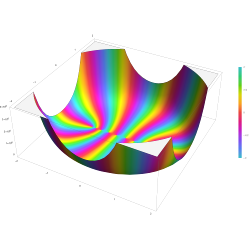 Plot of the Gegenbauer polynomial C n^(m)(x) with n=10 and m=1 in the complex plane from -2-2i to 2+2i with colors created with Mathematica 13.1 function ComplexPlot3D
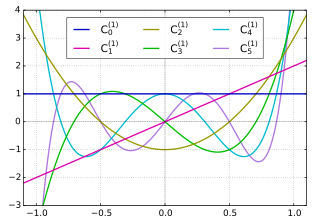 Gegenbauer polynomials with α=1
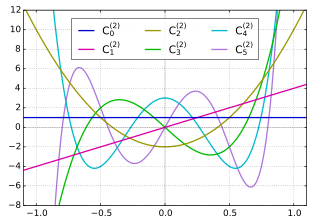 Gegenbauer polynomials with α=2
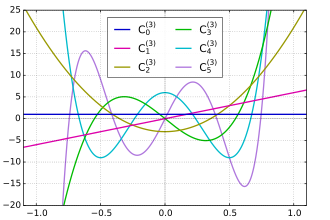 Gegenbauer polynomials with α=3
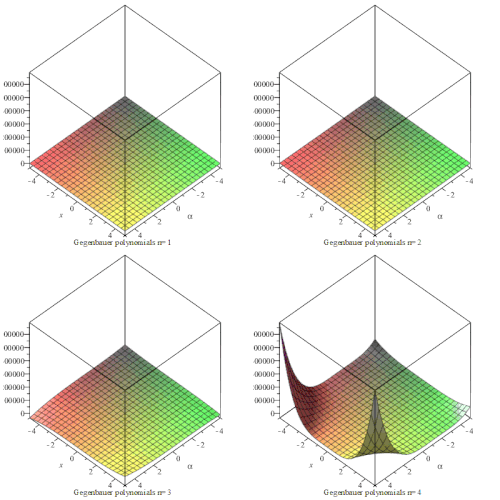 An animation showing the polynomials on the xα-plane for the first 4 values of n.