In mathematics, an ultrametric space is a metric space in which the triangle inequality is strengthened to for all , , and . Sometimes the associated metric is also called a non-Archimedean metric or super-metric.
Formal definition
An ultrametric on a set is a real-valued function
(where denotes the real numbers), such that for all :
- with equality if and only if (non-degeneracy)
- (symmetry)
- (strong triangle inequality or ultrametric inequality).
An ultrametric space is a pair consisting of a set together with an ultrametric on , which is called the space's associated distance function (also called a metric).
If satisfies all of the conditions except possibly condition 4, then is called an ultrapseudometric on . An ultrapseudometric space is a pair consisting of a set and an ultrapseudometric on .1
In the case when is an Abelian group (written additively) and is generated by a length function (so that ), the last property can be made stronger using the Krull sharpening to:
- with equality if .
We want to prove that if , then the equality occurs if . Without loss of generality, let us assume that This implies that . But we can also compute . Now, the value of cannot be , for if that is the case, we have contrary to the initial assumption. Thus, , and . Using the initial inequality, we have and therefore .
Properties
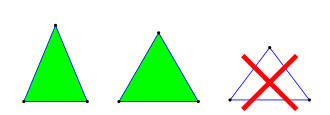
From the above definition, one can conclude several typical properties of ultrametrics. For example, for all , at least one of the three equalities or or holds. That is, every triple of points in the space forms an isosceles triangle, so the whole space is an isosceles set.
Defining the (open) ball of radius centred at as , we have the following properties:
- Every point inside a ball is one of its centers, i.e. if then .
- Intersecting balls are contained in each other, i.e. if is non-empty then either or .
- All balls of strictly positive radius are both open and closed sets in the induced topology. That is, open balls are also closed, and closed balls (replace with ) are also open.
- The set of all open balls with radius and center in a closed ball of radius forms a partition of the latter, and the mutual distance of two distinct open balls is (greater or) equal to .
Proving these statements is an instructive exercise.2 All directly derive from the ultrametric triangle inequality. Note that, by the second statement, a ball may have several center points that have non-zero distance. The intuition behind such seemingly strange effects is that, due to the strong triangle inequality, distances in ultrametrics do not add up.
Examples
- The discrete metric is an ultrametric.
- The p-adic numbers form a complete ultrametric space.
- Consider the set of words of arbitrary length (finite or infinite),, over some alphabet . Define the distance between two different words to be , where is the first place at which the words differ. The resulting metric is an ultrametric.
- The set of words with glued ends of the length over some alphabet is an ultrametric space with respect to the p-close distance. Two words and are p-close if any substring of p consecutive letters ( ) appears the same number of times (which could also be zero) both in and .3
- If is a sequence of real numbers decreasing to zero, then induces an ultrametric on the space of all complex sequences for which it is finite. (Note that this is not a seminorm since it lacks homogeneity — If the are allowed to be zero, one should use here the rather unusual convention that (Zero to the power of zero).
- If is an edge-weighted undirected graph, all edge weights are positive, and is the weight of the minimax path between and (that is, the largest weight of an edge, on a path chosen to minimize this largest weight), then the vertices of the graph, with distance measured by , form an ultrametric space, and all finite ultrametric spaces may be represented in this way.4
Applications
- A contraction mapping may then be thought of as a way of approximating the final result of a computation (which can be guaranteed to exist by the Banach fixed-point theorem). Similar ideas can be found in domain theory. p-adic analysis makes heavy use of the ultrametric nature of the p-adic metric.
- In condensed matter physics, the self-averaging overlap between spins in the SK Model of spin glasses exhibits an ultrametric structure, with the solution given by the full replica symmetry breaking procedure first outlined by Giorgio Parisi and coworkers.5 Ultrametricity also appears in the theory of aperiodic solids.6
- In taxonomy and phylogenetic tree construction, ultrametric distances are also utilized by the UPGMA and WPGMA methods.7 These algorithms require a constant-rate assumption and produce trees in which the distances from the root to every branch tip are equal. When DNA, RNA and protein data are analyzed, the ultrametricity assumption is called the molecular clock.
- Models of intermittency in three dimensional turbulence of fluids make use of so-called cascades, and in discrete models of dyadic cascades, which have an ultrametric structure.8
- In geography and landscape ecology, ultrametric distances have been applied to measure landscape complexity and to assess the extent to which one landscape function is more important than another.9
References
References
- Narici & Beckenstein 2011, pp. 1–18.
- "Ultrametric Triangle Inequality". Stack Exchange.
- Osipov, Gutkin (2013), "Clustering of periodic orbits in chaotic systems", Nonlinearity, 26 (26): 177–200, Bibcode:2013Nonli..26..177G, doi:10.1088/0951-7715/26/1/177.
- Leclerc, Bruno (1981), "Description combinatoire des ultramétriques", Centre de Mathématique Sociale. École Pratique des Hautes Études. Mathématiques et Sciences Humaines (in French) (73): 5–37, 127, MR 0623034.
- Mezard, M; Parisi, G; and Virasoro, M: SPIN GLASS THEORY AND BEYOND, World Scientific, 1986. ISBN 978-9971-5-0116-7
- Rammal, R.; Toulouse, G.; Virasoro, M. (1986). "Ultrametricity for physicists". Reviews of Modern Physics. 58 (3): 765–788. Bibcode:1986RvMP...58..765R. doi:10.1103/RevModPhys.58.765. Retrieved 20 June 2011.
- Legendre, P. and Legendre, L. 1998. Numerical Ecology. Second English Edition. Developments in Environmental Modelling 20. Elsevier, Amsterdam.
- Benzi, R.; Biferale, L.; Trovatore, E. (1997). "Ultrametric Structure of Multiscale Energy Correlations in Turbulent Models". Physical Review Letters. 79 (9): 1670–1674. arXiv:chao-dyn/9705018. Bibcode:1997PhRvL..79.1670B. doi:10.1103/PhysRevLett.79.1670. S2CID 53120932.
- Papadimitriou, Fivos (2013). "Mathematical modelling of land use and landscape complexity with ultrametric topology". Journal of Land Use Science. 8 (2): 234–254. doi:10.1080/1747423x.2011.637136. ISSN 1747-423X. S2CID 121927387.
Bibliography
Bibliography
- Narici, Lawrence; Beckenstein, Edward (2011). Topological Vector Spaces. Pure and applied mathematics (Second ed.). Boca Raton, FL: CRC Press. ISBN 978-1584888666. OCLC 144216834.
- Schaefer, Helmut H.; Wolff, Manfred P. (1999). Topological Vector Spaces. GTM. Vol. 8 (Second ed.). New York, NY: Springer New York Imprint Springer. ISBN 978-1-4612-7155-0. OCLC 840278135.
Further reading
Further reading
- Kaplansky, I. (1977), Set Theory and Metric Spaces, AMS Chelsea Publishing, ISBN 978-0-8218-2694-2.