 | |
| Clinical data | |
|---|---|
| ATC code |
|
| Identifiers | |
| |
| CAS Number | |
| PubChem CID | |
| ChemSpider | |
| UNII | |
| KEGG | |
| CompTox Dashboard (EPA) | |
| Chemical and physical data | |
| Formula | C30H39FN4O4 |
| Molar mass | 538.664 g·mol−1 |
| 3D model (JSmol) | |
| |
| |
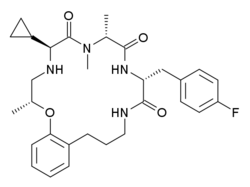
Ulimorelin (INN, USAN) (developmental code name TZP-101) is a drug with a modified cyclic peptide structure which acts as a selective agonist of the ghrelin/growth hormone secretagogue receptor (GHSR-1a).1 Unlike many related drugs, ulimorelin has little or no effect on growth hormone (GH) release in rats.2 However, like ghrelin and other ghrelin agonists, ulimorelin does stimulate GH release with concomitant increases in insulin-like growth factor 1 (IGF-1) in humans.3 It has been researched for enhancing gastrointestinal motility, especially in gastroparesis4 and in aiding recovery of bowel function following gastrointestinal surgery, where opioid analgesic drugs used for post-operative pain relief may worsen existing constipation.5678 While ulimorelin has been shown to increase both upper and lower gastrointestinal motility in rats,8 and showed promising results initially in humans,46 it failed in pivotal clinical trials in post operative ileus.7
A common side effect of ghrelin is reduced blood pressure. Ulimorelin has been shown to inhibit vasoconstriction of rat arteries in vitro elicited by the α1-adrenoceptors agonists phenylephrine and methoxamine, and to increase artery tension at high concentrations.9 Effects on blood pressure, however, were not observed in human clinical trials.47
References
References
- Hoveyda HR, Marsault E, Gagnon R, Mathieu AP, Vézina M, Landry A, et al. (December 2011). "Optimization of the potency and pharmacokinetic properties of a macrocyclic ghrelin receptor agonist (Part I): Development of ulimorelin (TZP-101) from hit to clinic". Journal of Medicinal Chemistry. 54 (24): 8305–20. doi:10.1021/jm2007062. PMID 22106937.
- Fraser GL, Hoveyda HR, Tannenbaum GS (December 2008). "Pharmacological demarcation of the growth hormone, gut motility and feeding effects of ghrelin using a novel ghrelin receptor agonist". Endocrinology. 149 (12): 6280–8. doi:10.1210/en.2008-0804. PMID 18719021.
- Lasseter KC, Shaughnessy L, Cummings D, Pezzullo JC, Wargin W, Gagnon R, et al. (February 2008). "Ghrelin agonist (TZP-101): safety, pharmacokinetics and pharmacodynamic evaluation in healthy volunteers: a phase I, first-in-human study". Journal of Clinical Pharmacology. 48 (2): 193–202. doi:10.1177/0091270007310380. PMID 18199894. S2CID 206433703.
- Wargin W, Thomas H, Clohs L, St-Louis C, Ejskjaer N, Gutierrez M, et al. (2009). "Contribution of protein binding to the pharmacokinetics of the ghrelin receptor agonist TZP-101 in healthy volunteers and adults with symptomatic gastroparesis: two randomized, double-blind studies and a binding profile study". Clinical Drug Investigation. 29 (6): 409–18. doi:10.2165/00044011-200929060-00004. PMID 19432500. S2CID 23063963.
- Popescu I, Fleshner PR, Pezzullo JC, Charlton PA, Kosutic G, Senagore AJ (February 2010). "The Ghrelin agonist TZP-101 for management of postoperative ileus after partial colectomy: a randomized, dose-ranging, placebo-controlled clinical trial". Diseases of the Colon and Rectum. 53 (2): 126–34. doi:10.1007/DCR.0b013e3181b54166. PMID 20087086. S2CID 25357270.
- Greenwood-Van Meerveld B, Kriegsman M, Nelson R (November 2011). "Ghrelin as a target for gastrointestinal motility disorders". Peptides. 32 (11): 2352–6. doi:10.1016/j.peptides.2011.03.014. PMID 21453735. S2CID 22222190.
- Bochicchio G, Charlton P, Pezzullo JC, Kosutic G, Senagore A (January 2012). "Ghrelin agonist TZP-101/ulimorelin accelerates gastrointestinal recovery independently of opioid use and surgery type: covariate analysis of phase 2 data". World Journal of Surgery. 36 (1): 39–45. doi:10.1007/s00268-011-1335-9. PMC 3243849. PMID 22072430.
- Shaw M, Pediconi C, McVey D, Mondou E, Quinn J, Chamblin B, Rousseau F (July 2013). "Safety and efficacy of ulimorelin administered postoperatively to accelerate recovery of gastrointestinal motility following partial bowel resection: results of two randomized, placebo-controlled phase 3 trials". Diseases of the Colon and Rectum. 56 (7): 888–97. doi:10.1097/DCR.0b013e31829196d0. PMID 23739196. S2CID 20364202.
- Fraser GL, Venkova K, Hoveyda HR, Thomas H, Greenwood-Van Meerveld B (February 2009). "Effect of the ghrelin receptor agonist TZP-101 on colonic transit in a rat model of postoperative ileus". European Journal of Pharmacology. 604 (1–3): 132–7. doi:10.1016/j.ejphar.2008.12.011. PMID 19121631.