| Uintaceras Temporal range: Middle Eocene,
| |
|---|---|
| |
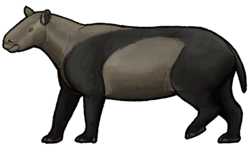
| Restoration | |
| |
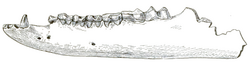
| Holotype jaw of the possible synonym Forstercooperia (Hyrachyus) grandis | |
Scientific classification 
| |
| Kingdom: | Animalia |
| Phylum: | Chordata |
| Class: | Mammalia |
| Infraclass: | Placentalia |
| Order: | Perissodactyla |
| Superfamily: | Rhinocerotoidea |
| Genus: | †Uintaceras Holbrook & Lucas, 1997 |
| Species: | †U. radinskyi
|
| Binomial name | |
| †Uintaceras radinskyi Holbrook & Lucas, 1997
| |
| Synonyms | |
| |
Uintaceras is an extinct genus of medium-sized early rhinocerotoids that lived in North America (Wyoming and Utah) during the Middle Eocene, with only the type species U. radinskyi, named in 1997, currently contained within the genus.12 Traditionally considered the oldest and most primitive species of the Rhinocerotidae, it may instead have been a close relative of the Asian Paraceratheriidae.3 The dubious species Forstercooperia (Hyrachyus) grandis (Radinsky, 1967; Peterson, 1919)45 is also possibly the same animal as Uintaceras,26 although the Asian material of F. grandis was assignable to Forstercooperia confluens.
Uintaceras weighed about 220 kilograms (490 lb) when fully grown. It was a relatively slender animal and Uintaceras resembled a typical hyracodontid (e.g. Hyracodon), but differed from the hyracodonts due to the presence of a primitive four-fingered hand and a number of other features of the structure of the legs, which were clearly not intended for fast and long running.6
References
References
- "Uintaceras Holbrook & Lucas, 1997". www.gbif.org. GBIF. Retrieved 2020-12-30.
- L. T. Holbrook and S. G. Lucas. 1997. A New Genus of Rhinocerotoid from the Eocene of Utah and the Status of North American "Forstercooperia". Journal of Vertebrate Paleontology 17(2):384-396
- Wang, Haibing; Bai, Bin; Meng, Jin; Wang, Yuanqing (2016-12-21). "Earliest known unequivocal rhinocerotoid sheds new light on the origin of Giant Rhinos and phylogeny of early rhinocerotoids". Scientific Reports. 6 (1) 39607. doi:10.1038/srep39607. ISSN 2045-2322. PMC 5175171. PMID 28000789.
- Radinsky, L.B. (1967). "A Review of the Rhinocerotoid Family Hyracodontidae (Perissodactyla)". Bulletin of the American Museum of Natural History. 136 (1): 1–46. hdl:2246/1987.
- Peterson, O.A. (1919). "Report upon the Material Discovered in the Upper Eocene of the Uinta Basin by Earl Douglas[s] in the years 1908-1909, and by 0. A. Peterson in 1912". Annals of the Carnegie Museum. pp. 40–168.
- Prothero, D.R. (2005). The Evolution of North American Rhinoceroses. Cambridge University Press. pp. 1–218. ISBN 0-521-83240-3.