 Profile of the Type 094 | |
 Type 094 submarine | |
| Class overview | |
|---|---|
| Name | Type 094 |
| Builders | Bohai Shipyard, Huludao, China1 |
| Operators |  People's Liberation Army Navy People's Liberation Army Navy |
| Preceded by | Type 092 submarine |
| Succeeded by | Type 096 |
| Cost | $750 million per unit2 |
| In commission | 2007–present1 |
| Building | 23 |
| Active | 64 |
| General characteristics | |
| Type | Ballistic missile submarine |
| Displacement | |
| Length | 137 m (449 ft 6 in)5 |
| Beam | 13 m (42 ft 8 in)5 |
| Propulsion | Nuclear, 1 shaft1 |
| Speed | 30 knots (56 km/h; 35 mph) submerged (official)5 |
| Range | Unlimited |
| Test depth | 400 m5 |
| Complement | 1401 |
| Armament | Missiles: 12 JL-2 or JL-3 SLBM |
The Type 094 (Chinese: 09-IV型核潜艇; Chinese designation: 09-IV; NATO reporting name: Jin class) is a class of nuclear-powered ballistic missile submarines developed by China for the People's Liberation Army Navy Submarine Force. The Type 094 succeeds the Type 092 submarine and precedes the Type 096 submarine, which is under development.
Description
The Type 094's chief designer was Zhang Jinlin.7 This type is likely based on the Type 093 nuclear-powered attack submarine.1
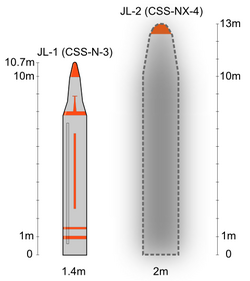
The Type 094 is China's "first credible sea-based nuclear deterrent" according to the United States Department of Defense.8 They were initially armed with 12 JL-2 SLBMs;1 each missile had one warhead9 and a 7,200 km (4,500 mi) range capable of reaching parts of Alaska launched from near China. By late 2022, they may have been rearmed with JL-3 SLBMs able to reach the continental United States from the South China Sea;10 ranges of over 10,000 km (6,200 mi) have been reported.11
Starting with the third boat, the sail was streamlined with a small cusp or fillet at the bottom of leading edge and a slight round down at the top of the sail.12 This was similar to the streamlining refitted to one of the first Type 093 submarines13 and likely did little to reduce overall drag.12
The fifth and sixth boats reduced the number of limber holes to reduce noise at high speeds.12
Popular reporting sometimes uses the designation "Type 094A" for boats starting with the third one; the designation appears not to be officially used by the PLAN.12
Noise
The Type 094 is noisier than contemporary submarines. In 2004,14 a Chinese researcher reported that the Type 094 had an acoustic signature of 120 decibels, comparable to the Los Angeles-class submarine.15 In 2009, the Office of Naval Intelligence of the United States Navy listed the Type 094 as noisier than Soviet/Russian SSBNs from the late 1970s.1617 In 2015, Australian researchers Brendan Thomas-Noone and Rorey Medcalf noted that noisiness and the range of the JL-2 limited the submarine's effectiveness in attacks on the contiguous United States, but not on India.17
Operational history
A Type 094 was photographed by commercial satellites in late 2006 at the Xiaopingdao Submarine Base.18 The first commissioned in 20071 and six were in commission in 2020.19 They began nuclear deterrence patrols in December 2015.20
Type 094 boats have surfaced unexpectedly in public view without official explanation. In October 2017, a boat surfaced amidst a Vietnamese fishing fleet near the Paracel Islands, possibly due to a technical issue.21 Boats have also surfaced in the Taiwan Strait in 2020, 2021, and 2024.22
Boats
| Name | Hull no. | Builder | Laid down | Launched | Commissioned | Status |
|---|---|---|---|---|---|---|
| 411 1 | Bohai Shipyard, Huludao1 | 2001 1 | 28 July 2004 1 | March 2007 1 | Active | |
| Changzheng 1023 | 412 1 | 2003 1 | 2006 1 | 2010 1 | Active | |
| Changzheng 1123 | 413 1 | 2004 1 | December 2009 1 | 2012 1 | Active | |
| 2006 24 | 2011 24 | 2015 24 | Active | |||
| Bohai Shipyard, Huludao24 | 2017 24 | April 2020 24 | Active | |||
| Changzheng 1825 | 42126 | 23 April 202125 | Active | |||
| 20243 | ||||||
| 20253 |
References
References
- Saunders, Stephen (2015). IHS Jane's Fighting Ships 2015-2016. p. 128. ISBN 978-0-7106-3143-5.
- Till, G. (Ed.), Chan, J. (Ed.). (2014). Naval Modernisation in South-East Asia. London: Routledge. Page 23 Archived 4 August 2018 at the Wayback Machine.
- Boyd, Henry; Waldwyn, Tom (16 February 2026). "Boomtime at Bohai: China ramps up submarine production". International Institute for Strategic Studies. Retrieved 6 March 2026.
- The International Institute for Strategic Studies 2025, p. 309.
- Liu Zhen (2 May 2025). "China's military reveals details of Type 094 nuclear submarine for first time". South China Morning Post. Retrieved 2 May 2025.
- LaGrone, Sam; Majumdar, Dave (9 June 2014). "Chinese Weapons That Worry the Pentagon". usni.org. Archived from the original on 26 June 2018. Retrieved 29 November 2017.
- 周劼 (Zhou, Jie) (9 January 2023). "张金麟院士在汉逝世,花甲之年挑起核潜艇研制工作重担" [Zhang Jinlin passed away in Wuhan, ......]. news.cjn.cn (in Chinese). Wuhan, China: Yangtze Daily. Retrieved 14 January 2023.
- Military and Security Developments Involving the People's Republic of China 2022, p. 53.
- United States National Air and Space Intelligence Center (June 2017). Ballistic and Cruise Missile Threat (PDF) (Report). NASIC-1031-0985-17. Archived (PDF) from the original on 14 May 2019. Retrieved 12 May 2019.
- Military and Security Developments Involving the People's Republic of China 2022, p. 96.
- Capaccio, Anthony (18 November 2022). "China Has Put Longer-Range ICBMs on Its Nuclear Subs, US Says". Bloomberg. Retrieved 19 November 2022.
- Carlson & Wang 2023, p. 18.
- Carlson & Wang 2023, p. 9.
- Erickson & Goldstein 2007, p. 19.
- Erickson & Goldstein 2007, p. 14.
- The People's Liberation Army Navy, A Modern Navy with Chinese Characteristics (PDF) (Report). Office of Naval Intelligence. August 2009. p. 22 (pp25 of PDF). Archived (PDF) from the original on 9 September 2014. Retrieved 24 January 2015.
- Thomas-Noone, Brendan; Medcalf, Rory (September 2015). Nuclear-armed submarines in Indo-Pacific Asia: Stabiliser or menace? (PDF) (Report). Lowy Institute for International Policy. p. 6 (pp8 of PDF). Archived from the original (PDF) on 9 September 2015. Retrieved 5 October 2015.
- Kristensen, Hans M. (4 October 2007). "Two More Chinese SSBNs Spotted". fas.org. Federation of American Scientists. Archived from the original on 22 April 2015. Retrieved 21 April 2015.
- O'Rourke, Ronald (21 May 2020). China Naval Modernization: Implications for U.S. Navy Capabilities—Background and Issues for Congress (Report). Congressional Research Service. p. 8. Retrieved 10 June 2020.
- Fisher, Richard D. Jr. (16 December 2015). "China advances sea- and land-based nuclear deterrent capabilities". Jane's Defence Weekly. 53 (6). Surrey, UK: Jane's Information Group. ISSN 0265-3818.
- Kirchberger 2023, p. 15.
- Chung, Lawrence (19 June 2024). "Why did a Chinese nuclear-powered submarine suddenly surface in the Taiwan Strait?". South China Morning Post. Archived from the original on 19 June 2024.
- "《新闻联播》曝光中国海上大阅兵独家画面(图)". sina.com.cn. 观察者网. 23 April 2019. Retrieved 25 April 2021.
- Jane's Fighting Ships, 2023-24 Edition, ISBN 978-0-7106-3428 3, page 132.
- Tate, Andrew (27 April 2021). "China commissions three major naval vessels on PLAN's 72nd anniversary". Janes. Retrieved 27 April 2021.
- 赵文涵, ed. (24 April 2021). "习近平出席海军三型主战舰艇集中交接入列活动". Xinhua News Agency. Retrieved 27 April 2021.
Sources
Sources
- Carlson, Christopher P.; Wang, Howard (August 2023). "A Brief Technical History of PLAN Nuclear Submarines". China Maritime Report (30). China Maritime Studies Institute.
- Erickson, Andrew S.; Goldstein, Lyle J. (2007). "China's Future Nuclear Submarine Force". Naval War College Review. 60 (1).
- Kirchberger, Sarah (September 2023). "China's Submarine Industrial Base: State-Led Innovation with Chinese Characteristics". China Maritime Report (31). China Maritime Studies Institute.
- The International Institute for Strategic Studies (2025). The Military Balance 2025. London: Routledge. ISBN 978-1-041-04967-8.
- Military and Security Developments Involving the People's Republic of China (PDF). Arlington, VA: United States Department of Defense. 2022.