Tyalgum | |
|---|---|
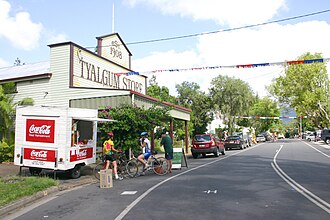 Australia Day 2006, Coolman Street, Tyalgum | |
Tyalgum | |
| Coordinates: 28°21′30″S 153°12′28″E / 28.35833°S 153.20778°E / -28.35833; 153.20778 | |
| Country | Australia |
| State | New South Wales |
| LGA | |
| Government | |
| • State electorate | |
| • Federal division | |
| Elevation | 55.0 m (180.4 ft) |
| Population | |
| • Total | 521 (2021 census)2 |
| Postcode | 2484 |
| Mean max temp | 29.4 °C (84.9 °F) |
| Mean min temp | 12.5 °C (54.5 °F) |
| Annual rainfall | 1,555.4 mm (61.24 in) |


Tyalgum (TAL-g'm or T'algum) is a rural village located in north-eastern New South Wales, Australia. At the time of the 2021 census, Tyalgum had a population of 521 people.4
By road, Tyalgum is located approximately 26 kilometres (16 mi) west of Murwillumbah, 70 kilometres (43 mi) from the Gold Coast, and 130 kilometres (81 mi) from Brisbane.
The Ngandowal and Minyungbal speaking people of the Bundjalung people are the traditional owners of the Tweed region, including Tyalgum, and the surrounding areas.56
Origin of place name
The origin of the name Tyalgum comes from the Yugambeh–Bundjalung languages with there being numerous theories as to how it was derived. Some believe it to be derived from the word daldal (or dal dal), meaning 'shrub' and -gum meaning 'locality', and others that the word itself means 'tall timbers'.78
Background
Tyalgum is situated at the junction of the Pumpenbil and Tyalgum creeks, which provide Tyalgum with its water supply. During early years of settlement, these waterways would have been used to transport the giant red cedar logs that were felled in the area. Other natural features include the valley environment around the village, created by the Border Ranges and Mount Warning.9 As forestry declined, the area became used for dairy farming and other cropping, the local dairy industry being the reason for the 1913 opening of a Norco butter processing plant ("Butter Factory") as with a number of similar villages and townships in the region.10 The Butter Factory ceased operation in 1947 but the building remains, located opposite the Tyalgum Hotel (originally the New State Hotel) and has been the site of various business ventures since then (see "external links").
The village has a number of significant early buildings which have led to its main street and associated buildings being declared a Heritage Conservation Area (HCA) by the Tweed Shire Council. The HCA "Statement of Significance" reads, among other statements:
Tyalgum is significant as an example of surviving early villages, important in being representative of the pattern of settlement in the Tweed region. The European settlement pattern typically originates with the cedar-cutters followed by dairying and crop farming settlers. ...
The village is significant aesthetically for its surviving early buildings. The provisional school (1906), the Tyalgum Hall (1908), the general store, the Literary and Mechanics Institute, the post office, bakery and butcher shop – all provide evidence of the Village of Tyalgum growing and servicing the greater community of Tyalgum in the early 20th century.
The Tyalgum Butter Factory (1913) provides specific evidence of the historical connection with the dairy industry that lead to the foundation of the Village. The building is an important representative example of both the industrial processes used in the dairy industry in 1913 and their application in the Tweed Valley.
Tyalgum is significant as a surviving example of a typical early villages, occurring on river banks and with spectacular views to Wollumbin/Mt Warning in the Tweed region. The village contains a collection of historic buildings set within an extraordinary landscape setting.10
As of 2026, there are plans for Tyalgum to disconnect from the electricity grid and produce renewable power locally, primarily using solar power and battery storage.1112 This project, known as the Tyalgum Energy Project, began in 2014 and is motivated by sustainability and for practical reasons. The practical considerations include that the village is at the end of the existing electricity grid which mean that they can be removed without disrupting energy supplies to surrounding communities and that, with socio-economic residents, its will allow residents to save significantly on electricity.1314
Climate
Tyalgum has a temperate climate. It has a mean annual temperature of 18.9 °C (66.0 °F). The rainfall is generally high with an annual mean of 1,555.4 millimetres (61.24 in), most of which occurs during the summer months.
Demographics
In the 2021 census, Tyalgum recorded a population of 521 people, 50% female and 50% male.
The median age of the Tyalgum population was 46 years old, above the national median of 38.
77.9% of people living in Tyalgum were born in Australia. Other top responses for country of birth were England (5.2%), New Zealand (2.1%), South Africa (1.2%), the United States of America (1.0%), and Germany (0.8%).
95.4% of people spoke only English at home; the next most common languages were 0.6% Punjabi, 0.6% German, 0.6% Mandarin, and 0.6% Thai.2
Music Festival
The Tyalgum Music Festival, originally the "Tyalgum Festival of Classical Music", was founded in c.1991 by concert violinists John Willison and Carmel Kaine who had recently moved into the area.15a Over its existence, the Festival has played host to a range of nationally recognised classical perfomers; concerts take place in the Tyalgum Community Hall (originally the Tyalgum Literary Institute Hall), which has been praised for its good acoustics.1718 In 2026 the Festival was looking forward to welcoming performing artists for its (stated) 34th year of operation.19
The Bakehouse Pottery and Galleria Artisans
The Bakehouse Pottery in Coolman Street, previously the village bakery and later, the "Bakehouse Pottery and Galleria Artisans", was operational from 1980 to 2001 under the ownership of noted Australian ceramic artist, teacher and lecturer Les Peterkin OA, who also served the community in several other capacities while resident in Tyalgum.20 Since Peterkin's departure, the premises are now the Flutterbies Cottage Café.20
2019 fire
In the early morning of 20 August 2019, fire destroyed three local businesses in Tyalgum's main street (Coolman Street) adjacent to the General Store, which was unharmed.2122 The businesses, a local bookshop, jeweller, and boutique have since been re-established (two under new names) and relocated to buildings elsewhere in the street, including to the old Bank building plus La Markette Lane, a recently constructed cluster of artisan shops behind that building and Flutterbies Cottage Café, however the original building did not survive and is now an open space.
Gallery
-
 Tyalgum main street with shop frontages, June 2026
 -
 Tyalgum May 2026: street scene
 -
 Tyalgum May 2026: street scene (2)
 -
 Tyalgum May 2026: General Store interior
 -
 Tyalgum May 2026: La Markette Lane (1)
 -
 Tyalgum May 2026: La Markette Lane (2)
 -
 Tyalgum May 2026: Tyalgum Hotel with Mount Warning behind
 -
 Norco Butter Factory at Tyalgum, 1918
Notes
Notes
- What appears to be the founding concert, in December 1991, was credited to "The Limpinwood Ensemble" (being Willison and Kaine with some associates) plus a number of guest artists.16 The first use of the term "festival" possibly dates from the following year.
References
References
- Australian Bureau of Statistics (28 June 2022). "Tyalgum (urban centre and locality)". Australian Census 2021.
- Australian Bureau of Statistics (31 October 2012). "Tyalgum (State Suburb)". 2011 Census QuickStats. Retrieved 24 October 2013.
- "Averages for Tyalgum (Coodgee Street)". Climate Averages for Australian Sites. Bureau of Meteorology. Retrieved 6 February 2007.
- "2021 Tyalgum, Census All persons QuickStats | Australian Bureau of Statistics". www.abs.gov.au. Retrieved 8 August 2023.
- "The Tweed: Aboriginal acknowledgement". www.tweed.nsw.gov.au. Retrieved 23 March 2026.
- "Aboriginal cultural heritage". www.tweed.nsw.gov.au. Retrieved 23 March 2026.
- "Tyalgum (village)". NSW Place and Road Naming Proposals System. Retrieved 30 March 2026.
- Tyalgum Public School (1981), History of Tyalgum & district, Murwillumbah, NSW: Summerland Printers, p. 9, ISBN 978-0-9593688-0-2
- Tyalgum Public School (1981), History of Tyalgum & district, Murwillumbah, NSW: Summerland Printers, pp. 9–11, ISBN 978-0-9593688-0-2
- Tweed Shire Council, 2016: Land Use and Planning Controls: "Section A18 Heritage", 100 pp. Available at https://www.tweed.nsw.gov.au/files/assets/public/v/1/documents/development-and-business/land-use-and-planning-controls/dcps/section-a18-heritage.pdf.
- Actioning Infinite Possibilities. "Tyalgum Energy Project". AIP Collective. Retrieved 30 March 2026.
- Hartley, Sophie (17 April 2025). "Tyalgum Energy Project NSW". Movement monitor. Retrieved 30 March 2026.
- Kurmelovs, Royce (23 August 2016). "The Australian town that wants to get off the grid". BBC News. Retrieved 30 March 2026.
- Huxley, Jennifer (17 October 2017). "Small Australian town aims to become its own power station". ABC News. Retrieved 30 March 2026.
- "Festival owes its roots to acclaimed violinists". Tweed Daily News. 7 September 2007. Retrieved 22 May 2026. (archived version)
- 1991 concert program
- "Tyalgum Festival of Classical Music 2012 : Blue Silence". Australian Music Centre. Retrieved 22 May 2026.
- Boss, Liana (8 February 2016). "Musical heritage thriving in Tyalgum". Tweed Daily News. Retrieved 22 May 2026.
- "Tyalgum Music Festival". visitnsw.com. Retrieved 22 May 2026.
- "Legislative Assembly Friday 27 June 2025". parliament.nsw.gov.au. Retrieved 22 May 2026. (section heading "Leslie Angus Peterkin, OAM")
- "Two shops destroyed, another damaged in early morning fire". Daily Telegraph, Sydney. 20 August 2019. Retrieved 13 June 2026.
- "Three shops destroyed in Tyalgum fire" (PDF). Nimbin Good Times. 1 September 2019. Retrieved 13 June 2026.
External links
External links
- Bakehouse Pottery Tyalgum, The Beginnings - Les Peterkin - video including shots of pottery/gallery exterior and interior at different times
- Big Volcano Visitor Guide: Tyalgum, NSW, 2484
- The Butter Factory (6 Coolman Street) - sales history and particulars through the years - includes photographs of exterior and interior at different times, also Information board #1: Tyalgum Butter Factory
- Information board #2: The Tyalgum Hotel (originally the New State Hotel)
- Information board #9: Cromptons Butcher Shop
- Information board #10: Tyalgum Hall