Trans World Airlines Flight Center | |
 The terminal's headhouse in 2010 | |
 | |
| Location | John F. Kennedy International Airport Queens, New York, United States |
|---|---|
| Coordinates | 40°38′45″N 73°46′39″W / 40.64583°N 73.77750°W / 40.64583; -73.77750 |
| Area | 17.6 acres (7.1 ha) |
| Architect | Eero Saarinen and Associates |
| Architectural style | Futurist, Neo-futurist, Googie, Fantastic |
| NRHP reference No. | 050009941 |
| NYCL No. | 1915, 1916 |
| Significant dates | |
| Added to NRHP | September 7, 2005 |
| Designated NYCL | July 19, 1994 |
The TWA Flight Center (also known as the Trans World Flight Center or TWA Terminal) is a building at John F. Kennedy International Airport (JFK) in Queens, New York, United States. Designed by Eero Saarinen and Associates for Trans World Airlines (TWA) and completed in 1962, the building operated as an airport terminal for four decades. The building's main section, the headhouse, was adaptively repurposed as part of the TWA Hotel in 2019. The headhouse is flanked by two towers added for the hotel and is partially surrounded by Terminal 5 (T5), a terminal for JetBlue.
The headhouse has a thin shell concrete roof, shaped like a set of bird's wings and supported by four Y-shaped piers. An open, three-level space with tall windows originally offered views of departing and arriving jets. The TWA Flight Center also includes two tube-shaped, red-carpeted departure and arrival corridors extending outward from the headhouse. These formerly connected to the TWA Flight Center's detached "flight wings", which contained the gates. The flight wings were demolished and the corridors were truncated in the 2000s, during the development of Terminal 5.
Saarinen's firm was hired to design the TWA Flight Center as part of a 1955 master plan for Idlewild (now JFK) Airport. After years of design and modeling work, construction began in June 1959, and the TWA Flight Center was dedicated on May 28, 1962. It originally had one flight wing; Roche-Dinkeloo, a successor firm to Saarinen's company, designed a second flight wing, which opened in 1970. Various other additions took place over the years, and domestic flights were moved to the Sundrome in 1981. After TWA sold its assets to American Airlines in 2001, the terminal closed. There were proposals to refurbish the original structure as an entrance to T5 (which opened in 2008), but they were ultimately abandoned. As part of the TWA Hotel's construction, the headhouse was renovated, and the two hotel wings were constructed, opening in 2019. The original design was widely acclaimed; the interior and the exterior of the headhouse are New York City designated landmarks, and the building is on the National Register of Historic Places.
Architecture
The TWA Flight Center, designed by Eero Saarinen and his associates, is centered on a headhouse consisting of a reinforced concrete shell roof.2 The design incorporates elements of the Futurist, Neo-futurist, Googie, and Fantastic architectural styles.3 Key collaborators from the Saarinen office included Kevin Roche, Cesar Pelli, Norman Pettula, and Edward Saad; the interiors were largely designed by Warren Platner.4 To engineer the roof, Saarinen collaborated with Charles S. Whitney and Boyd G. Anderson of the firm Ammann & Whitney.25a The project involved Grove Shepherd Wilson & Kruge as general contractor;67 the Arup Group as the structural engineer; Langan as the civil engineer; and Jaros, Baum & Bolles as the mechanical, electrical, and plumbing engineer.7 It was one of several airport terminals Saarinen designed, along with the Dulles Main Terminal in Virginia and Ellinikon International Airport near Athens, Greece.8
The headhouse sits on a curve along one of JFK Airport's access roads, in front of the elevated AirTrain JFK people mover.9 The headhouse's form was designed to accommodate its small wedge-shaped site, with walkways and gates placed at acute angles.10 Radiating from the headhouse are two departure–arrival passenger tubes, the "Flight Tubes", extending southeast and northeast.911b The TWA Flight Center was among the first to use enclosed passenger jetways, which connected with flight wings (structures with airline gates). The jetways removed the need for passengers to walk on the ground to reach planes, and they sheltered passengers from inclement weather.101314
When the headhouse was used as a terminal, a parking lot15 and a passenger canopy were located outside the front entrance.1617 Adjoining the headhouse to the east is JetBlue's Terminal 5 (T5), built in 2008 to designs by Gensler.1819 T5's entry hall wraps around the TWA Flight Center's headhouse.2021 The original headhouse serves as a lobby for TWA Hotel, which opened in 201922 and includes two buildings designed by Lubrano Ciavarra Architects.23 There is a valet parking lot for the hotel outside the headhouse's entrance,24 along with a nearby parking garage for T5, which connects with a nearby AirTrain JFK station.25
Exterior
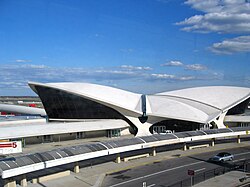
The TWA Flight Center's headhouse is a two-story structure.9 The main portion of the headhouse's facade is made of large green-tinted glass walls,911 measuring 1⁄4 inch (6.4 mm) thick and spanning 3,500 square feet (330 m2).26 The facade uses 236 pieces of glass, which were cut on-site during construction.27 These walls allowed passengers inside to visualize planes landing, taxiing, unloading, loading, and taking off.28 They were coated with a dark purple mylar film at some point before 2005.9 A canopy extends outward from the headhouse, covering part of the sidewalk outside.15
Single-story annexes extend outward from the headhouse to the north and south and contain several door openings within the concave walls. Inside these annexes are maintenance areas.29 The TWA Flight Center also had its own control tower, from which TWA staff could see planes on the apron.2630 The tower had control systems and monitors that allowed staff to display flight information in the headhouse.30 Also part of the original plans was a heliport, which was never used outside the 1964 New York World's Fair.30
Roof
The roof was designed to span a wide space using as little material as possible.3 It is composed of two upward-slanting concrete shells at the edges, which resemble bird's wings, and two smaller shells slanting downward toward the front and back of the structure.31 The upward-slanting shells reach up to 75 feet (23 m) above ground level. The shells converge at the center, where each of the four shells supports the others. Four Y-shaped piers support the roof, facing the front and back;91132 these measure 51 feet (16 m) tall by 315 feet (96 m) long.31 Skylights are placed within the gaps between the shells.1129 The roof weighs 6,000 short tons (5,400 t),3334c covering about 1.5 acres (0.61 ha).26 The concrete varies in thickness from 7 inches (180 mm) at the edges to 40 inches (1,000 mm) at the convergence of the four shells.3334d The roof shells are cantilevered by up to 80 feet (24 m) and contain steel reinforcement to accommodate the roof's weight.34 The main entrance is on the land side, where the roof projects over a sidewalk (formerly a driveway) with a scupper.1129
When the TWA Flight Center was erected, thin-shell concrete roofs could not be built in other parts of New York City due to building code restrictions. The roof could be built only because the Port Authority of New York and New Jersey was exempt from city building codes.37 The shape of the roof recalled that of the Chevrolet Impala's "gull wing", developed by General Motors, for which Saarinen had designed the GM Technical Center.38
Interior
The TWA Flight Center incorporated many innovations for its time, including closed-circuit television, a central public address system, baggage carousels, a schedule board, baggage scales, and gates that were distant from the headhouse.103940 TWA staff received instructions through a pneumatic tube system.30 Departing and arriving passengers at the TWA Flight Center were not separated into their own areas, a common practice at other airport terminals.41 A writer for The American Scholar magazine said the overall layout acted like a grand procession, with passengers ascending from the entrance.42 From an intermediate level, passengers continued to the flight wings,42 two outlying gate structures detached from the headhouse.43 The historian Alice T. Friedman said the design allowed occupants to both engage in activities (such as sitting down or observing planes) and to watch others partake in the same activities.44 According to the writer Kornel Ringli, the interior's curving shape created an impression of movement and speed, which was then amplified in the popular media.45
Headhouse

The headhouse spans 200,000 square feet (19,000 m2),4647 with a width of 152 feet (46 m) and a length of 230 feet (70 m) at ground level.26 It contains two full stories. An intermediate level, facing east, is joined to the lower level by a central staircase and to the upper level by four peripheral staircases.4849 The interior uses concrete extensively in design details such as desks, seats, and the flight information display; these concrete surfaces not only served as a continuation of the exterior but also demonstrated the malleability of the material.50 The interior also uses almost 58 million ceramic tiles,2628 which line the walls and floors;2949 the mosaic tiles visually complemented the headhouse's concrete surfaces.50 Loudspeakers are placed throughout the headhouse.30 As part of the TWA Hotel's development, the original headhouse's interior was converted into the hotel's lobby, retail, and amenity area,4751 with restaurants and the hotel's reception desk.52 TWA-related objects are exhibited there.5153
The lower level contains the former ticket counter and baggage claim areas.1041 These areas, situated in distinct wings flanking a central entrance lobby,41 were placed near the curbside canopy to maximize convenience for passengers.10 A sculpted marble information desk, carved as a single slab, rises from the lobby floor,2912 and a split-flap display by Solari originally displayed flight information.1026 When the terminal was in operation, arriving passengers picked up their luggage at carousels next to the entrance, which traveled at 65 feet per minute (20 m/min).2628 The lower level also had computerized baggage scales and conveyor belts.54 There are also mechanical, service, and office areas in a partial basement under the intermediate level, as well as a tunnel leading to the former Flight Wing 1.55 The TWA Hotel operates a 50,000-square-foot (4,600 m2) event area in the basement.56
Twelve steps from the lower level ascend about 5 feet (1.5 m) to the intermediate level.15 There is a sunken conversation pit on the intermediate level,1644 which faces east and originally overlooked a tarmac.55 Although the original conversation pit had been removed by the 1990s,16 it was recreated as part of the TWA Hotel.57 In addition, by the early 1990s, a switchback ramp had been added between the lower level and the intermediate level to comply with the Americans with Disabilities Act of 1990.58 There is also an elliptical plaque commemorating Saarinen.59
A concrete balcony on the upper floor spans above the central staircase that connects the lower floor to the intermediate level.164955 The upper floor had multiple eateries.4960 The TWA operated its Ambassador Club on the northern portion of the upper floor (left of the entrance), designed by Saarinen Associates.4961 The southern (right) portion of the upper floor contained the London Bar & Constellation Club, the Lisbon Lounge, and the Paris Café,62 all designed by Raymond Loewy.49 There were also offices on the upper level, north and south of the public areas.55 A three-sided clock, dating from 1963, hangs from the center of the ceiling, where the rooftop shells converge. The clock was not part of the original plans, but it was retained when the building became part of the TWA Hotel.63


Passageways


The two passageways leading from the headhouse are completely enclosed and cross an access roadway.4955 The passageway leading southeast was called Flight Tube 2, while the passageway leading northeast was called Flight Tube 1.9 The tubes originally led to the flight wings and are 6 feet (1.8 m) higher at the site of the flight wings than at the headhouse. Flight Tube 1 is about 232 feet (71 m) long while Flight Tube 2 is 272 feet (83 m) long.55 Following the opening of the TWA Hotel, the tubes have connected the headhouse to the guestrooms in the hotel;225164 Flight Tube 1 leads to the hotel's Saarinen wing, and Flight Tube 2 leads to the Hughes wing.57 The ends of the flight tubes contain mockups of Saarinen's and Hughes's offices,53 and the end of Flight Tube 1 also has an elevator connecting directly to JetBlue's Terminal 5.5765
The tubes are covered in concrete, with an elliptical cross section and indirect lighting.11 TWA's press releases indicated that the design features were intended to heighten travelers' anticipation before they boarded their planes.60 Original plans called for the passageways to be designed as bridges with glass ceilings; each passage would have two moving walkways, one in each direction, with a stationary hallway in between.31 As a cost-saving measure, the moving walkways were removed from the final plans.1441 Although Saarinen had wanted to reduce the distance that passengers walked to planes, the TWA Flight Center's passengers still had to walk a significant distance through the flight tubes. This contrasted with Saarinen's later Dulles International Airport Main Terminal, where he designed mobile lounges to ferry passengers directly to planes.66 The tubes were preserved when T5 was built.2120
Flight wings


Flight Tube 2 originally connected with Flight Wing 2, built as part of the original TWA Flight Center in 1962, while Flight Tube 1 connected with Flight Wing 1, built during a 1967–1970 expansion designed by Saarinen Associates' successor firm Roche-Dinkeloo.920 Both sections were characterized as violin-shaped, with jetways extending outward from the end of each wing.9 The flight wings had concrete and plaster bases, along with passenger concourses cantilevered above.55 The presence of the flight wings allowed TWA passengers to more easily transfer between flights, since they only had to travel between the two flight wings (or between gates in the same wing), rather than changing between terminals.30 Fueling and heating systems were embedded into the apron adjoining the flight wings.54
Flight Wing 2, shaped like a multi-sided polygon,67 was the smaller of the two structures, with seven gates.6768 It contained utilitarian decor as well as a small flight operation center above the passenger area.6970 Two bridges led to departure lounges (labeled gates 39 and 42), which could both fit 100 passengers; these had a red-and-oyster color scheme with furnishings.1269 Flight Wing 1 was larger than Flight Wing 2, having been built to accommodate Boeing 747 jumbo jets, and had 10 gates.6768 Flight Wing 1 had four levels, which contained passenger areas, Federal Inspection Services, and operations facilities; there were also baggage claim carousels in Flight Wing 1's basement, connected to the headhouse via people mover.67 Both flight wings were demolished with the construction of T5 in the 2000s.7172
T5 and TWA Hotel
Abutting the TWA Flight Center are JetBlue's Terminal 5 and the TWA Hotel's wings. T5 is variously cited as containing 625,000 square feet (58,100 m2)19 or 635,000 square feet (59,000 m2) of space.18 T5 has a 55,000-square-foot (5,100 m2) retail area,19 a children's play area, and a 1,500-space parking garage.7374 It has 26 gates1819 and could handle 20 million passengers annually.75
Two towers, flanking the headhouse's sunken lounge, curve around the original headhouse.4257 These towers, which were constructed as part of the TWA Hotel, have 512 guest rooms.765277 The hotel is outside the sterile area of T5.73 The hotel's decorations, replicas of the original furnishings, include brass lighting, walnut-accented furnishings, and rotary phones. The hallways contain red carpeting, evocative of the color of the furniture in the original TWA lounge. The rooms also contain modern design features such as blackout curtains and multiple-pane soundproof windows.7879 Some of the rooms are oriented toward the headhouse, while others face the runways.57 The hotel has underground event space, built around the TWA Flight Center;7680 the land under the headhouse rested on pilings and could not be excavated.76 There is also a 10,000-square-foot (930 m2) observation deck and a swimming pool.52
History
New York International Airport, also known as Idlewild Airport, started operating in 19488182 and was renamed John F. Kennedy (JFK) International Airport in 1963.83 Transcontinental and Western Airlines (TWA) signed a lease with Idlewild's operator, the Port of New York Authority (later the Port Authority of New York and New Jersey, or PANYNJ) in 1949.8485 Idlewild had the highest volume of international air traffic of any airport globally by 1954,8186 amid the growing popularity of air travel in the U.S. and worldwide.87
Development
In February 1955, the Port of New York Authority announced a master plan for renovating Idlewild Airport.8288 Major airlines at the airport, including TWA (which by then had been renamed Trans World Airlines8990) would build their own terminals. Smaller airlines would be served from a central terminal, the International Arrivals Building.889192 When the locations of each airline's terminal were announced, TWA and Pan Am were assigned spots flanking the International Arrivals Building.859394 The site assigned to TWA was not the airline's first choice for an Idlewild terminal,1036 and TWA's hangar was on the opposite side of its assigned lot.85
Saarinen commission and research
Under the leadership of TWA president Ralph S. Damon, TWA hired Eero Saarinen's firm, Eero Saarinen & Associates, to design the TWA Terminal.859596 TWA public-relations executive Rex Werner convinced the company to select Saarinen,97 who agreed to take the commission even as his firm was simultaneously working on 15 other projects.96 His wife Aline B. Saarinen recalled that he had viewed most other air terminals as ugly, shoddy, and inconvenient.598 A writer for Interiors magazine described TWA as having "vision and confidence" for the project,8599 and Kornel Ringli said that TWA sought a high-quality design similar to what Saarinen had designed for previous clients.100

TWA anticipated that, at peak hours, the terminal would accommodate a thousand passengers, with two thousand departures and arrivals per hour.5 Additionally, TWA needed fourteen positions at the terminal for large jets.101102103 Saarinen & Associates studied the operations of airports across the U.S.,42 finding that, on average, passengers had to walk over 900 feet (270 m) from terminal to plane.104105 Saarinen & Associates also observed passenger circulation patterns in Grand Central Terminal, the United States' busiest railroad station, where they discovered that passengers often walked in curving paths, despite the station's rectangular shape.96 The team drew up 35 plans for different aircraft-parking configurations, along with various studies of freight and passenger flow.106 According to Saarinen associate Kevin Roche, Saarinen had thought the TWA tract was ideal, despite airline officials' dissatisfaction with the lot.36
Design
Saarinen & Associates started creating designs for the headhouse's form, or shape, in February 1956.101103 Saarinen said he had been challenged to devise a "distinctive and memorable" design,107108 which would deviate from traditional airport terminal designs.40 He wanted the new terminal to have a practical purpose and not only "interpret the sensation of flying",109110 but also "express the drama and specialness and excitement of travel".111 Damon, similarly, wanted "the spirit of flight" to be encapsulated in the design.93 The building, according to Saarinen, was intended to heighten travelers' anticipation as they approached,8595 with similar interior and exterior features creating a unified design.112113 Saarinen did not consider any rectangular designs, but shell structures—such as what he ultimately designed for the headhouse—were not particularly new, either.114
One of his original designs was sketched on the back of a restaurant menu while he and Aline were eating dinner with Time magazine's associate editor Cranston Jones.115 The preliminary designs—which called for a main waiting hall, separate arrival and departure wings, and passageways to two standalone gate buildings—were finished by mid-1956.116 In conjunction with the building's design, Saarinen prepared a brochure outlining his plans to TWA officials.117 Unhappy with initial designs, Saarinen asked TWA for more time and took an additional year to resolve the design,3 testing out numerous shapes.38 Roche described one initial design as an oval shell upon four piers, saying that Saarinen had rejected that plan as awkward.11831 An engineer for the project, Abba Tor, had warned that a single slab of concrete might crack.119
Saarinen & Associates first created 3D models of the planned headhouse, then drew sketches of the structure; this contrasted with the design processes of more traditional buildings, in which architects drew the sketches first.111 Saarinen & Associates created several wire, cardboard, and clay models of the headhouse's roof,610118 constructed at various scales.31 One early model for the headhouse was based on Jørn Utzon's winning proposal for the Sydney Opera House's architectural design competition, for which Saarinen had been a judge.111 Saarinen had originally envisioned the roof as a single shell, but he refined the design twice before ultimately devising the plan with four shells.120 The final model for the shell may have been inspired by one of Saarinen's breakfasts, a grapefruit that he pushed down at the center.3132120 The roof may also have been inspired by Minoru Yamasaki's design for St. Louis Lambert International Airport's main terminal; Eero's father Eliel Saarinen's design for Helsinki Central Station; and McKim, Mead & White's design for the original New York Penn Station.121 During another discussion, Roche used a saw to bisect one of the models, creating the inspiration for the roof's four shells.3132

The interior was designed next; since the space was to be symmetrical, Saarinen & Associates only created drawings for half the interior.31 Roche said the area around the center staircase was remodeled at least ten times.122 Saarinen's team frequently studied the models throughout the night, crawling across them.123 The team also designed two outlying gate structures, or flight wings, connected to the headhouse by passageways. With few specifications to rely on, Saarinen & Associates designed gates for aircraft with wingspans of 110 feet (34 m), which turned out to be inadequate even before the building's completion.41 In addition to around 130 possible plans created by Saarinen & Associates, contractors provided hundreds of their own drawings, and workers designed cross-sections and contour maps as well. The drawings took some 5,500 man-hours to produce, and they were accurate to about 1⁄8 inch (3.2 mm).631 Saarinen & Associates devised 600 sketches of the building, of which 200 were used in the final design.7 The resulting plan was characterized as providing a "smooth and luxurious switch from ground transportation to planes".10193
Marketing and changes to plans
TWA announced plans for the terminal at the Barbizon Plaza in Manhattan on November 12, 1957.124 At the time, it was to cost $12 million (equivalent to $102 million in 2024) and begin construction the following year.125126127 The plans called for a structure with four concrete roof shells, supported by four piers; there were to be check-in counters, waiting areas, and other amenities inside.127 Two passageways would lead to outlying structures, containing gates from which passengers would board.126127 At the time, the building was supposed to be completed in 1960,126127 while the TWA hangar had already been constructed earlier in 1957.128 In conjunction with the announcement, TWA issued two press releases describing the planned building in detail.124
The plans were revised in 1958 after TWA determined Saarinen's original design to be too expensive.129 Only one of the two planned gate structures, Flight Wing 2, was initially built as a cost-saving measure.1441130 The passageways were to have a glazed roof and moving walkways in the original plan, but these features were absent in the final construction.1441 Two "arms" flanking the headhouse were also removed from the plans.14
Aline Saarinen helped promote the terminal and prepared images of it for exhibitions, the popular press, and trade magazines.131132 The building was covered in dozens of press releases and articles during its development, including in trade publications, the popular media, and TWA's own magazine.131 All of these publications promoted Saarinen's role in the design, which Ringli said was part of Aline's efforts to "turn the terminal into a memorial to [Eero Saarinen]".59 Many media articles used information from TWA's press releases without significant modifications, even though the press releases sometimes neglected to mention inconvenient design details, such as the presence of stairs or the absence of a full canopy outside the building.15 TWA convened a committee to devise a formal name for the terminal, and the committee suggested the name "Trans World Flight Center" to create an explicit link between TWA's global stature and the building's function.133
Construction

Grove Shepherd Wilson & Kruge received the contract in early 1959.134 Construction began on June 9,131135 initially with 14 engineers and 150 skilled craftspeople.136 At the time, work was anticipated to be completed in 1961.135 A grid was devised to manage the steel-pipe scaffolding at the construction site, and 5,500 supports were used in the scaffolding.136137138e The contractors prefabricated 27 distinct shapes of wedges for the scaffolding, using 2,500 pieces in total.31 The process of creating the scaffolding lasted more than a year.139 The contractors relied partially on computer calculations to design and construct the various parts of the terminal.731 The four Y-shaped piers required hundreds of additional drawings to fabricate.31
Even as work on the TWA Flight Center proceeded, several competing airlines had already completed terminals at Idlewild Airport. To compete with these airlines, TWA opened a temporary terminal in August 1960; one-eighth of the airline's passengers criticized the design of the temporary structure.140 The permanent structure's roof was poured as a single form starting on August 31, 1960,136139141 a job that took 120 hours.142 The pour involved 3,200 cubic yards (2,400 m3) of concrete,139141 which was cast in four phases. Three 45-short-ton (40-long-ton; 41 t) cranes delivered buckets of concrete to the site.139 The contractors constructed the roof shells to the specifications outlined in Saarinen's contour maps, which had a margin of error of 1 foot (0.3 m).7136137 Although the project employed carpenters who did not have a particular specialty, the procedures were precise enough that they required a maximum deviation of 0.25 inches (6.4 mm) from the plan.34137
The scaffolding was removed in December 1960, after construction had progressed enough that the entire weight of the roof could be supported by the piers.102138 By April 1961, when only the concrete vaults had been completed, Saarinen remarked that "If anything happened and they had to stop work right now and just leave it in this state, I think it would make a beautiful ruin, like the Baths of Caracalla".34143 The terminal hosted its first preview events the same month.144 Saarinen died later that year,145 and Roche and another of Saarinen's associates, John Dinkeloo, formed Roche-Dinkeloo, which worked to complete the building.146 The TWA Flight Center was one of several commissions that Roche-Dinkeloo had received from Saarinen's former clients following his death.147 In the three months before the building's official opening in 1962, TWA published twelve press releases promoting it. TWA's advertising manager said the airline's approach to promoting the building was to treat it "as though it were a national monument".60 The building had cost $15 million (equivalent to $119 million in 2024) in total.148149
Original use
Opening and early years

On March 19, 1962, passengers started using the incomplete TWA Flight Center to access planes.150151 TWA president Charles C. Tillinghast Jr. announced plans the next month to officially open the terminal,151 and workers continued to fit out the interior.35 Prior to its official opening, the building hosted a press tour on May 1759 and was used for a fundraising ball on May 22.59152 The completed terminal was dedicated as scheduled on May 28, 1962.59149 It was finished after most of the other major U.S. airline terminals at Idlewild were completed. After the opening of the International Arrivals Building in 1957, United Airlines and Eastern Air Lines opened their own terminals in 1959, followed by American Airlines and Pan American World Airways (Worldport) in 1960, and Northwest Airlines and TWA in 1962.91153 National Airlines' Sundrome would be the last, opening in 1969.153
The terminal as completed had seven aircraft positions: six from Flight Wing 2 and a seventh from a temporary structure attached to Flight Tube 1.13154 Four of Bernard Buffet's paintings, depicting cities where TWA operated, were installed in the TWA Flight Center in 1963.155 The terminal recorded 1.5 million travelers in its first year, 20% higher than expected.156 Throughout the decade, passenger aircraft gradually became larger, and JFK Airport's passenger numbers also increased.43 As such, the TWA Terminal quickly became functionally inadequate42157 and was poorly equipped to accommodate wide-body aircraft.158 International flights at JFK during that time were routed through the International Arrivals Building.159 In 1966, Restaurant Associates took over all of the TWA Flight Center's foodservice operations.160161 The terminal accommodated 3 million annual passengers at that point, with 140 daily flights,161 and it recorded 11 million passengers in its first five years, exceeding original projections by more than 50%.158
Late 1960s to early 1980s: Expansions
TWA devised plans in 1966 for an expansion of the existing facility, with ticket counters and baggage areas connected to the original headhouse via a tunnel.158 In June 1967, TWA announced that it would build Flight Wing 1 northwest of the existing structure, hiring Roche-Dinkeloo to design it.162163 Flight Wing 1 was expected to cost $20 million and be completed in two years.163164 Work started in 1968,159 and the concrete shell was finished by that December.165 The expansion included a customs facility to alleviate congestion at the International Arrivals Building's customs terminal,166 located within the basement.167 The headhouse's ticketing counter and the baggage handling area were expanded, and the new addition was connected to the basement of Flight Wing 1.67 BWIA West Indies Airways began operating from the TWA Terminal in November 1968,168 though it moved to another terminal after less than a year.169 Flight Wing 1 hosted its first passengers on February 25, 1970;170 it had cost $21 million in total.167 The wing was not dedicated until March 19, when international passengers could pass through the terminal directly.167171

In 197816 or 1979, TWA built a traffic island with a concrete-and-glass canopy to provide shelter for passengers waiting for ground transport.17 Measuring 330 by 22 feet (100.6 by 6.7 m),16 the shelter, constructed by the architectural firm Witthoefft & Rudolf, won the Albert S. Bard Award for architectural excellence.172 A bomb detonated at the terminal in March 1979, injuring four people.173 The TWA Flight Center was overcrowded by the early 1980s,174 and passengers sometimes had to line up outside because the terminal was so crowded.42 This prompted TWA to lease the neighboring Sundrome in December 1980.174175 The expanded facility opened in April 1981;176177 domestic flights were subsequently relocated to the Sundrome, while the TWA Flight Center continued to host international flights.174 A passageway was also built to connect the TWA Flight Center and the Sundrome.177178
Mid-1980s to early 2000s
Throughout the late 20th century, the TWA Flight Center underwent further modifications, including the addition of security screening equipment42179 dividing the interior into two sections.80 Following a series of bombings and aircraft hijackings, in 1985, TWA implemented more stringent baggage checks and hired more guards and police to patrol the terminal.180 In addition, TWA began testing out an X-ray screening machine in September 1989,181 among the first machines of its type to be used in an airport.182 The Port Authority had also hired Pei Cobb Freed & Partners in 1984 to design a renovation of JFK Airport;183 the plans, published in 1990, called for a central terminal connecting with the TWA Flight Center and other terminals.184 These plans were never carried out,183184 and TWA planned a renovation of the terminal that also did not occur.46
Progressive Architecture magazine described the terminal in 1992 as being in "tawdry condition", with parts of the structure appearing actively deteriorated.178 TWA wanted to merge with another airline by then, and the terminal's continued operation was uncertain.185 The New York City Landmarks Preservation Commission (LPC) designated the terminal as a landmark in 1994, amid reports that the building might be demolished.3964 Following the 1996 crash of TWA Flight 800, investigators found that the TWA Flight Center's security protocols were lax and that unauthorized personnel could theoretically access the terminal's baggage room and even the tarmac.186 Later that year, amid a decline in TWA's finances, the airline eliminated many routes and moved its remaining New York operations to the TWA Flight Center.187 The PANYNJ considered expanding the terminal during that decade,64 and elastomeric coating was added to the roof in 1999 to prevent leakage.29
TWA sold its assets in October 2001 to American Airlines,21 which briefly operated flights out of the TWA Flight Center.188 American Airlines ceased flight operations at the terminal in December 2001 and allowed its lease, inherited from TWA, to expire the next month.188189 By then, airport officials saw the terminal as functionally outdated.190191 Among other issues, the building did not meet modern accessibility or security standards, was frequently overcrowded, and had inadequate exterior canopies and access roads.191 Like many terminals designed before the advent of jumbo jets, increased passenger traffic, and security issues, the design had proved difficult to update as air travel evolved, particularly with regard to the placement of security checkpoints.192159 The PANYNJ could bypass the LPC designation and demolish parts of the terminal;190193194 the Federal Aviation Administration (FAA), which could approve or reject the PANYNJ's redevelopment plan, declined to intervene.195
Preservation and later use
Proposals for redevelopment

In early 2001, the PANYNJ proposed preserving the tubes and erecting a new structure east of the existing building. The PANYNJ wished to destroy one or both of the flight wings.190193 By that August, the PANYNJ had presented its first proposal, which entailed converting the headhouse into a restaurant or conference center, while encircling the existing building with one or possibly two new terminals.196 Preservationists expressed concerns that the terminal could be significantly modified.112 The Municipal Art Society (MAS) and the architects Philip Johnson and Robert A.M. Stern were against the proposal,196 as was Docomomo International.197 Detractors said the Saarinen headhouse's original design intention would be lost if it were encircled by another terminal,196198 and that the flight wings were an integral part of the architecture.197 Philip Johnson, speaking at the 2001 presentation, said of the PANYNJ proposal:
This building represents a new idea in 20th-century architecture, and yet we are willing to strangle it by enclosing it within another building. Imagine, tying a bird's wings up. This will make the building invisible. If you're going to strangle a building to death, you might as well tear it down.196
The MAS wanted the original structure to remain in use as a terminal,194191 while the New York Landmarks Conservancy, another preservationist group, advocated for a more flexible plan that allowed adaptive reuse.199200 By late 2002, there was still no agreement on the usage of the TWA Flight Center, except that the headhouse and passageways would be preserved.188 The following year, a draft of a request for proposal (RFP) for the terminal was released.201 In addition, JetBlue proposed reopening the headhouse as a check-in facility and constructing a 26-gate terminal behind the headhouse.202203 At the time, JetBlue was operating out of the adjacent Sundrome and was the airport's fastest growing carrier.202 Due to the preservation disputes, the National Trust for Historic Preservation included the TWA Flight Center on its America's Most Endangered Places list in 2003.204 The Wall Street Journal credited the National Trust listing with having influenced the building's addition to the National Register of Historic Places in 2005.205
Construction of JetBlue terminal
The PANYNJ and JetBlue came to an agreement on the construction of the new terminal in August 2004,206207 and Gensler was hired to design the new structure, known as T5.207208 As part of the plan, two JetBlue ticket kiosks were to be installed in the original headhouse,200209 which, along with T5, was supposed to have become part of a new Terminal 5.210 Because the headhouse was not intended to be fully integrated into the new terminal, another tenant had to be identified for the rest of the headhouse.200 Separately, the PANYNJ signed an agreement with the FAA and historic-preservation agencies for the renovation of the headhouse.211 The structure was also supposed to host an art exhibition called Terminal 5,192 with work, lectures, and temporary installations drawing inspiration from the headhouse's architecture.192 Though the exhibition was planned to run from October 2004 to January 2005,192212 the show closed abruptly after the headhouse was vandalized during the opening gala.212213
In December 2005, the PANYNJ began construction of the T5 facility behind and partially encircling the headhouse.21 The two flight wings were demolished to make space for the new facility, and roadways were constructed under the flight tubes.71 The construction of T5 obstructed direct views of the tarmac from the headhouse.42 The PANYNJ issued a final RFP for the headhouse in 2006,201 requesting proposals for the space not occupied by the ticket counters.200209 Originally, the PANYNJ was to renovate a departure lounge at the end of Flight Wing 2,201 known as the "trumpet".214215 The lounge was lifted and moved 1,500 ft (460 m)216217 at a cost of $895,000.214217 The lounge was later demolished,7172 and the PANYNJ prioritized renovating the headhouse instead.21215 The cost of relocating the "trumpet" had been estimated at $10 million, slightly less than the $11 million estimated cost of the headhouse project.201
The PANYNJ approved $19 million in repairs to the headhouse in early 2008.210215 The headhouse's renovation included removing asbestos and replacing or restoring deteriorated design details.210 T5 opened on October 22, 2008.18218219 At the time of T5's opening, JetBlue and PANYNJ had yet to complete renovation of the original Saarinen headhouse.215 There were disagreements over whether the headhouse should be used for conferences, converted to a restaurant, or adapted for some other use.220
Conversion of headhouse into hotel

The PANYNJ was seeking to convert the still-vacant headhouse into a hotel by 2011,221 and Open House New York (OHNY) began providing free tours of the unused headhouse that October.222 The OHNY tours took place once a year,223224 and the headhouse soon became one of OHNY's most popular tour sites.224 The firm Beyer Blinder Belle finished restoring the headhouse in 2012.222225 André Balazs was selected in 2013 to operate a hotel at the TWA Flight Center;46226 Balazs, a fan of Saarinen's architecture, had planned a Standard Hotels location there.220 Balazs's proposal was abandoned due to disagreements with the PANYNJ,46223 and another request for proposals was launched the following year.46227 There were proposals to convert the headhouse into a capsule hotel operated by Yotel,228 or to use it as a terminal for Eos Airlines, but neither plan was accepted.229
JetBlue and the hotel developer MCR Hotels jointly negotiated for the rights to operate a hotel there,230 and they won the lease in September 2015.231 Afterward, the historian Lori Walters used laser scanners to document the building's architectural details.232 Construction of JetBlue and MCR's TWA Hotel began in December 2016233 and was funded by a $230 million loan.229234 The structures on either side of the headhouse were demolished,235 and hotel-room towers were built on either side.236237 The project also involved conducting asbestos abatement236 and replacing or restoring many original design details.79238239 Since the headhouse was a designated landmark, the renovation was eligible for federal and state tax credits,236 and the developers were required to consult with nearly two dozen government agencies.239 The hotel opened on May 15, 2019, and the TWA Flight Center has been part of the hotel since then.240
Impact
When plans for the TWA Flight Center were first announced, the building was detailed extensively in both the popular press and in architectural and aviation media,131 a trend that continued during the building's construction.241 Despite being finished after many other terminals at JFK Airport, the TWA Flight Center incorporated many novel features for its time, which influenced the design of other airport terminals.3940 TWA copied elements of the terminal's design for its World Travel Center at 299 Park Avenue in Manhattan, which opened in 1968.242243 The company also used the terminal in marketing materials for years after the building's completion.243
The TWA Flight Center gradually became one of Saarinen's best known works, alongside such structures as the GM Tech Center, CBS Building, the Dulles Airport Main Terminal, and Gateway Arch.244245 Kornel Ringli said in 2015 that the TWA Terminal's design reflected Saarinen's tendency to customize designs according to his clients' needs, as the architect had done for the General Motors Technical Center, John Deere World Headquarters, and Kresge Auditorium.246 The architect Robert Venturi stated that Saarinen's designs deviated from the then-commonplace architectural philosophy "form follows function".247 Henry Grabar wrote for The Atlantic in 2017 that the TWA Terminal was "the most distinctive example of corporate-showpiece architecture", alongside other Saarinen works such as the General Motors complex and IBM's Thomas J. Watson Research Center.80
Reception
Contemporary

Edward Hudson of The New York Times described the plans in 1957 as "hav[ing] a startling effect" for first-time visitors, but "not so revolutionary" inside.248 Another newspaper said the building was "planned to combine the functional realities of a jet-age air terminal with the aesthetic drama of flight".249 Just before the building's opening, The Christian Science Monitor wrote that architects had praised it "as perhaps the finest example of the creative genius of the late Eero Saarinen".250
The completion of the terminal prompted significant architectural commentary, much of it positive.130241 The New York Times architectural critic Ada Louise Huxtable saw the TWA Flight Center as a bright spot in the "mediocrity" of JFK Airport,154251 and Maude Dorr of Industrial Design magazine said the terminal "reflects the excitement of travel".66 Architectural Forum magazine, comparing the TWA Flight Center with other terminals at JFK Airport, wrote that "there can be little doubt about who won".45 The interior was also praised. The critic Edgar Kaufmann Jr. in 1962 called the interior "one of the few major works of American architecture in recent years that reaches its full stature as an interior",4999252 viewing it as "a festival of ordered movements and exhilarating vistas".16 Ken Macrorie of The Reporter compared the tarmac-facing waiting room to a railroad hub's waiting area and alluded to the similarities with the city's original Pennsylvania Station.12253
Many contemporary media compared the terminal's headhouse to "a bird in flight", despite Saarinen's insistence that the resemblance was coincidental.34143 Architectural Forum (which praised the terminal) and Architectural Review (which criticized it) both characterized the design as a "concrete bird".34 The writer Douglas Haskell said the building's shape directly conveyed its purpose, akin to Disneyland's Sleeping Beauty Castle, saying that both buildings satiated the public's appreciation of symbolism.254 Saarinen did not object to the building's avian comparisons, saying that "people are forever looking for literary explanations".255 Privately, Saarinen described the structure as a "Leonardo da Vinci flying machine"101247 and acknowledged that the building did indeed resemble a bird.254
The design also had detractors,136154 and the historian Alice T. Friedman retrospectively said that the TWA Terminal had "emerged as something of a lightning rod for contemporary audiences, only some of which had to do with architecture".107 One major critic was the historian Vincent Scully, who disliked Saarinen's use of "whammo shapes" at the TWA Flight Center and the Dulles Main Terminal,34130 calling the former "pseudo-concrete choked with steel".256 The British critic Reyner Banham questioned the practicality of the design, which did not clearly link "function and symbol", but he said that the TWA Terminal was no worse than any other airport terminal.130257 The Italian engineer and architect Pier Luigi Nervi was also skeptical of the design, saying that the structure was "too heavy and elaborate for the problem it seeks to solve".130258 Friedman also wrote that detractors also had negative impressions of the TWA Flight Center and Saarinen's other designs for large businesses, citing their capitalist connotations.259
Retrospective

Adulation for the original design continued after its completion.252261 In the 1990s, Progressive Architecture magazine said the TWA Flight Center "represented a high point not only in the design of air terminals, but in the exercise of corporate responsibility",178 while The Globe and Mail called it among "the most potent images of '50s design".262 New York Times critic Herbert Muschamp called the TWA Flight Center "the most dynamically modeled space of its era",260 and the architect Robert A. M. Stern likened the headhouse to a "Grand Central of the jet age".220260 Conversely, Paul Goldberger said in 1990 that the terminal was "but a shadow of its former self" because it had undergone so many alterations over the years.179
The Engineering News Record said in 2003 that the building remained architecturally influential even as it had become functionally outdated.263 In a 2005 book about Saarinen's work, Jayne Merkel said "the building did for TWA what the [Gateway] Arch [...] would eventually do for Saint Louis".93 According to Merkel, it was not until the Port Authority proposed demolishing the terminal for T5 that "the full impact of the building was revealed".241 After the nearby Sundrome was demolished in 2011, David W. Dunlap of The New York Times wrote that the TWA Flight Center's "captivating and evocative design" explained why it had been preserved over the years.264 Joseph Giovannini of The Wall Street Journal wrote two years later that "the flowing lines and rising forms of the terminal are buoyant, all lift and no weight", contrasting it with Ludwig Mies van der Rohe's Seagram Building,225 while Chris Beanland of The Independent called the building a "swoop-roof marvel" that retained its 1962 look.265 Ringli wrote in 2015 that the building's appearance and TWA's marketing efforts made the terminal similar to "successful consumer goods with attractive packaging", even though the building quickly became obsolete.157 Two years later, Henry Grabar described the TWA Flight Center as being "the world's most famous airport terminal" and Saarinen's most widely-appreciated building.80
After the TWA Hotel conversion was complete, Australian Design Review wrote that the original Flight Center's design had retained its quality throughout the years,266 and an observer for The American Scholar wrote that "Saarinen's terminal maintains its sublime power".42 Karrie Jacobs wrote for Architect magazine that the design "doesn't speak of technological advancement but of craft", describing the terminal as "quaint" and likening it to the curved forms of Saarinen's Ingalls Rink and Dulles Main Terminal.56 In a 2021 report, the scholar Song Jiewon wrote that the original structure had become "the physical manifestation of a vision of America's future".43 The architectural historian Michael J. Lewis described the building as "perhaps the world's finest example of an inhabitable sculpture", saying it still looked modern.267
Awards and media

When the terminal was completed, it received numerous accolades and awards, including from the Queens Chamber of Commerce270 and the New York Concrete Industrial Board.271 Architectural Forum included the TWA Flight Center and the Pepsi-Cola Building as part of a 1962 exhibition of ten of the "world's most significant modern buildings".272 The American Institute of Architects (AIA) gave the terminal an Award of Merit in 1963, and it was featured in magazines printed internationally.136 In addition, Saarinen won the AIA Gold Medal posthumously in 1962.273
The TWA Flight Center ranked 115th on the AIA's 2007 List of America's Favorite Architecture, which listed the top 150 buildings in the United States.268269 Beyer Blinder Belle received an award for its 2012 restoration of the building,222 and the Preservation League of New York State also gave the building an excellence award.274 When the TWA Hotel conversion was completed, the project received the New York State Office of Parks, Recreation and Historic Preservation's 2019 preservation award.275
The building was frequently used in the popular media as a symbol of the jet age.276 A scale model of the terminal was displayed at the Museum of Modern Art in Manhattan while the building was under development.134277 The photographer Balthazar Korab took multiple pictures of the terminal during its development.278 After the terminal was completed, it was documented in numerous photographs by Korab,279276 Charles Eames,28 and Ezra Stoller,280 and it was a setting for fashion photo shoots.276 Shortly after the TWA Flight Center closed, the headhouse was used for the filming of Catch Me If You Can in 2002.281276 JetBlue used a depiction of the Saarinen terminal's roof as the official logo for the opening of T5 in 2008.21276 The building has been replicated in the New York Botanical Garden's annual holiday train show,276 and TWA Hotel contains a model airport depicting the terminal and other nearby buildings at 1:400 scale.53282
Landmark designations
The LPC held public hearings on the possibility of designating the TWA Flight Center's exterior and interior as official city landmarks in 1993.283 The terminal's exterior and interior were designated as landmarks on July 19, 1994,39284 and the New York City Council ratified the designation that October.260f The designation preserves the headhouse and the older Flight Wing 2, but not the newer Flight Wing 1,193285 and it focuses mostly on the building's architecture, rather than its historical significance or operational usefulness.156 Both TWA and the PANYNJ supported the exterior landmark designation, but PANYNJ officials testified that they would need to modify the building in the future.284286 Although city landmarks typically cannot be modified without LPC approval, this rule does not apply to buildings owned by state or federal agencies such as the PANYNJ. As such, the designation did not protect the TWA Flight Center from modifications, a major point of contention when the building's redevelopment was proposed in the 2000s.287
On September 7, 2005,1 the National Park Service listed the TWA Flight Center on the National Register of Historic Places (NRHP).205 The building had been determined eligible for listing on the register in 2001,195 but it was not added until after the building had been placed on the America's Most Endangered Places list.205 The NRHP listing also does not preserve the building from modification.288
See also
See also
References
References
Notes
- Saarinen worked with the same team in executing the Kresge Auditorium (1953–1955) and the main terminal at Dulles International Airport (1958–1962).2
- In its reports about the TWA Flight Center head house, the New York City Landmarks Preservation Commission uses approximate compass directions for convenience; for instance, objects that are actually to the northeast are described as being to the north.12 In this article, the precise compass directions are used.
- Some sources cite the roof as using 5,000 short tons (4,500 long tons; 4,500 t) of concrete and 500 short tons (450 long tons; 450 t) of steel, for a total of 5,500 short tons (4,900 long tons; 5,000 t).2635
- Another source describes the shell's thickness as varying from 7 to 44 inches (180 to 1,120 mm).36
- Merkel 2005, p. 209, gives a different figure, saying that up to 1,800 supports "were made up of 5,000 tubular scaffold frames".
- Kornel Ringli conflates the 1994 LPC designation with the later NRHP designation,156 which occurred in 2005.2051
Citations
- "National Register of Historic Places 2005 Weekly Lists" (PDF). National Register of Historic Places, National Park Service. 2005. p. 242. Archived (PDF) from the original on September 1, 2020. Retrieved July 2, 2020.
- Whitehead, Rob (2014). "Saarinen's Shells: The Evolution of Engineering Influence". Iowa State University Digital Repository. p. 84. Archived from the original on January 6, 2018. Retrieved November 4, 2018.
- Makovsky, Paul (September 19, 2005). "Reconsidering Eero". Metropolis Magazine. Archived from the original on July 1, 2020. Retrieved July 1, 2020.
- Pelkonen, Eeva-Liisa; Albrecht, Donald, eds. (2006). Eero Saarinen: Shaping the Future. Yale University Press. p. 199. ISBN 978-0-300-12237-4. Retrieved August 28, 2024.
- Landmarks Preservation Commission 1994, p. 5.
- Architectural Forum 1960, p. 119.
- Román 2003, p. 53.
- Simons, G.M. (2019). Olympic Airways: A History. Air World. p. 343. ISBN 978-1-4738-8355-0. Retrieved April 18, 2026.
- National Park Service 2005, p. 3.
- Landmarks Preservation Commission 1994, p. 6.
- Landmarks Preservation Commission 1994, p. 8.
- Landmarks Preservation Commission Interior 1994, p. 8.
- Stoff, Joshua (2009). John F. Kennedy International Airport. Images of Aviation. Arcadia Publishing. p. 75. ISBN 978-0-7385-6468-5. Archived from the original on August 4, 2022. Retrieved July 1, 2020.
- National Park Service 2005, p. 23.
- Ringli 2015, p. 115.
- Smith, G.E. Kidder (1996). Source Book of American Architecture: 500 Notable Buildings from the 10th Century to the Present. Princeton Architectural Press. p. 446. ISBN 1-56898-024-8.
- Blumenthal, Ralph (May 20, 1979). "At Kennedy, It Looks Like Another Frustrating Summer". The New York Times. ISSN 0362-4331. Archived from the original on July 3, 2020. Retrieved July 2, 2020.
- Linstedt, Sharon (October 22, 2008). "JetBlue Opens New JFK Terminal Today". The Buffalo News. p. 15. Retrieved November 6, 2025 – via Newspapers.com.
- "Mayor Bloomberg, Port Authority and Jetblue Cut Ribbon on New $875 Million Terminal at JFK Airport". Media-Newswire.com. September 23, 2008. Archived from the original on July 3, 2020. Retrieved July 1, 2020.
- Blum, Andrew (July 21, 2005). "JetBlue's Terminal Takes Wing". Business Week, Innovation. Archived from the original on July 2, 2020. Retrieved July 1, 2020.
- Dunlap, David W. (February 21, 2008). "Saarinen Terminal to Reopen at Kennedy Airport". The New York Times. ISSN 0362-4331. Archived from the original on July 4, 2020. Retrieved July 1, 2020.
- "Thin Shell Classic TWA Structure Gets New Life". Concrete Products. Vol. 122, no. 8. August 2019. p. 24. ProQuest 2281992197.
- "Beyer Blinder Belle, INC, Lubrano Ciavarra, And Stonehill Taylor Propel Eero Saarinen's TWA Flight Center into a 21st-Century Hotel". Interior Design. December 20, 2022. Retrieved November 21, 2025.
- "Parking". TWA Hotel. Retrieved December 15, 2025.
- Vianna, Carla (May 15, 2019). "What to Know About JFK's Wild 1960s Bar-Packed Hotel, Opening Today". Eater NY. Retrieved December 15, 2025.
- Andersen, H. Viggo (May 27, 1962). "TWA to Unveil Spectacular N.Y. Flight Center Monday". The Hartford Courant. p. 9C. ISSN 1047-4153. ProQuest 547740007.
- "New York's Modern Wonder: T.W.A.'s Flight Center Dramatizes Jet Age". Daily Boston Globe. May 13, 1962. p. 59. ISSN 0743-1791. ProQuest 276592983.
- Friedman 2010, p. 134.
- National Park Service 2005, p. 4.
- Ringli 2015, p. 57.
- Merkel 2005, p. 209.
- Leubkeman, Christopher Hart. "Form Swallows Function" in Progressive Architecture 1992, p. 108.
- Architectural Forum 1960, p. 122.
- Merkel 2005, p. 210.
- Mayer, Robert (May 18, 1962). "TWA Readies Its Swooping New Terminal". Newsday. p. 44. ISSN 2574-5298. ProQuest 899092554.
- Ringli 2015, p. 84.
- Fowler, Glenn (July 9, 1965). "Broad Revisions of Building Code Proposed to City; Changes Would Allow Wider Freedom in Architecture – Costs Would Be Cut". The New York Times. ISSN 0362-4331. Retrieved May 16, 2024.
- Friedman 2010, p. 133.
- Dunlap, David W. (July 20, 1994). "T.W.A.'s Hub Is Declared A Landmark". The New York Times. ISSN 0362-4331. Archived from the original on March 27, 2022. Retrieved May 26, 2010.
- National Park Service 2005, p. 8.
- Ringli 2015, p. 114.
- Wills, Eric (June 3, 2019). "Flights of Fancy". The American Scholar. Retrieved November 7, 2025.
- Song 2021, p. 509.
- Friedman 2010, p. 140.
- Ringli 2015, p. 87.
- Negroni, Christine (February 6, 2018). "Updating the Landmark T.W.A. Terminal at J.F.K., This Time as a Hotel". The New York Times. ISSN 0362-4331. Retrieved November 6, 2025.
- "Thin Shell Classic TWA Structure Gets New Life". Concrete Products. Vol. 122, no. 8. September 23, 2019. p. 24. ProQuest 2281992197. Retrieved November 7, 2025.
- National Park Service 2005, pp. 4–5.
- Landmarks Preservation Commission Interior 1994, p. 7.
- de Muga, Patricia, ed. (2011). Eero Saarinen : Objects and Furniture Design. Polígrafa. p. 110. ISBN 978-84-343-1264-7.
- Woo, Jen (February 13, 2019). "The TWA Hotel Turns an Abandoned Airport Terminal Into a Midcentury Dream". Dwell. Retrieved December 13, 2025.
- Brown, Genevieve Shaw (April 17, 2018). "Step inside the brand new TWA hotel at JFK airport in New York City". ABC News. Retrieved April 19, 2026.
- "Museum Exhibits". TWA Hotel. Retrieved December 13, 2025.
- Ringli 2015, pp. 57–58.
- National Park Service 2005, p. 5.
- Jacobs, Karrie (May 29, 2019). "The Seductive Fantasy of Saarinen's TWA Terminal". Architect Magazine. Archived from the original on January 15, 2021. Retrieved July 2, 2020.
- Creedy, Kathryn B. (June 23, 2019). "TWA Hotel at JFK Airport Feels Straight out of the '60s". Los Angeles Times. ISSN 0458-3035. Retrieved November 7, 2025.
- Progressive Architecture 1992, pp. 92–93.
- Ringli 2015, p. 117.
- Ringli 2015, p. 116.
- Roche 1958, p. 81.
- New York (State). Bureau of Aviation (1961). Go Ahead New York. State of New York, Department of Commerce, Aviation Bureau. p. 5. Retrieved April 19, 2026.
- Swithinbank, Robin (November 12, 2024). "Vulcain Has Created a Desk Clock That Looks Like One at J.F.K." The New York Times. ISSN 0362-4331. Retrieved August 31, 2025.
- Firshein, Sarah (July 23, 2019). "How the TWA Terminal, A Midcentury Icon, Became One of NYC's Coolest New Hotels". Curbed NY. Archived from the original on October 6, 2020. Retrieved July 2, 2020.
- "Directions". TWA Hotel. Retrieved December 13, 2025.
- Dorr, Maude (May 1963). "Portraits in Architecture". Industrial Design. Vol. 10, no. 5. pp. 68–70. ProQuest 2307676694.
- National Park Service 2005, p. 27.
- "Work Begins on New Terminal". Staten Island Advance. June 4, 1967. p. 23. Retrieved November 6, 2025 – via Newspapers.com.
- National Park Service 2005, pp. 5–6.
- Landmarks Preservation Commission Interior 1994, p. 6.
- Romeo, Jim (October 20, 2008). "JetBlue's New T5 Terminal At JFK Airport". Constructioneer. Vol. 63, no. 20. ProQuest 236662488.
- "JetBlue Takes 5 at JFK" (PDF). Airliners. January–February 2009. p. 25. Archived (PDF) from the original on November 27, 2021. Retrieved August 28, 2020.
- Cheslaw, Louis (January 31, 2020). "JFK's Terminal 5 Is Actually a Decent Place to Hang Out". Condé Nast Traveler. Archived from the original on July 15, 2020. Retrieved July 1, 2020.
- Maynard, Micheline (October 22, 2008). "JetBlue Twitters Its New Terminal". The Lede. Archived from the original on May 25, 2009. Retrieved May 26, 2010.
- Lubell, Sam (August 10, 2004). "Gensler Designing Jet Blue Terminal at JFK Airport". Architectural Record. Archived from the original on February 14, 2009. Retrieved July 1, 2020.
- Bernstein, Fred A. (May 15, 2019). "TWA Hotel at JFK Gives New Life to Saarinen's Flight Center". Architectural Record. Retrieved April 19, 2026.
- Firshein, Sarah (October 3, 2023). "TWA Hotel – Hotel Review". Condé Nast Traveler. Retrieved April 14, 2025.
- Brown, Genevieve Shaw (April 17, 2018). "Step Inside the Brand New TWA Hotel at JFK Airport in New York City". ABC News. Archived from the original on April 18, 2018. Retrieved April 18, 2018.
- Plitt, Amy (April 17, 2018). "TWA Hotel's Rooms Will Combine the Best of '60s Style: First Look". Curbed NY. Archived from the original on April 19, 2018. Retrieved April 18, 2018.
- Grabar, Henry (April 18, 2017). "Jet-Age Chic". The Atlantic. Archived from the original on September 15, 2025. Retrieved April 19, 2026.
- "Idlewild Airport Officially Opened; Six Foreign Flag Carriers and Two Others Will Not Begin Operations for a Week". The New York Times. July 1, 1948. ISSN 0362-4331. Archived from the original on January 3, 2019. Retrieved July 1, 2020.
- Ringli 2015, p. 50.
- "The Light That Does Not Fail". The New York Times. December 29, 1963. ISSN 0362-4331. Archived from the original on November 1, 2018. Retrieved July 1, 2020.
- "TWA to Use Idlewild, Dewey Praises Move". The New York Times. September 7, 1949. ISSN 0362-4331. Archived from the original on July 2, 2020. Retrieved July 1, 2020.
- Landmarks Preservation Commission 1994, p. 4.
- Hudson, Edward (December 6, 1955). "New Structures Rise at Idlewild; Makeshift Buildings Giving Way as Airport Undergoes a Construction Boom". The New York Times. ISSN 0362-4331. Archived from the original on July 1, 2020. Retrieved July 1, 2020.
- Ringli 2015, p. 47.
- Talbert, Ansel F. (February 21, 1955). "Idlewild Will Be A Terminal City: 60 Million Plan Starts in the Fall; Will Handle 140 Planes at a Time". New York Herald Tribune. p. 1. ISSN 1941-0646. ProQuest 1328093779; Ingraham, Joseph C. (February 21, 1955). "Vast Airport City Set for Idlewild Within Five Years; Vast Airport City Due at Idlewild Port Authority to Start Work in Late '55 on 655-Acre Passenger Terminal". The New York Times. ISSN 0362-4331. Retrieved November 7, 2025.
- "'Trans World Airlines' Made Corporate Name". The New York Times. April 28, 1950. ISSN 0362-4331. Archived from the original on July 2, 2020. Retrieved July 1, 2020.
- "TWA History". TWA Museum. Archived from the original on December 15, 2020. Retrieved November 1, 2018.
- National Park Service 2005, p. 16.
- Gordon, Alastair (2014). Naked Airport: A Cultural History of the World's Most Revolutionary Structure. University of Chicago Press. ISBN 978-1-4668-6911-0; Pearman, Hugh (2004). Airports: A Century of Architecture. Laurence King Publishing. ISBN 978-1-85669-356-1. Retrieved August 30, 2015.
- Merkel 2005, p. 205.
- "Airline Will Sue for a Better Site; National Objects to Its Spot in Idlewild 'City'--Will Ask Court to Halt Building". The New York Times. March 12, 1955. ISSN 0362-4331. Retrieved November 7, 2025.
- Scullin, George (1968). International Airport: The Story of Kennedy Airport and U.S. Commercial Aviation. Little, Brown. p. 154. Archived from the original on August 1, 2020. Retrieved July 1, 2020.
- Román 2003, p. 43.
- Ringli 2015, p. 79.
- "Dream of Eero Saarinen a Tribute to His Memory". Aviation News. Vol. 4. May 25, 1962. p. 2.
- Kaufmann, Edgar Jr. (July 1962). "Inside Eero Saarinen's TWA Building". Interiors. Vol. 121. p. 87.
- Ringli 2015, p. 81.
- Roche 1958, p. 79.
- National Park Service 2005, p. 22.
- Merkel 2005, p. 206.
- "Oracle". Transcript-Telegram. September 1, 1960. p. 28. Retrieved October 13, 2025 – via Newspapers.com.
- Ringli 2015, p. 54.
- Ringli 2015, p. 55.
- Friedman 2010, p. 132.
- Ringli 2015, p. 82.
- National Park Service 2005, p. 9.
- "Saarinen's Twa Flight Center" (PDF). Architectural Record. July 1962. p. 129. Archived (PDF) from the original on July 16, 2020. Retrieved July 2, 2020.
- Román 2003, p. 46.
- Román 2003, p. 67.
- Gössel, Peter (2001). Architecture in the Twentieth Century. Taschen. p. 250. ISBN 978-3-8228-1162-7. OCLC 48467235.
- Ringli 2015, pp. 82–83.
- Román 2003, pp. 43–46.
- Ringli 2015, pp. 55–56.
- Ringli 2015, p. 110.
- Roche 1958, p. 80.
- Dunlap, David W. (February 17, 2017). "Abba Tor, Who Engineered T.W.A. Terminal at Kennedy Airport, Dies at 93". The New York Times. ISSN 0362-4331. Archived from the original on July 3, 2020. Retrieved July 3, 2020.
- Román 2003, p. 50.
- Román 2003, pp. 50–52.
- Roche 1958, p. 82.
- Makovsky, Paul (November 1, 2008). "Iconic Workplace: Eero Saarinen and Associates". Metropolis. Retrieved November 7, 2025.
- Ringli 2015, p. 111.
- "TWA Unveils Terminal Plans". The Washington Post and Times Herald. December 22, 1957. p. E19. ISSN 0190-8286. ProQuest 148949649; "TWA Plans New $12 Million Terminal at Idlewild Airport". The Wall Street Journal. November 13, 1957. p. 14. ISSN 0099-9660. ProQuest 132313163.
- Talbert, Ansel F. (November 13, 1957). "T.W.A. Plans Terminal At Idlewild: To Cover 3 Acres, Cost 12 Million". New York Herald Tribune. p. 21. ISSN 1941-0646. ProQuest 1325238301.
- Hudson, Edward (November 13, 1957). "Bold Design Is Set for Air Terminal; Trans World Airlines Plan a Terminal at Idlewild". The New York Times. ISSN 0362-4331. Archived from the original on July 2, 2020. Retrieved July 1, 2020.
- Gleason, Gene (February 11, 1957). "New Terminal At Idlewid to Be Ready Soon: $50,000,000 Projects Will Open In Summer; Hotel Work Starts". New York Herald Tribune. p. A1. ISSN 1941-0646. ProQuest 1327311550.
- "T.W.A. Restudying Terminal Design; Original Plans for Futuristic Unit at Idlewild Found to Be Too Expensive". The New York Times. October 11, 1958. ISSN 0362-4331. Archived from the original on July 2, 2020. Retrieved July 1, 2020.
- Román 2003, p. 60.
- Ringli 2015, p. 112.
- Ringli, Kornel (March 22, 2013). "Eero Saarinens TWA-Terminal In New York: Beflügelter Mythos" [Eero Saarinen's TWA Terminal in New York: Inspired Myth]. Neue Zürcher Zeitung (in Swiss High German). Archived from the original on November 1, 2018. Retrieved July 1, 2020.
- Ringli 2015, pp. 116–117.
- "T.W.A. Plans New Terminal In New York". Daily Boston Globe. May 10, 1959. p. A_31. ISSN 0743-1791. ProQuest 250869877. Retrieved November 7, 2025 – via Newspapers.com.
- Seldin, Joel (June 8, 1959). "$150 Million Terminal Advances at Idlewild: Eastern Air Line Facility-- The First Of Four-- Will Begin Operations Aug. 1". New York Herald Tribune. p. 11. ISSN 1941-0646. ProQuest 1328052510; Hudson, Edward (June 8, 1959). "Jet-Age Buildings Rise at Idlewild; U. S. Lines to Begin Moving to New Quarters – First Shift Is Due in August". The New York Times. ISSN 0362-4331. Retrieved November 7, 2025.
- Landmarks Preservation Commission 1994, p. 7.
- Architectural Forum 1960, p. 120.
- "T.W.A.'s Terminal Standing on Own; 5,500 Supports Removed". The New York Times. December 8, 1960. ISSN 0362-4331. Archived from the original on July 1, 2020. Retrieved July 1, 2020.
- "Odd-Looking Roof Is All Concrete". New York Herald Tribune. August 30, 1960. p. 17. ISSN 1941-0646. ProQuest 1327222963.
- Ringli 2015, pp. 113–114.
- "T.W.A. Roof Going Up; Concrete-Pouring At Idlewild to Be Done About Sept. 15". The New York Times. August 30, 1960. ISSN 0362-4331. Archived from the original on July 1, 2020. Retrieved July 1, 2020.
- Landmarks Preservation Commission 1994, p. 11.
- Saarinen, Eero; Saarinen, Aline B. (1962). Eero Saarinen on His Work: A Selection of Buildings Dating from 1947 to 1964 with Statements by the Architect. Yale University Press. p. 60. Archived from the original on February 3, 2022. Retrieved February 3, 2022.
- "New Profile At Idlewild". Newsday. April 21, 1961. p. 46. ISSN 2574-5298. ProQuest 899116586.
- "Eero Saarinen, 51, Architect, Is Dead; Versatile Designer Created Terminal for T.W.A. Here and Embassies for U.S." The New York Times. September 2, 1961. ISSN 0362-4331. Archived from the original on July 12, 2021. Retrieved July 1, 2020.
- Dameron, Amanda (November 17, 2017). "Kevin Roche on How He Got His Start—Nodding Off in an Interview With Eero Saarinen". Dwell. Archived from the original on November 1, 2018. Retrieved November 1, 2018.
- Reddy, Tony (June 14, 2012). "A life at the top floor of architecture". The Irish Times. Retrieved November 23, 2025.
- "Soaring Saarinen". Newsweek. Vol. 59, no. 22. May 28, 1962. p. 74. ProQuest 1879127870.
- Silberfarb, Edward J. (May 29, 1962). "TWA Steps Into a Jet-Age Spotlight". New York Herald Tribune. p. 21. ISSN 1941-0646. ProQuest 1326229814; "Javits Asks More to Lure Tourists; At T.W.A. Center, He Urges Funds for Travel Agency". The New York Times. May 29, 1962. ISSN 0362-4331. Archived from the original on July 1, 2020. Retrieved July 1, 2020.
- Hudson, Edward (April 22, 1962). "Unfinished T.W.A. Terminal Is an Elegant Causeway; Travelers Use It to Get to Planes in Building's Wing". The New York Times. ISSN 0362-4331. Archived from the original on July 2, 2020. Retrieved July 1, 2020.
- "TWA Will Open Its New Idlewild Terminal May 28". The Hartford Courant. April 22, 1962. p. 25A. ISSN 1047-4153. ProQuest 547718211.
- "Around the World Ball Held". New York Herald Tribune. May 23, 1962. p. 20. ISSN 1941-0646. ProQuest 1326183331; "Fete at Airport Held to Assist Travelers Aid; Around the World Ball at New Flight Center of T.W.A. Is Benefit". The New York Times. May 23, 1962. ISSN 0362-4331. Archived from the original on July 2, 2020. Retrieved July 1, 2020.
- Dunlap, David W. (October 26, 1997). "A 'New' Kennedy Airport Takes Wing". The New York Times. ISSN 0362-4331. Archived from the original on June 18, 2013. Retrieved July 1, 2020.
- National Park Service 2005, p. 24.
- O'Doherty, Brian (July 10, 1963). "Art: 4 Buffets at Idlewild; T.W.A. Exhibits Paintings in Flight Center Designed by Saarinen". The New York Times. ISSN 0362-4331. Retrieved November 6, 2025.
- Ringli 2015, p. 124.
- Ringli 2015, p. 25.
- Ringli 2015, p. 123.
- National Park Service 2005, p. 26.
- "Restaurant & Waldorf Associates". The Wall Street Journal. June 30, 1966. p. 22. ISSN 0099-9660. ProQuest 133101324.
- "Restaurant Associates Wins T.W.A. Business". The New York Times. June 30, 1966. ISSN 0362-4331. Retrieved November 6, 2025.
- National Park Service 2005, p. 17.
- "Notes From the Field of Travel: Flight Wing One at Kennedy". The New York Times. June 4, 1967. ISSN 0362-4331. Archived from the original on July 3, 2020. Retrieved July 2, 2020.
- "TWA Will Break Ground For Kennedy Terminal in July". The Wall Street Journal. June 6, 1967. p. 17. ISSN 0099-9660. ProQuest 133220256.
- "T.W.A. Terminal for Jumbo Jets Near Completion". The New York Times. December 15, 1968. ISSN 0362-4331. Archived from the original on July 3, 2020. Retrieved July 2, 2020.
- Engle, Frank (January 30, 1967). "Kennedy Airport Will Speed Up Flyers' Red Tape". Women's Wear Daily. Vol. 114, no. 20. p. 2. ProQuest 1523477408; "Expansion Planned at JFK Airport". Newsday. January 2, 1969. p. 29. ISSN 2574-5298. ProQuest 915474132.
- Mazza, Frank (March 22, 1970). "TWA Opens 21M Terminal at Kennedy". New York Daily News. p. 25. ISSN 2692-1251. Retrieved November 6, 2025 – via Newspapers.com.
- "Airline Moves Operations". The New York Times. November 4, 1968. ISSN 0362-4331. Retrieved November 6, 2025.
- "SAS to Handle BWIA Facilities at JFK Airport". New York Amsterdam News. October 4, 1969. p. 33. Retrieved November 6, 2025 – via Newspapers.com.
- Hudson, Edward (February 26, 1970). "Mishap on T.W.A. 747 Inaugural: Film Projector Fails". The New York Times. ISSN 0362-4331. Archived from the original on July 4, 2020. Retrieved July 2, 2020.
- Hudson, Edward (March 20, 1970). "T.W.A. Dedicates Huge Terminal at Kennedy". The New York Times. ISSN 0362-4331. Archived from the original on July 4, 2020. Retrieved July 2, 2020.
- Goldberger, Paul (June 18, 1979). "Architecture: 4 Honor Buildings". The New York Times. ISSN 0362-4331. Archived from the original on July 3, 2020. Retrieved July 2, 2020.
- "Kennedy Bomb Hurts 4 Workers In Baggage Area". The New York Times. March 26, 1979. ISSN 0362-4331. Retrieved November 6, 2025; Gianotti, Peter M; Page, Susan (March 26, 1979). "Bomb Explodes in Bag at JFK: Bomb Explodes at JFK; 4 Hurt Caller Claims an anti-Castro Group Is Responsible for Blast at TWA Terminal". Newsday. p. 1. ISSN 2574-5298. ProQuest 964464252.
- "TWA Leases From Pan Am Kennedy Airport Terminal". The Wall Street Journal. December 4, 1980. p. 54. ISSN 0099-9660. ProQuest 134497047.
- "T.W.A. Leases Terminal". The New York Times. December 5, 1980. ISSN 0362-4331. Retrieved November 6, 2025.
- "In Brief; Nation; TWA Opens Kennedy Terminal". Boston Globe. April 3, 1981. p. 1. ISSN 0743-1791. ProQuest 294086719.
- Pugh, Thomas (April 3, 1981). "TWA's New JFK Facility Takes Flight". New York Daily News. p. 318. ISSN 2692-1251. Retrieved November 6, 2025 – via Newspapers.com.
- Progressive Architecture 1992, p. 96.
- Goldberger, Paul (June 17, 1990). "Architecture View; Blueprint an Airport That Might Have Been". The New York Times. ISSN 0362-4331. Retrieved November 6, 2025.
- Gross, Jane (June 30, 1985). "Kennedy Airport Tightens Security". The New York Times. ISSN 0362-4331. Retrieved November 6, 2025.
- Sharn, Lori (September 1, 1989). "Tests Begin at JFK on Airport Bomb Detector". USA Today. p. 03A. ProQuest 306239358.
- "JFK to Get Plastic-Explosives Screener". Newsday. August 18, 1989. p. 19. ISSN 2574-5298. ProQuest 278137975; Weiner, Eric (August 31, 1989). "Airlines Ordered to Install Device to Detect Bombs". The New York Times. ISSN 0362-4331. Retrieved November 6, 2025.
- Goldberger, Paul (June 17, 1990). "Architecture View; Blueprint an Airport That Might Have Been". The New York Times. ISSN 0362-4331. Retrieved December 13, 2025.
- Cohen, Michelle (October 11, 2014). "An Architect's Gift from the Jet Age: The TWA Flight Center at JFK International Airport". 6sqft. Retrieved December 13, 2025.
- Salpukas, Agis (November 9, 1991). "3 International Airlines Plan A New Terminal at Kennedy". The New York Times. ISSN 0362-4331. Retrieved November 6, 2025.
- Kocieniewski, David; Sullivan, John (August 11, 1996). "Security at Kennedy Airport Called Porous, Even After Crash". The New York Times. ISSN 0362-4331. Retrieved November 6, 2025.
- Polner, Robert (December 24, 1996). "Pink Christmas". Newsday. p. 3. ISSN 2574-5298. Retrieved November 7, 2025 – via Newspapers.com; Bryant, Adam (December 24, 1996). "T.W.A. Plans Cutbacks at Kennedy Hub". The New York Times. ISSN 0362-4331. Archived from the original on July 4, 2020. Retrieved July 2, 2020.
- Dunlap, David W. (November 28, 2002). "Blocks; Unusual Planning Duel Over Kennedy Terminal". The New York Times. ISSN 0362-4331. Archived from the original on July 2, 2020. Retrieved July 2, 2020.
- National Park Service 2005, p. 28.
- "Terminated". Journal-News. April 5, 2001. p. 3. Archived from the original on August 4, 2022. Retrieved July 3, 2020 – via Newspapers.com.
- Sforza, Daniel (July 28, 2003). "Aviation Landmark a Sore Point with Airport ; Future of TWA Terminal a Focus of Debate". The Record. p. A.01. ProQuest 3192827357.
- Ho, Cathy Lang (September 21, 2004). "Now Boarding: Destination, JFK". The Architect's Newspaper. Archived from the original on July 1, 2020. Retrieved July 1, 2020.
- Kennedy, Randy (April 4, 2001). "Airport Growth Squeezes the Landmark T.W.A. Terminal". The New York Times. ISSN 0362-4331. Archived from the original on July 3, 2020. Retrieved July 2, 2020.
- Howell, Ron (August 15, 2001). "Preservationists: Save TWA Terminal". Newsday. p. A33. ISSN 2574-5298. ProQuest 279477688.
- Song 2021, p. 510.
- Dunlap, David W. (August 14, 2001). "Planning a Nest of Concrete for a Landmark of Flight". The New York Times. ISSN 0362-4331. Archived from the original on July 1, 2020. Retrieved July 1, 2020.
- Brake, Alan G. (May 2001). "Saarinen's TWA Threatened" (PDF). Architecture: the AIA Journal. Vol. 90, no. 5. p. 46. ProQuest 227815456.
- Song 2021, p. 511.
- Duffy, Robert W. (September 26, 2001). "TWA's Terminal in New York Draws Defenders of Landmark ; Preservationists Don't Want Design by Saarinen Ravaged". St. Louis Post-Dispatch. p. C.1. ProQuest 404159155.
- Moore, Martha T. (December 4, 2006). "New Beginning Sought for Terminal ; Airlines Have All Outgrown Architectural Masterpiece at JFK Airport". USA Today. p. A.3. ProQuest 408960950.
- Song 2021, p. 516.
- Kilgannon, Corey (October 19, 2003). "J.F.K. Project Would Reopen Famed Terminal". The New York Times. ISSN 0362-4331. Archived from the original on July 2, 2020. Retrieved July 2, 2020.
- Incantalupo, Tom (October 21, 2003). "JetBlue Plans Terminal". Newsday. p. 66. ISSN 2574-5298. Retrieved November 6, 2025 – via Newspapers.com.
- Lack, Katherine Shana (August 2003). "TWA Terminal Makes Endangered List" (PDF). Architecture: the AIA Journal. Vol. 92, no. 8. p. 13. ProQuest 227864379.
- Bortolot, Lana (June 19, 2013). "It's Terminal but Backers Hope to Keep Worldport at JFK Alive". The Wall Street Journal. p. A.17. ISSN 0099-9660. ProQuest 1369306860. Retrieved November 7, 2025.
- Lueck, Thomas J. (August 5, 2004). "JetBlue to Build New Terminal At Kennedy". The New York Times. ISSN 0362-4331. Archived from the original on July 2, 2020. Retrieved July 2, 2020.
- Bomkamp, Samantha (August 7, 2008). "JetBlue Readies New Terminal at JFK for Post-9/11 World". The Buffalo News. Associated Press. pp. B6, B7. Retrieved November 6, 2025 – via Newspapers.com.
- Dunlap, David W. (August 6, 2004). "New York: Queens: Architect For Terminal Is Named". The New York Times. ISSN 0362-4331. Retrieved November 6, 2025.
- Dunlap, David W. (November 16, 2006). "A Move to Make a Silent Air Terminal Hum Again". The New York Times. ISSN 0362-4331. Retrieved November 6, 2025.
- Dunlap, David W. (February 22, 2008). "Renovated T.W.A. Terminal to Reopen as JetBlue Portal". The New York Times. ISSN 0362-4331. Archived from the original on July 3, 2020. Retrieved July 3, 2020.
- "New JetBlue Terminal and Restored Historic TWA Terminal". Constructioneer. Vol. 59, no. 20. October 2004. p. 59. ProQuest 236658666.
- Czarnecki, John E. (October 11, 2004). "Art Exhibition at JFK Airport's TWA Terminal Abruptly Shut Down". Architectural Record. Archived from the original on August 27, 2005. Retrieved July 1, 2020.
- Vogel, Carol (October 7, 2004). "Port Authority Shuts Art Exhibit in Aftermath of Rowdy Party". The New York Times. ISSN 0362-4331. Archived from the original on July 28, 2020. Retrieved July 1, 2020.
- Foster, Margaret (March 27, 2008). "Moved Once, Saarinen's TWA Trumpet To Fall". Preservationnation.org. Archived from the original on March 13, 2009.
- Braggs, Ashleigh (February 2009). "Great Heights". PM Network. Vol. 23, no. 2. pp. 70–73, 11. ProQuest 346184193.
- Walton, Krista (April 23, 2007). "Saarinen's TWA Trumpet To Move". National Trust for Historic Preservation. Archived from the original on July 21, 2016. Retrieved June 1, 2020.
- Mindlin, Alex (March 16, 2008). "Departure Lounge to Nowhere". The New York Times. ISSN 0362-4331. Retrieved November 6, 2025.
- Maynard, Micheline (October 22, 2008). "JetBlue Twitters Its New Terminal". The New York Times. ISSN 0362-4331. Archived from the original on August 4, 2022. Retrieved July 1, 2020.
- Russell, James S. (October 22, 2008). "JetBlue's New Terminal at JFK Offers Huge Capacity, No Charm". Bloomberg L.P.
- Byrnes, Mark (September 20, 2013). "JFK's Most Famous Terminal May Soon Be Transformed Into a Flashy Hotel". Bloomberg.com. Retrieved November 7, 2025.
- Grossman, Andrew; Brown, Eliot (February 7, 2011). "Hotel Plan Set for Ghost Terminal". The Wall Street Journal. ISSN 0099-9660. Retrieved November 6, 2025; "Wanted: Developer for Hotel at JFK". Newsday. February 8, 2011. pp. A40. ISSN 2574-5298. Retrieved November 6, 2025 – via Newspapers.com.
- Meier, Allison (May 2, 2015). "How Public Tours Helped Save NYC's Most Futuristic Air Terminal". Hyperallergic. Archived from the original on May 24, 2015. Retrieved November 6, 2025.
- Lam, Chau (October 10, 2014). "Iconic TWA Terminal to Show off Its Artistic Side". Newsday. ISSN 2574-5298. Retrieved November 6, 2025.
- Colman, David (October 10, 2013). "Peering Past New York's Locked Doors". The New York Times. ISSN 0362-4331. Retrieved November 6, 2025.
- Giovannini, Joseph (September 14, 2013). "Eero Saarinan's TWA Terminal: All Lift, No Weight". The Wall Street Journal. ISSN 0099-9660. Retrieved November 6, 2025.
- Hooper, Emily (September 10, 2013). "Hotelier Andre Balazs to Update Saarinen's TWA Terminal With New Standard Hotel". The Architect's Newspaper. Retrieved November 6, 2025; Thompson, Max (September 13, 2013). "Scheme for Famous JFK Terminal Takes Flight". The Architects' Journal. Retrieved November 6, 2025.
- Geiger, Daniel (August 11, 2014). "Port Authority Hits Restart on Terminal Plans". Crain's New York Business. Retrieved November 7, 2025.
- Karmin, Craig (November 11, 2014). "Hotels Think Small". The Wall Street Journal. ISSN 0099-9660. Retrieved November 7, 2025.
- Song 2021, p. 519.
- Karmin, Craig; Mann, Ted (April 14, 2015). "JetBlue Wants to Turn Former TWA Terminal Into Hotel". The Wall Street Journal. ISSN 0099-9660. Archived from the original on September 27, 2020. Retrieved July 1, 2020; Melcher, Henry (April 17, 2015). "JetBlue Wants to Turn Eero Saarinen's Iconic TWA Terminal into a Hotel". The Architect's Newspaper. Retrieved November 6, 2025.
- O'Reilly, Anthony (September 24, 2015). "Lease Approved to Turn TWA Flight Center into Hotel". Queens Chronicle. Retrieved November 6, 2025; Giudice, Anthony (September 24, 2015). "Deal Approved to Turn JFK's Historic TWA Flight Center into Hotel Complex". QNS. Retrieved November 6, 2025.
- Azzarello, Nina (August 22, 2015). "Max Touhey Photographs JFK's TWA Terminal Before Its Renovation". designboom. Retrieved March 2, 2024; "Capturing JFK's Space-Age TWA Terminal Before It's Revamped". Curbed NY. June 24, 2015. Retrieved March 2, 2024.
- Plitt, Amy (December 15, 2016). "TWA Terminal Hotel Celebrates Groundbreaking with a New Rendering". Curbed NY. Archived from the original on December 26, 2017. Retrieved December 26, 2017.
- Jordan, John (May 16, 2018). "TWA Flight Center, Hotel Project Lands $230M Construction Loan". GlobeSt. Retrieved November 6, 2025.
- Peterson, Barbara (August 3, 2016). "TWA Terminal Hotel Construction Begins at JFK". Conde Nast Traveler. Archived from the original on November 18, 2016. Retrieved November 17, 2016.
- Dunlap, David W. (December 6, 2016). "Hotel Project Would Revive Embodiment of Jet Age at Kennedy Airport". The New York Times. ISSN 0362-4331. Retrieved November 7, 2025.
- "Fact Sheet for MCR Development's TWA Hotel at JFK Airport" (PDF). TWA Hotel. Archived from the original (PDF) on November 7, 2017. Retrieved November 7, 2017.
- Grabar, Henry (May 1, 2017). "Jet-Age Chic". The Atlantic. Archived from the original on December 26, 2017. Retrieved December 26, 2017.
- Fox, Jena Tesse (June 13, 2018). "Defunct TWA Terminal at JFK Soars Anew as a Hotel". Hotel Management. Vol. 233, no. 7. p. 16. ProQuest 2055559234.
- "Up, Up and Away at the TWA Hotel". CBS News. May 12, 2019. Archived from the original on May 15, 2019. Retrieved May 14, 2019; Wichter, Zach (May 15, 2019). "The TWA Hotel Takes Flight at J.F.K." The New York Times. ISSN 0362-4331. Retrieved November 7, 2025.
- Merkel 2005, p. 213.
- "New TWA Office for Travelers". New York Daily News. August 11, 1968. p. 164. ISSN 2692-1251. Retrieved November 6, 2025 – via Newspapers.com.
- Ringli 2015, p. 125.
- Wilson, Larry (April 24, 1994). "Corning Inc. Building Joins Elite". Star-Gazette. p. 5. Retrieved October 31, 2025 – via Newspapers.com.
- Risen, Clay (November 7, 2004). "Saarinen Rising: A Much-Maligned Modernist Finally Gets His Due". The Boston Globe. Archived from the original on July 1, 2020. Retrieved July 1, 2020.
- Ringli 2015, p. 24.
- Román 2003, p. 61.
- Hudson, Edward (November 17, 1957). "Aviation: Unusual Terminal for Idlewild; Startling Effect". The New York Times. ISSN 0362-4331. Archived from the original on July 1, 2020. Retrieved July 1, 2020.
- "Face to the Future". The Sun and the Erie County Independent. December 5, 1957. p. 8. Archived from the original on August 4, 2022. Retrieved July 1, 2020 – via Newspapers.com.
- Kenney, Harry C. (May 26, 1962). "Architects Hail TWA Center: Three Basic Wishes". The Christian Science Monitor. p. 10. ISSN 0882-7729. ProQuest 510286442.
- Huxtable, Ada Louise (November 25, 1962). "Idlewild: Distressing Monument to Air Age; Paradox". The New York Times. ISSN 0362-4331. Archived from the original on July 3, 2020. Retrieved July 1, 2020.
- National Park Service 2005, p. 25.
- Macrorie, Ken (September 13, 1962). "Arriving and Departing". The Reporter. Vol. 27. pp. 52–55.
- Ringli 2015, p. 86.
- Friedman 2010, p. 143.
- Scully, Vincent J. (1969). American Architecture and Urbanism. Praeger. p. 204. ISBN 978-0-275-78140-8.
- Banham, Reyner (1975). Age of the Masters: A Personal View of Modern Architecture. Icon editions. Harper & Row. p. 125. ISBN 978-0-06-430369-9. OCLC 1831115.
- Architectural Forum 1960, p. 122.
- Friedman 2010, p. 142.
- Muschamp, Herbert (November 6, 1994). "Architecture View; Stay of Execution for a Dazzling Airline Terminal". The New York Times. ISSN 0362-4331. Archived from the original on June 3, 2013. Retrieved May 26, 2010.
- National Park Service 2005, p. 10.
- Lasker, David (October 29, 1992). "Inside It's All One Thing". The Globe and Mail. p. D.1. ProQuest 385347086.
- Merkel, Jayne; Cho, Aileen (December 15, 2003). "For Airport Designers and Architects, The Future Is At The Gate Airports Must Handle Larger Planes, Regional Carriers and Retail Needs". Engineering News-Record. Vol. 251, no. 24. pp. 36–40. ProQuest 235754478.
- Dunlap, David W. (October 7, 2011). "A Modern Masterpiece, No Longer Used, Will Soon Disappear at Kennedy Airport". City Room. Retrieved November 6, 2025.
- Beanland, Chris (February 13, 2013). "Designed for the Jet Age". The Independent. Retrieved November 7, 2025.
- Rymer, Melissa (June 5, 2020). "Skeletons – TWA Flight Center". Australian Design Review. Retrieved March 2, 2024.
- Lewis, Michael J. (June 17, 2022). "When Design Takes Flight". The Wall Street Journal. ISSN 0099-9660. Retrieved November 7, 2025.
- "List of America's Favorite Architecture". FavoriteArchitecture.org. AIA. 2007. Archived from the original on May 10, 2011. Retrieved September 27, 2010.
- Kugel, Seth (May 27, 2007). "The List: 33 Architectural Favorites in New York". The New York Times. ISSN 0362-4331. Archived from the original on January 20, 2023. Retrieved January 20, 2023.
- Ferretti, Fred (December 2, 1962). "New Buildings Honored by Queens Chamber". New York Herald Tribune. p. J12. ISSN 1941-0646. ProQuest 1337204099; "T.W.A. Terminal at Idlewild Wins Top Design Award". The New York Times. December 2, 1962. ISSN 0362-4331. Archived from the original on July 1, 2020. Retrieved July 1, 2020.
- "3 Floors Leased at 128 W. 36th St". The New York Times. November 19, 1962. ISSN 0362-4331. Archived from the original on July 4, 2020. Retrieved July 1, 2020.
- "Prize Buildings in Photo Exhibit; 2 City Structures Included in 10 Modern Choices Church Is Cited" (PDF). The New York Times. April 21, 1962. p. 42. ISSN 0362-4331. Retrieved April 21, 2021.
- Solomon, Nancy (2008). Architecture INTL: Celebrating the Past, Designing the Future. HarperCollins. p. 236. ISBN 978-1-58471-162-9.
- Winerip, Michael (April 23, 2013). "Their Castle Could Be Yours, For Under a Million". The New York Times. ISSN 0362-4331. Retrieved November 7, 2025.
- Gannon, Devin (December 9, 2019). "State Recognizes TWA Hotel as Historic Site, Nominates Two Other NYC Buildings". 6sqft. Retrieved November 7, 2025; Sperling, Jonathan (December 6, 2019). "JFK Airport's TWA Hotel Receives State Historic Preservation Award". Queens Daily Eagle. Retrieved November 7, 2025.
- Ringli 2015, p. 126.
- "Our Pioneering Opera House". The Sydney Morning Herald. March 15, 1959. p. 136. Retrieved November 7, 2025 – via Newspapers.com.
- Campbell, Robert (May 1, 2001). "Modern Exposure". Preservation. Vol. 53, no. 3. p. 53. ProQuest 2783593355.
- Lasky, Julie (July 25, 2012). "Balthazar Korab, Architect Turned Photographer". The New York Times. ISSN 0362-4331. Retrieved November 7, 2025; Woo, Elaine (February 1, 2013). "Balthazar Korab Dies at 86; Architect-Photographer With Wide-Ranging Eye". Los Angeles Times. ISSN 0458-3035. Retrieved November 7, 2025.
- Iovine, Julie V. (February 13, 2013). "The Confidence of an America in Full Stride; Ezra Stoller: Beyond Architecture". The Wall Street Journal. ISSN 0099-9660. Retrieved November 7, 2025.
- Kinetz, Erika (January 19, 2003). "Neighborhood Report: Kennedy Airport; An Airport Landmark, When It Was Young". The New York Times. ISSN 0362-4331. Archived from the original on July 2, 2020. Retrieved July 2, 2020.
- Lauria-Blum, Julia (September 9, 2023). "The TWA Flight Center". Metropolitan Airport News. Retrieved December 4, 2023.
- Dunlap, David W. (June 20, 1993). "Postings; Landmarking Enters the Jet Age". The New York Times. ISSN 0362-4331. Archived from the original on April 21, 2021. Retrieved April 21, 2021; Landmarks Preservation Commission 1994, p. 2; Landmarks Preservation Commission Interior 1994, p. 2.
- "New York City Declares TWA Terminal a Landmark". The Record. Associated Press. July 21, 1994. p. A28. ProQuest 3190657150.
- Song 2021, p. 515.
- Bertrand, Donald (October 23, 1994). "Council Mulls Ruling Calling JFK's TWA Terminal a Landmark". New York Daily News. p. 350. ISSN 2692-1251. Retrieved November 6, 2025 – via Newspapers.com.
- Song 2021, pp. 515–516.
- Song 2021, pp. 511–512.
Sources
- Fisher, Thomas; Leubkeman, Christopher Hart (May 1992). "Landmarks: TWA Terminal" (PDF). Progressive Architecture. Vol. 73, no. 5. ProQuest 197300322.
- Friedman, Alice T. (2010). American Glamour and the Evolution of Modern Architecture. Yale University Press. ISBN 978-0-300-11654-0.
- Merkel, Jayne (2005). Eero Saarinen. Phaidon. ISBN 978-0-7148-6592-8. OCLC 57750853.
- Ringli, Kornel (2015). Designing TWA: Eero Saarinens Flughafenterminal in New York. Park Books. ISBN 978-3-906027-83-8.
- Roche, Kevin (January 1958). "TWA's Graceful New Terminal" (PDF). Architectural Forum. Vol. 108. pp. 79–83.
- Román, Antonio (2003). Eero Saarinen: An Architecture of Multiplicity. Princeton Architectural Press. ISBN 1-56898-340-9. OCLC 50644049.
- "Shaping a Two-Acre Sculpture" (PDF). Architectural Forum. Vol. 113. August 1960. pp. 118–123.
- Song, Jiewon (2021). "Urban Law and the Expulsion of Authenticity: Preservation of the TWA Terminal in the JFK Airport Redevelopment Plan" (PDF). International Journal of Cultural Property. 28 (4): 505–529. doi:10.1017/S0940739121000412. ISSN 0940-7391. ProQuest 2638917695.
- Trans World Airlines Flight Center (PDF) (Report). National Register of Historic Places, National Park Service. September 7, 2005.
- Trans World Airlines Flight Center (Now TWA Terminal A) at New York International Airport (PDF) (Report). New York City Landmarks Preservation Commission. July 9, 1994.
- Trans World Airlines Flight Center (Now TWA Terminal A) at New York International Airport Interior (PDF) (Report). New York City Landmarks Preservation Commission. July 9, 1994.
External links
External links
| External images | |
|---|---|
| TWA Flight Center: c. 1962, Departure & Arrival Board | |
| TWA Flight Center: c. 1962, Departure & Arrival Corridor | |
| TWA Flight Center: c. 1962, Interior View |
- Media related to TWA Flight Center at Wikimedia Commons
- Historic American Buildings Survey (HABS) No. NY-6371, "Trans World Airlines Flight Center, John F. Kennedy International Airport, Jamaica Bay, Queens (Subdivision), Queens, NY", 32 measured drawings