| Turned L | |
|---|---|
| Ꞁ ꞁ | |
 | |
| Usage | |
| Writing system | Latin script |
| Type | alphabetic |
| Language of origin | Cornish language |
| Sound values | [ɬ] |
| History | |
| Development | |
| Time period | 1790, 1922 |


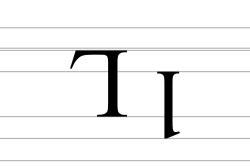
Turned L (Ꞁ ꞁ) is an additional letter which was used in medieval Welsh and in certain phonetic transcriptions used in German dialectology. Its capital form is also homoglyphic with the letter reversed ge.
Usage
Turned L is used by William Pryce in his Cornish grammar Archæologia Cornu-Britannica published in 1790. It represents the voiceless alveolar lateral fricative /ɬ/ used in Welsh. In this work, Pryce also used the additional letters turned A ⟨Ɐ ɐ⟩, Chi ⟨Χ χ⟩, Insular D ⟨Ꝺ ꝺ⟩, Insular G ⟨Ᵹ ᵹ⟩, turned Insular G ⟨Ꝿ ꝿ⟩, and Insular T ⟨Ꞇ ꞇ⟩.
In German dialectology, in 1922, Walter Steinhauser uses turned l ⟨ꞁ⟩ to represent middle Bavarian l (donaubairische l), a palatal consonant.12
Forms and variants
-
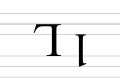 Form with the lowercase under the baseline.
 -
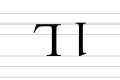 Form with the lowercase above the baseline.
Computing codes
Turned L can be represented with the following Unicode characters (Latin Extended-D):
| Preview | Ꞁ | ꞁ | ||
|---|---|---|---|---|
| Unicode name | LATIN CAPITAL LETTER TURNED L | LATIN SMALL LETTER TURNED L | ||
| Encodings | decimal | hex | dec | hex |
| Unicode | 42880 | U+A780 | 42881 | U+A781 |
| UTF-8 | 234 158 128 | EA 9E 80 | 234 158 129 | EA 9E 81 |
| Numeric character reference | Ꞁ |
Ꞁ |
ꞁ |
ꞁ |
Notes and references
- Steinhauser 1922, p. 12.
- Heepe 1928, p. 38.
Bibliography
- Everson, Michael (2006). Proposal to add Latin letters and a Greek symbol to the UCS (PDF).
- Heepe, Martin (1928). Lautzeichen und ihre Anwendung in verschiedenen Sprachgebieten (in German). Berlin: Reichsdruckerei.
- Pryce, William (1790). Archæologia Cornu-Britannica, or, an Essay to Preserve the Ancient Cornish Language. Sherborne: W. Cruttwell.
- Steinhauser, Walter (1922). Beiträge zur Kunde der bairisch-österreichischen Mundarten, herausgegeben von der Wörterbuch Kommission der Akademie. II. Heft: 1. Textproben. 2. Wortkundliches (in German). Vienne: Hölder-Pichler-Tempsky.