| Turkish Sign Language | |
|---|---|
| Türk İşaret Dili | |
| Native to | Turkey, Northern Cyprus |
| Signers | 250,000 (2021)1 |
Early form | Possibly from Ottoman Sign Language
|
| Language codes | |
| ISO 639-3 | tsm |
| Glottolog | turk1288 |
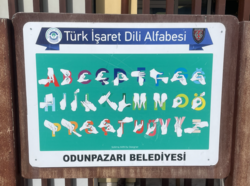
Turkish Sign Language (Turkish: Türk İşaret Dili, TİD) is the language used by the deaf community in Turkey. As with other sign languages, TİD has a unique grammar that is different from the oral languages used in the region.
TİD uses a two-handed manual alphabet which is very different from the two-handed alphabets used in the BANZSL sign languages. It also uses the tongue in certain phrases.
Grammar
There is little published information on Turkish Sign Language. Turkish Sign Language exhibits a subject-object-verb order (SOV). There is a rich set of modal verbs which appear in a clause-final position.2
Signing communities
As an estimate of the size of the TiD’s community, there are a total of 89,000 people (54,000 male, 35,000 female) with hearing impairment and 55,000 people (35,000 male, 21,000 female) with speaking disability living in Turkey, according to the Turkish Statistical Institute based on year 2000 census data.3
History
TİD is dissimilar from European sign languages. There was a court sign language of the Ottoman Empire, which reached its height in the 16th century and 17th centuries and lasted at least until the early 20th.4 However, there is no record of the signs themselves and no evidence the language was ancestral to modern Turkish Sign Language.5
Deaf schools were established in 1902, and until 1953 used TİD alongside the Turkish spoken and written language in education.6 Since 1953 Turkey has adopted an oralist approach to deaf education.
References
References
- Turkish Sign Language at Ethnologue (25th ed., 2022)

- Karabüklü, Serpil; Bross, Fabian; Wilbur, Ronnie B.; Hole, Daniel (2018). "Modal signs and scope relations in TID". Formal and Experimental Advances in Sign Language Theory. 2: 82–92. doi:10.31009/FEAST.i2.07. PMC 12330788.
- Türkiye İstatistik Kurumu, Nüfus, Konut ve Demografi Verileri 2000
- Miles, M. (2000). "Signing in the Seraglio: Mutes, dwarfs and jestures at the Ottoman Court 1500-1700". Disability & Society. 15 (1): 115–134. doi:10.1080/09687590025801. S2CID 145331019.
- Turkish Sign Language (TİD) General Info Archived 2012-04-15 at the Wayback Machine, Dr. Aslı Özyürek, Koç University website, accessed 2011-10-06
- Deringil, S. (2002). İktidarın Sembolleri ve İdeoloji: II. Abdülhamid Dönemi (1876–1909), YKY, İstanbul, 249.
External links
External links
- Turkish Sign Language (Turkish and English) Website including dictionary and general information, by the Turkish Academy of Sciences and Koç University
- Turkish National Deaf Federation homepage (Turkish and English).