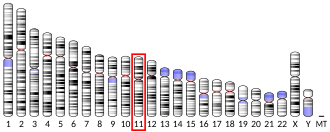
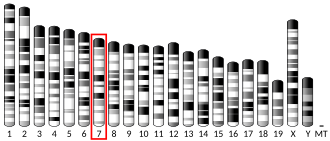
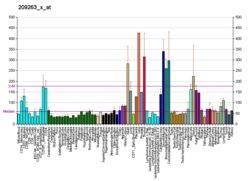
Tetraspanin-4 is a protein that in humans is encoded by the TSPAN4 gene.56
The protein encoded by this gene is a member of the transmembrane 4 superfamily, also known as the tetraspanin family. Most of these members are cell-surface proteins that are characterized by the presence of four hydrophobic domains. The proteins mediate signal transduction events that play a role in the regulation of cell development, activation, growth and motility. This encoded protein is a cell surface glycoprotein and is similar in sequence to its family member CD53 antigen. It is known to complex with integrins and other transmembrane 4 superfamily proteins. Alternatively spliced transcript variants encoding different isoforms have been identified.6
Interactions
TSPAN4 has been shown to interact with CD9,5 ITGA6,5 CD29,5 CD49c5 and CD81.5
References
References
Further reading
Further reading
- Berditchevski F (2002). "Complexes of tetraspanins with integrins: more than meets the eye". J. Cell Sci. 114 (Pt 23): 4143–51. doi:10.1242/jcs.114.23.4143. PMID 11739647.
- Todd SC, Doctor VS, Levy S (1998). "Sequences and expression of six new members of the tetraspanin/TM4SF family". Biochim. Biophys. Acta. 1399 (1): 101–4. doi:10.1016/s0167-4781(98)00087-6. PMID 9714763.
- Serru V, Le Naour F, Billard M, et al. (1999). "Selective tetraspan-integrin complexes (CD81/alpha4beta1, CD151/alpha3beta1, CD151/alpha6beta1) under conditions disrupting tetraspan interactions". Biochem. J. 340 (1): 103–11. doi:10.1042/0264-6021:3400103. PMC 1220227. PMID 10229664.
- Yauch RL, Kazarov AR, Desai B, et al. (2000). "Direct extracellular contact between integrin alpha(3)beta(1) and TM4SF protein CD151". J. Biol. Chem. 275 (13): 9230–8. doi:10.1074/jbc.275.13.9230. PMID 10734060.
- Lozahic S, Christiansen D, Manié S, et al. (2000). "CD46 (membrane cofactor protein) associates with multiple beta1 integrins and tetraspans". Eur. J. Immunol. 30 (3): 900–7. doi:10.1002/1521-4141(200003)30:3<900::AID-IMMU900>3.0.CO;2-X. PMID 10741407.
- Suzuki H, Fukunishi Y, Kagawa I, et al. (2001). "Protein-protein interaction panel using mouse full-length cDNAs". Genome Res. 11 (10): 1758–65. doi:10.1101/gr.180101. PMC 311163. PMID 11591653.
- Strausberg RL, Feingold EA, Grouse LH, et al. (2003). "Generation and initial analysis of more than 15,000 full-length human and mouse cDNA sequences". Proc. Natl. Acad. Sci. U.S.A. 99 (26): 16899–903. Bibcode:2002PNAS...9916899M. doi:10.1073/pnas.242603899. PMC 139241. PMID 12477932.
- Clark AG, Glanowski S, Nielsen R, et al. (2003). "Inferring nonneutral evolution from human-chimp-mouse orthologous gene trios". Science. 302 (5652): 1960–3. Bibcode:2003Sci...302.1960C. doi:10.1126/science.1088821. PMID 14671302. S2CID 6682593.
- Ota T, Suzuki Y, Nishikawa T, et al. (2004). "Complete sequencing and characterization of 21,243 full-length human cDNAs". Nat. Genet. 36 (1): 40–5. doi:10.1038/ng1285. PMID 14702039.
- Gerhard DS, Wagner L, Feingold EA, et al. (2004). "The status, quality, and expansion of the NIH full-length cDNA project: the Mammalian Gene Collection (MGC)". Genome Res. 14 (10B): 2121–7. doi:10.1101/gr.2596504. PMC 528928. PMID 15489334.
- Rual JF, Venkatesan K, Hao T, et al. (2005). "Towards a proteome-scale map of the human protein-protein interaction network". Nature. 437 (7062): 1173–8. Bibcode:2005Natur.437.1173R. doi:10.1038/nature04209. PMID 16189514. S2CID 4427026.
- Oh JH, Yang JO, Hahn Y, et al. (2006). "Transcriptome analysis of human gastric cancer". Mamm. Genome. 16 (12): 942–54. doi:10.1007/s00335-005-0075-2. PMID 16341674. S2CID 69278.