| Trithuria submersa | |
|---|---|
| |
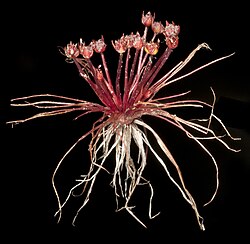
| Complete flowering Trithuria submersa specimen | |
Scientific classification 
| |
| Kingdom: | Plantae |
| Clade: | Embryophytes |
| Clade: | Tracheophytes |
| Clade: | Spermatophytes |
| Clade: | Angiosperms |
| Order: | Nymphaeales |
| Family: | Hydatellaceae |
| Genus: | Trithuria |
| Section: | Trithuria sect. Trithuria |
| Species: | T. submersa
|
| Binomial name | |
| Trithuria submersa | |
| |
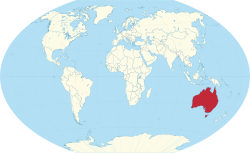
| Trithuria submersa is endemic to Australia1 | |
| Synonyms1 | |
|
Juncella submersa (Hook.f.) Hieron. | |
Trithuria submersa is a species of plant in the family Hydatellaceae endemic to the Australian states New South Wales, South Australia, Tasmania, Victoria, and Western Australia.1
Description
Vegetative characteristics
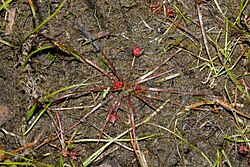
It is a 8 cm tall, and 2-5 cm wide,2 annual herb with glabrous, red, 15–403(–50)4 mm long, and up to 1 mm wide leaves3 and fibrous roots.5 Individuals growing submerged in water are slender and green in colour.2
Generative characteristics
It is a monoecious species6 with emergent, bisexual reproductive units ("flowers").7 The several 2–3 mm wide reproductive units5 consist of (5–)10–32(–40) mm long stalks,4 (2–)4–88 ovate to lanceolate, 2–4 mm long bracts, 10–20(–35) carpels5 with 3-6 stigmatic hairs,92 and 2–4 central stamens with 2 mm long red filaments and purple anthers,5 which are 0.6 mm long.9 The three-ribbed,59 obovoid, 0.5–0.8 mm long fruit5 bears sculptured,8 brown, 0.5 mm long, and 0.3 mm wide seeds.9 It is a self-pollinating species.7 Flowering and fruiting occurs from September to January.10 Seed germination occurs in winter, once the seasonally dry habitat becomes wet.11
Cytology
The diploid chromosome count is 2n = 56.12
Taxonomy
It was published by Joseph Dalton Hooker in 1858.1 The lectotype was collected by R.C. Gunn in Macquarie River, Tasmania, Australia on the 6th of November 1845. It is the type species of its genus.8 It is placed in Trithuria sect. Trithuria.1314
Etymology
The specific epithet submersa, meaning "underwater", refers to the species aquatic habitat.9
Distribution
It is endemic to the Australian states New South Wales, South Australia, Tasmania, Victoria, and Western Australia.1
Conservation
Under the Threatened Species Protection Act 1995, it is classified as rare.15
Ecology
It occurs in temporary pools, at the edge of streams, and seasonal swamps.6
References
References
- "Trithuria submersa Hook.f." Plants of the World Online. Royal Botanic Gardens, Kew. Retrieved 12 November 2024.
- D.A.Cooke. Trithuria submersa, in (ed.), Flora of Australia. Australian Biological Resources Study, Department of Climate Change, Energy, the Environment and Water: Canberra. https://profiles.ala.org.au/opus/foa/profile/Trithuria%20submersa [Date Accessed: 13 November 2024]
- Royal Botanic Gardens and Domain Trust, Sydney. (n.d.). Trithuria submersa Hook.f. PlantNET (the NSW Plant Information Network System). Retrieved November 12, 2024, from https://plantnet.rbgsyd.nsw.gov.au/cgi-bin/NSWfl.pl?page=nswfl&lvl=sp&name=Trithuria~submersa
- Royal Botanic Gardens Victoria. (2014, January 25). Trithuria submersa Hook.f. VicFlora Flora of Victoria. Retrieved November 12, 2024, from https://vicflora.rbg.vic.gov.au/flora/taxon/4b0fcf12-f7e0-4caa-9529-50b0f77be40c
- Duretto MF (2011) 1 Hydatellaceae, 2011:1. In MF Duretto (Ed.) Flora of Tasmania Online. 4 pp. (Tasmanian Herbarium, Tasmanian Museum & Art Gallery: Hobart). www.tmag.tas.gov.au/floratasmania
- Western Australian Herbarium & Department of Biodiversity, Conservation and Attractions. (n.d.-c). Trithuria submersa Hook.f. Florabase—the Western Australian Flora. Retrieved November 12, 2024, from https://florabase.dbca.wa.gov.au/browse/profile/1141
- Taylor, M. L., Macfarlane, T. D., & Williams, J. H. (2010). Reproductive ecology of the basal angiosperm Trithuria submersa (Hydatellaceae). Annals of Botany, 106(6), 909-920.
- Sokoloff, D. D., Remizowa, M. V., Macfarlane, T. D., & Rudall, P. J. (2008). Classification of the early‐divergent angiosperm family Hydatellaceae: One genus instead of two, four new species and sexual dimorphism in dioecious taxa. Taxon, 57(1), 179-200.
- Government of South Australia Department for Environment and Water & Botanic Gardens of South Australia. (n.d.). Trithuria submersa (Hydatellaceae). Seeds of South Australia. Retrieved November 12, 2024, from https://spapps.environment.sa.gov.au/SeedsOfSA/speciesinformation.html?rid=4619
- Trithuria submersa Hook.f. (n.d.). Atlas of Living Australia. Retrieved November 12, 2024, from https://bie.ala.org.au/species/https://id.biodiversity.org.au/node/apni/7022449
- Moschin, S., Nigris, S., Offer, E., Babolin, N., Chiappetta, A., Bruno, L., & Baldan, B. (2024). Reproductive development in Trithuria submersa (Hydatellaceae: Nymphaeales): the involvement of AGAMOUS-like genes. Planta, 260(5), 1-13.
- Kynast, R. G., Joseph, J. A., Pellicer, J., Ramsay, M. M., & Rudall, P. J. (2014). Chromosome behavior at the base of the angiosperm radiation: Karyology of Trithuria submersa (Hydatellaceae, Nymphaeales). American Journal of Botany, 101(9), 1447–1455. http://www.jstor.org/stable/43826701
- Sokoloff, D. D., Remizowa, M. V., Macfarlane, T. D., Conran, J. G., Yadav, S. R., & Rudall, P. J. (2013). Comparative fruit structure in Hydatellaceae (Nymphaeales) reveals specialized pericarp dehiscence in some early–divergent angiosperms with ascidiate carpels. Taxon, 62(1), 40-61.
- Iles, W. J., Rudall, P. J., Sokoloff, D. D., Remizowa, M. V., Macfarlane, T. D., Logacheva, M. D., & Graham, S. W. (2012). Molecular phylogenetics of Hydatellaceae (Nymphaeales): Sexual‐system homoplasy and a new sectional classification. American Journal of Botany, 99(4), 663-676.
- Threatened Species Section (2024). submerged watertuft (Trithuria submersa): Species Management Profile for Tasmania's Threatened Species Link. Department of Natural Resources and Environment Tasmania. Accessed on 12/11/2024.