| Ayurvedic terminology | |
| Sanskrit | त्रिफला (triphala) |
|---|---|
| Hindi | त्रिफला |
| Literal meaning | Three fruits |
| Traditional Chinese | 三勒漿 | ||||||||
|---|---|---|---|---|---|---|---|---|---|
| Simplified Chinese | 三勒浆 | ||||||||
| Literal meaning | Three Myrobalan Juice | ||||||||
| |||||||||
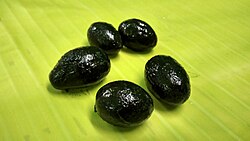
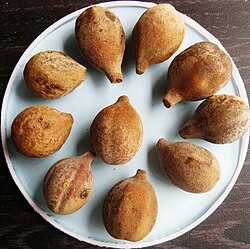
Triphala (Hindi: त्रिफला; Sanskrit: त्रिफला, triphalā, "three fruits") is a polyherbal Ayurvedic formulation, specifically a churna or powder, a kwatha or decoction1 or infusion produced from chebulic myrobalan (Sanskrit: हरीतकी, harītakī; Hindi: हरीतकी, haritaki), beleric myrobalan (Sanskrit: विभीतकी, vibhītakī; Hindi: बिभीतकी, bibhitaki), and emblic myrobalan (Sanskrit: आमलकी, āmalakī; Hindi: आँवला, ā̃vlā). Containing vitamin C, it is considered an Ayurvedic rasayana formula when the dried and powdered fruit are prepared in a 1:1:12 or 1:2:3 ratio.3 It is one of the most common Ayurvedic treatments in the world because of its ability to balance all three "doshas" simultaneously.2 Less prominently, as sanlejiang, the drink has a 1200-year history as a kind of fruit wine in China4 with the non-alcoholic form now being marketed there as a traditional herbal remedy.5

History
The Charaka Samhita6 as we know today is from 1st century CE finds earliest records of Triphala. According to Charak, taking the Triphala Rasayana (Triphala with honey and ghee) daily has the potential to make a person live for one hundred years devoid of old age and diseases.7 Sushruta Samhita7 from 6th century CE8 and Bhavaprakasha Nighantu from 16th CE9 also mention triphala repeatedly.
The earliest record of triphala in China is Li Zhao's c. 820 Supplement to the Book of Tang (Tangguoshi Bu), which lists it in a section on domestic and foreign alcohol available in the Tang capital Chang'an.4 It states the Chinese formulation was based on a recipe from Persia.4 One such recipe is included in Han E's mid- or late-Tang Summary of the Four Seasons (《四時纂要》, Sì Shí Zuǎnyào), first published in 996: pulverize 3 liang (about 120 grams or 4 ounces) of the pits of each of the 3 fruits to a sesame seed consistency; thoroughly mix 1 dou (about 2 liters or 0.5 U.S. gallons) of clear honey with 2 dou of fresh clear water before adding the pulverized seeds; seal tightly with clean paper; open, stir, remove internal condensation, and reseal to allow fermentation to proceed; and reopen and consume after thirty days.10 Han praised the sweet resulting wine as a digestif, deflatulent, and mild laxative.11 The Ming-era encyclopedist Gao Lian copied much of this in his Eight Treatises on Nurturing Life (《遵生八笺》, Zūnshēng Bā Jiān) but emended the recipe to use 3 liang total in the mixture.11 Commenters varied as to whether preparation in the 8th or 9th lunar month (normally September or October) produced the best results.12
Research and pharmacology
The phytochemical composition of Triphala includes bioactive compounds such as gallic acid, chebulagic acid, ellagic acid, flavonoids, and tannins. Scientific research has investigated the synergistic interaction of its constituent herbs such as Emblica officinalis, Terminalia bellerica, and Terminalia chebula for potential antioxidant, antimicrobial, and anti-inflammatory properties.13
While it is traditionally used in Ayurveda for various metabolic and gastrointestinal conditions, the specific molecular mechanisms and clinical applications of Triphala remain under active investigation. The preclinical studies have explored its potential effects on glucose metabolism, lipid profiles, and oxidative stress, though its large-scale clinical trials are required to validate its efficacy in evidence-based medicine. With current pharmacological research is focused on standardizing Triphala formulations, understanding its pharmacokinetics and bioavailability, and determining optimal dosages. Researchers are also investigating advanced drug delivery systems, such as nanoparticle-based formulations, alongside toxicological studies to assess safety profiles and potential herb-drug interactions.13
References
References
Citations
- Chen (2021), p. 1.
- O'Mathuna (2011).
- Parveen & al. (2018).
- Chen (2021), p. 3.
- Chen (2021), p. 2.
- Bairwa, Vinay Kumar (2025). "Triphala's characteristics and potential therapeutic uses in modern health" (PDF). International Journal of Physiology, Pathophysiology and Pharmacology. 17 (2): 19–36. doi:10.62347/OBSS5026. PMC 12089839. PMID 40401115.
- Peterson, Christine Tara; Denniston, Kate; Chopra, Deepak (August 2017). "Therapeutic Uses of Triphala in Ayurvedic Medicine". Journal of Alternative and Complementary Medicine (New York, N.Y.). 23 (8): 607–614. doi:10.1089/acm.2017.0083. ISSN 1557-7708. PMC 5567597. PMID 28696777.
- Meulenbeld, G. Jan (1999). A History of Indian Medical Literature. Vol. IA. Egbert Forsten. pp. 333 to 357. ISBN 9789069801247. The formation of the Sushruta Samhita may have begun in the last centuries BCE and was completed in its presently surviving form by another author which is Dalhana commentary in the early centuries CE.
- Rajagopala, Manjusha; B K, Dhanisha (31 January 2023). "A narrative review of Triphala (fruits of three myrobalans) in ophthalmology" (PDF). Annals of Ayurvedic Medicine. 12 (1): 56–68.
- Chen (2021), pp. 4–5.
- Chen (2021), p. 5.
- Chen (2021), p. 6.
- Bairwa, Vinay Kumar (2025). "Triphala’s characteristics and potential therapeutic uses in modern health" (PDF). International Journal of Physiology, Pathophysiology and Pharmacology. 17 (2): 19–36. doi:10.62347/OBSS5026.
Bibliography
- Ming Chen (2021), "'Method from Persia': Study of the Origins of the 'Three Myrobalan Decoction'" (PDF), Hualin International Journal of Buddhist Studies, vol. 4, pp. 1–78.
- O'Mathuna, Donal (12 April 2011), "Does It Work? Can Triphala Act as an Antimicrobial?", Irish Times
- Parveen, Romana; et al. (March 2018), "Phytochemical Analysis and In-Vitro Biochemical Characterization of Aqueous and Methanolic Extract of Triphala, a Conventional Herbal Remedy", Biotechnology Reports, vol. 17, Elsevier, pp. 126–136, doi:10.1016/j.btre.2018.02.003, PMC 5881245, PMID 29619331.