| Trioctagonal tiling | |
|---|---|
 Poincaré disk model of the hyperbolic plane | |
| Type | Hyperbolic uniform tiling |
| Vertex configuration | (3.8)2 |
| Schläfli symbol | r{8,3} or |
| Wythoff symbol | 2 | 8 3| 3 3 | 4 |
| Coxeter diagram |     or or     
|
| Symmetry group | [8,3], (*832) [(4,3,3)], (*433) |
| Dual | Order-8-3 rhombille tiling |
| Properties | Vertex-transitive edge-transitive |
In geometry, the trioctagonal tiling is a semiregular tiling of the hyperbolic plane, representing a rectified Order-3 octagonal tiling. There are two triangles and two octagons alternating on each vertex. It has Schläfli symbol of r{8,3}.
Symmetry
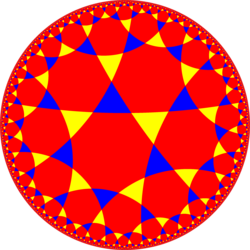 The half symmetry [1+,8,3] = [(4,3,3)] can be shown with alternating two colors of triangles, by Coxeter diagram .
|
 Dual tiling |
Related polyhedra and tilings
From a Wythoff construction there are eight hyperbolic uniform tilings that can be based from the regular octagonal tiling.
Drawing the tiles colored as red on the original faces, yellow at the original vertices, and blue along the original edges, there are 8 forms.
| Uniform octagonal/triangular tilings | |||||||||||||
|---|---|---|---|---|---|---|---|---|---|---|---|---|---|
| Symmetry: [8,3], (*832) | [8,3]+ (832) |
[1+,8,3] (*443) |
[8,3+] (3*4) | ||||||||||
| {8,3} | t{8,3} | r{8,3} | t{3,8} | {3,8} | rr{8,3} s2{3,8} |
tr{8,3} | sr{8,3} | h{8,3} | h2{8,3} | s{3,8} | |||
|
|
|
|
|
|
|
|

|
| |||||

|
|

|
|
  or or 
|
or
|

| |||||||

|

|
 
|
 
|
 
|

|

|

|
 
|
 
|
 
| |||
| Uniform duals | |||||||||||||
| V83 | V3.16.16 | V3.8.3.8 | V6.6.8 | V38 | V3.4.8.4 | V4.6.16 | V34.8 | V(3.4)3 | V8.6.6 | V35.4 | |||

|
|
|
|
|
|
|

|
|
|
| |||
|
|

|

|

|
|

|

|

|

|

|

| |||
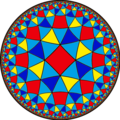
It can also be generated from the (4 3 3) hyperbolic tilings:
| Symmetry: [(4,3,3)], (*433) | [(4,3,3)]+, (433) | |||||||||
|---|---|---|---|---|---|---|---|---|---|---|
|
|
|
|
|
|
|
|
| |||
|
|
|
|
|
|
|
|
| |||

|

|

|

|

|

|

|
| |||
| h{8,3} t0(4,3,3) |
r{3,8}1/2 t0,1(4,3,3) |
h{8,3} t1(4,3,3) |
h2{8,3} t1,2(4,3,3) |
{3,8}1/2 t2(4,3,3) |
h2{8,3} t0,2(4,3,3) |
t{3,8}1/2 t0,1,2(4,3,3) |
s{3,8}1/2 s(4,3,3) | |||
| Uniform duals | ||||||||||

|

|
|

|

|
|

|

| |||
| V(3.4)3 | V3.8.3.8 | V(3.4)3 | V3.6.4.6 | V(3.3)4 | V3.6.4.6 | V6.6.8 | V3.3.3.3.3.4 | |||
The trioctagonal tiling can be seen in a sequence of quasiregular polyhedrons and tilings:
| Quasiregular tilings: (3.n)2 | ||||||||||||
|---|---|---|---|---|---|---|---|---|---|---|---|---|
| Sym. *n32 [n,3] |
Spherical | Euclid. | Compact hyperb. | Paraco. | Noncompact hyperbolic | |||||||
| *332 [3,3] Td |
*432 [4,3] Oh |
*532 [5,3] Ih |
*632 [6,3] p6m |
*732 [7,3] |
*832 [8,3]... |
*∞32 [∞,3] |
[12i,3] | [9i,3] | [6i,3] | |||
Figure
|

|

|

|

|

|

|

|

|

|

| ||
Figure
|

|

|

|

|
||||||||
| Vertex | (3.3)2 | (3.4)2 | (3.5)2 | (3.6)2 | (3.7)2 | (3.8)2 | (3.∞)2 | (3.12i)2 | (3.9i)2 | (3.6i)2 | ||
| Schläfli | r{3,3} | r{3,4} | r{3,5} | r{3,6} | r{3,7} | r{3,8} | r{3,∞} | r{3,12i} | r{3,9i} | r{3,6i} | ||
Coxeter 
|
|

|

|

|

|
|

|

| ||||

|
|
|

|
|||||||||
| Dual uniform figures | ||||||||||||
| Dual conf. |
 V(3.3)2 |
 V(3.4)2 |
 V(3.5)2 |
 V(3.6)2 |
 V(3.7)2 |
 V(3.8)2 |
 V(3.∞)2 |
|||||
| Dimensional family of quasiregular polyhedra and tilings: (8.n)2 | |||||||||||
|---|---|---|---|---|---|---|---|---|---|---|---|
| Symmetry *8n2 [n,8] |
Hyperbolic... | Paracompact | Noncompact | ||||||||
| *832 [3,8] |
*842 [4,8] |
*852 [5,8] |
*862 [6,8] |
*872 [7,8] |
*882 [8,8]... |
*∞82 [∞,8] |
[iπ/λ,8] | ||||
| Coxeter |
|
|
|
|
|
|
|
| |||
| Quasiregular figures configuration |
3.8.3.8 |
 4.8.4.8 |
 8.5.8.5 |
 8.6.8.6 |
 8.7.8.7 |
 8.8.8.8 |
 8.∞.8.∞ |
 |||
See also
See also
- Trihexagonal tiling - 3.6.3.6 tiling
- Rhombille tiling - dual V3.6.3.6 tiling
- Tilings of regular polygons
- List of uniform tilings
References
References
- John H. Conway, Heidi Burgiel, Chaim Goodman-Strauss, The Symmetries of Things 2008, ISBN 978-1-56881-220-5 (Chapter 19, The Hyperbolic Archimedean Tessellations)
- "Chapter 10: Regular honeycombs in hyperbolic space". The Beauty of Geometry: Twelve Essays. Dover Publications. 1999. ISBN 0-486-40919-8. LCCN 99035678.
External links
External links
- Weisstein, Eric W. "Hyperbolic tiling". MathWorld.
- Weisstein, Eric W. "Poincaré hyperbolic disk". MathWorld.
- Hyperbolic and Spherical Tiling Gallery
- KaleidoTile 3: Educational software to create spherical, planar and hyperbolic tilings
- Hyperbolic Planar Tessellations, Don Hatch