| Trachypithecus | |
|---|---|

| |
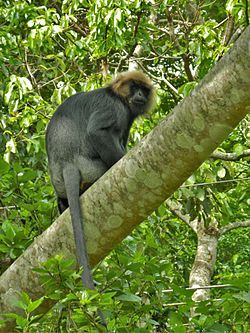
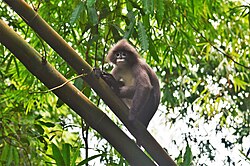
| Dusky leaf monkey (Trachypithecus obscurus) | |
Scientific classification 
| |
| Kingdom: | Animalia |
| Phylum: | Chordata |
| Class: | Mammalia |
| Infraclass: | Placentalia |
| Order: | Primates |
| Family: | Cercopithecidae |
| Subfamily: | Colobinae |
| Tribe: | Presbytini |
| Genus: | Trachypithecus Reichenbach, 1862 |
| Type species | |
| Semnopithecus pyrrhus1 | |
| Species | |
|
16, see text | |
Trachypithecus is a genus of Old World monkeys containing species known as lutungs, langurs, or leaf monkeys. Their range is much of Southeast Asia (northeast India, Vietnam, southern China, Borneo, Thailand, Java, and Bali).
The name "lutung" comes from the Sundanese language meaning "blackness", ultimately from Proto-Austronesian *luCuŋ (which originally referred to the Formosan rock macaque);2 it is preferred in one paper because the authors wanted the name langurs to only refer to monkeys in the genus Semnopithecus,3 although some "lutungs" are now "langurs" again.456 The scientific name of the genus comes from the Ancient Greek τραχύς (trakhús), meaning "rough", and πίθηκος (píthēkos), meaning "monkey".
Evolution

Genetic analysis indicates that the ancestors of the modern species of lutung first differentiated from one another a little over 3 million years ago, during the late Pliocene. The various species alive today then diverged during the Pleistocene, presumably driven by habitat changes during the Ice Ages.7 The oldest fossils clearly identified as belonging to the genus date from the middle Pleistocene of Vietnam and Laos; later fossils are also known from Thailand, Java, and Sumatra. The closest living relatives of the lutungs are probably either the gray langurs or the surilis, although the exact relationships remain unclear, possibly due to hybridisation between these genera during the course of their recent evolutionary history.3
Taxonomy
As of 2005, the authors of Mammal Species of the World recognized the following Trachypithecus species:8
- Genus Semnopithecus
- formerly T. vetulus group - moved into genus Semnopithecus in most recent classifications9
- Purple-faced langur, Semnopithecus vetulus
- Nilgiri langur, Semnopithecus johnii
- formerly T. vetulus group - moved into genus Semnopithecus in most recent classifications9
- Genus Trachypithecus
- T. cristatus group
- Javan lutung, Trachypithecus auratus
- Silvery lutung, silvery langur or silvered leaf monkey, Trachypithecus cristatus, but also used for T. germaini
- Indochinese lutung or Germain's langur, Trachypithecus germaini
- Tenasserim lutung, Trachypithecus barbei
- T. obscurus group
- Dusky leaf monkey, Trachypithecus obscurus
- Phayre's leaf monkey, Trachypithecus phayrei
- T. pileatus group
- Capped langur, Trachypithecus pileatus
- Shortridge's langur, Trachypithecus shortridgei
- Gee's golden langur, Trachypithecus geei
- T. francoisi group
- Francois' langur, Trachypithecus francoisi
- Hatinh langur, Trachypithecus hatinhensis
- White-headed langur, Trachypithecus poliocephalus
- Laotian langur, Trachypithecus laotum
- Delacour's langur, Trachypithecus delacouri
- Indochinese black langur, Trachypithecus ebenus
- T. cristatus group
Since then, the T. vetulus group (the purple-faced langur and the Nilgiri langur) have been moved the genus Semnopithecus based on DNA and other evidence.41011121314
In 2008, Roos et al. described the Malay Peninsula form of the silvery lutung as a separate subspecies and subsequently it has been elevated to a separate species within the T. cristatus group as the Selangor silvered langur, T. selangorensis.1015 Roos et al. also elevated the West Javan Langur, Trachypithecus mauritius, and Annamese Langur, Trachypithecus margarita, to species status (formerly subspecies of T. auratus and T. germaini, respectively).1015 In 2020, Roos et al. discovered a new species, Popa langur (T. popa), which is found only in Myanmar.16 Lastly, the White-headed langur (T. leucocephalus), previously thought to be a subspecies of the Francois langur (T. Francois) or Cat Ba langur (T. poliocephalus), is currently recognized as a distinct species by IUCN Red List assessors and the American Society of Mammalogists, based on a 2007 paper by Groves.171819
This leaves the current understanding of the genus Trachypithecus to be:
| Common name | Scientific name and subspecies | Range | Size and ecology | IUCN status and estimated population |
|---|---|---|---|---|
| Annamese langur
|
T. margarita (Elliot, 1909) |
Southeastern Asia
|
Size: 40–76 cm (16–30 in) long, plus 57–110 cm (22–43 in) tail20 Habitat: Forest21 Diet: Leaves, flowers, and fruit20 |
EN
|
| Capped langur
|
T. pileatus (Blyth, 1843) Three subspecies
|
Southern Asia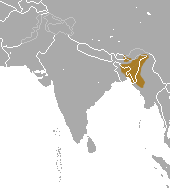
|
Size: 40–76 cm (16–30 in) long, plus 57–110 cm (22–43 in) tail20 Habitat: Forest22 Diet: Leaves, seeds, and fruit, as well as flowers, buds, bark, and caterpillars22 |
VU
|
| Cat Ba langur
|
T. poliocephalus (Pousargues, 1898) |
Cát Bà Island, Vietnam (in purple)
|
Size: 40–76 cm (16–30 in) long, plus 57–110 cm (22–43 in) tail20 Habitat: Forests and caves23 Diet: Leaves, flowers, and fruit20 |
CR
|
| Delacour's langur
|
T. delacouri (Osgood, 1911) |
Northern Vietnam
|
Size: 40–76 cm (16–30 in) long, plus 57–110 cm (22–43 in) tail20 Habitat: Forest, rocky areas, and caves24 Diet: Leaves, flowers, and fruit20 |
CR
|
| Dusky leaf monkey
|
T. obscurus (Reid, 1837) Seven subspecies
|
Southeastern Asia
|
Size: 42–61 cm (17–24 in) long, plus 50–85 cm (20–33 in) tail25 Habitat: Forest26 Diet: Leaves, shoots, fruit, and seedlings25 |
EN
|
| East Javan langur
|
T. auratus (É. Geoffroy, 1812) |
Java and nearby islands in Indonesia
|
Size: 44–65 cm (17–26 in) long, plus 61–87 cm (24–34 in) tail27 Habitat: Forest28 Diet: Leaves and flowers, as well as fruit and insect larvae27 |
VU
|
| François' langur
|
T. francoisi (Pousargues, 1898) |
Southern Asia
|
Size: 40–76 cm (16–30 in) long, plus 57–110 cm (22–43 in) tail20 Habitat: Forest, rocky areas, and caves29 Diet: Leaves, fruit, and seeds, as well as insects30 |
EN
|
| Gee's golden langur
|
T. geei (Khajuria, 1956) |
Southern Asia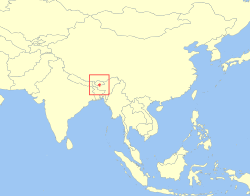
|
Size: 50–75 cm (20–30 in) long, plus 70–100 cm (28–39 in) tail31 Habitat: Forest32 Diet: Fruit, leaves, flowers, seeds, and twigs31 |
EN
|
| Germain's langur
|
T. germaini (A. Milne-Edwards, 1876) |
Southeastern Asia
|
Size: 40–76 cm (16–30 in) long, plus 57–110 cm (22–43 in) tail20 Habitat: Forest and rocky areas33 Diet: Leaves, fruit, and flowers33 |
EN
|
| Hatinh langur
|
T. hatinhensis (Dao, 1970) |
Vietnam
|
Size: 40–76 cm (16–30 in) long, plus 57–110 cm (22–43 in) tail20 Habitat: Forest, rocky areas, and caves34 Diet: Leaves, as well as fruit, vines, and flowers34 |
EN
|
| Indochinese black langur | T. ebenus (Brandon-Jones, 1995) |
Southeastern Asia | Size: 40–76 cm (16–30 in) long, plus 57–110 cm (22–43 in) tail20 Habitat: Forest, rocky areas, and caves34 Diet: Leaves, as well as fruit, vines, and flowers34 |
EN
|
| Indochinese grey langur
|
T. crepuscula (Elliot, 1909) |
Southeast Asia (in red)
|
Size: 40–76 cm (16–30 in) long, plus 57–110 cm (22–43 in) tail20 Habitat: Forest, inland wetlands, and rocky areas35 Diet: Leaves, flowers, and fruit20 |
EN
|
| Laotian langur
|
T. laotum (Thomas, 1911) |
Laos
|
Size: 40–76 cm (16–30 in) long, plus 57–110 cm (22–43 in) tail20 Habitat: Forest and rocky areas36 Diet: Leaves, flowers, and fruit20 |
EN
|
| Phayre's leaf monkey
|
T. phayrei (Blyth, 1847) Two subspecies
|
Southeast Asia (in green)
|
Size: 40–76 cm (16–30 in) long, plus 57–110 cm (22–43 in) tail20 Habitat: Forest37 Diet: Leaves, as well as bamboo shoots38 |
EN
|
| Popa langur | T. popa Roos et al., 2020 |
Myanmar
|
Size: 40–76 cm (16–30 in) long, plus 57–110 cm (22–43 in) tail20 Habitat: Forest39 Diet: Leaves, flowers, and fruit20 |
CR
|
| Shortridge's langur
|
T. shortridgei (Wroughton, 1915) |
Southern Asia
|
Size: 40–76 cm (16–30 in) long, plus 57–110 cm (22–43 in) tail20 Habitat: Forest40 Diet: Leaves, flowers, and fruit20 |
EN
|
| Selangor silvered langur
|
T. selangorensis Roos, Nadler, Walter, 2008 |
Peninsular Malaysia | Size: 40–76 cm (16–30 in) long, plus 57–110 cm (22–43 in) tail20 Habitat: Forest41 Diet: Leaves, flowers, and fruit20 |
NT
|
| Silvery lutung
|
T. cristatus (Raffles, 1821) Two subspecies
|
Southeastern Asia
|
Size: 46–56 cm (18–22 in) long, plus 63–84 cm (25–33 in) tail42 Habitat: Forest43 Diet: Leaves, as well as fruit, seeds, shoots, flowers, and buds42 |
VU
|
| Tenasserim lutung | T. barbei (Blyth, 1847) |
Southeastern Asia
|
Size: 40–76 cm (16–30 in) long, plus 57–110 cm (22–43 in) tail20 Habitat: Forest44 Diet: Leaves, flowers, and fruit20 |
VU
|
| West Javan langur
|
T. mauritius (Griffith, 1821) |
Island of Java | Size: 40–76 cm (16–30 in) long, plus 57–110 cm (22–43 in) tail20 Habitat: Forest45 Diet: Leaves, flowers, and fruit20 |
VU
|
| White-headed langur
|
T. leucocephalus Tan, 1957 |
Southern China | Size: 40–76 cm (16–30 in) long, plus 57–110 cm (22–43 in) tail20 Habitat: Rocky areas17 Diet: Leaves, flowers, and fruit20 |
CR
|






Physical description

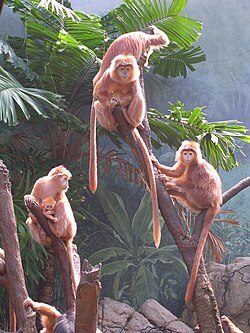
Lutungs have a rather slim build with a long tail. The fur color varies, depending on the species, from black and grey to orange yellow. Many species have skin designs and a brighter lower surface, the hair on the head is often compared to a hood. Their arms are very short in comparison to their hind legs, and their thumbs are also somewhat shorter than in other primates. The inner surfaces of the hands and feet are hairless so that their fur does not get caught when reaching into branches. These animals reach a length of 40 to 80 cm and a weight of 5 to 15 kg, with males being generally larger than females. A ridge over the eyes and other details, primarily related to the head, differentiate the lutungs from the surilis.
Habitat and distribution
Lutungs live in forests. They often prefer rainforests, although they are occasionally also found in secluded mountain forests and limestone karst forests. Lutungs are found in South-east Asia and parts of South Asia, from India in the west to China in the east.46
Behaviour
Lutungs spend the largest part of the day in the trees, where they walk along the branches on all fours.They also jump from tree to tree, often covering long distances between trees; those long jumps are referred to as leaping. Lutungs are diurnal, although more active in the early mornings and the afternoon.
They live in groups of five to 20 animals, mostly in harems, i.e. a single male with several females. Young males must leave their birth group when fully mature, often forming bachelor groups. If a new male takes over a harem, defeating or scaring off the former harem leader, he often kills the infants in the group. This behavior is also known as infanticide. Lutungs are territorial, and emit loud calls to defend their territories from rival males, resorting to force if the outsiders are not scared off. They have a common repertoire of sounds with which they warn group members. Mutual grooming also plays an important role in maintaining the bonds between individuals.
Lutungs are herbivores, primarily eating leaves, fruits, and buds. To digest the tough leaves, they developed a multichambered stomach.
Reproduction
Lutungs typically give birth to a single young, after a seven-month gestation period. Twins occur, but are rare. Newborns usually have golden-yellow or orange fur. The mother shares responsibilities of rearing the young with the other females ("aunties") of the harem. Females within a group hand the young around, play with them, carry them, and cuddle them, allowing the mother to forage or spend time alone. If the mother dies, another female adopts the young animal. Lutungs are weaned in the latter half of their first year, and reach full maturity at 4 to 5 years. The life expectancy is estimated at 20 years.
References
References
- Wilson, D. E.; Reeder, D. M., eds. (2005). Mammal Species of the World: A Taxonomic and Geographic Reference (3rd ed.). Baltimore: Johns Hopkins University Press. ISBN 978-0-8018-8221-0. OCLC 62265494.
- Blust, Robert; Trussel, Stephen (2010). "*luCuŋ: the Formosan rock monkey; Macaca cyclopis". Austronesian Comparative Dictionary. Max Planck Institute for Evolutionary Anthropology. Retrieved 8 November 2022.
- Harding, L.E. (2010). "Trachypithecus cristatus (Primates: Cercopithecidae)". Mammalian Species. 42 (1): 149–165. doi:10.1644/862.1.
- Wilson, Don E.; Mittermeier, Russell A.; Rylands, Anthony B. (2012). "Introduction". Handbook of the Mammals of the World, Volume 3: Primates (1st ed.). Lynx Edicions. ISBN 978-84-96553-89-7. Retrieved 2018-08-30.
- Roos, C.; Boonratana, R.; Supriatna, J.; Fellowes, J.R.; Groves, C.P.; Nash, S.D.; Rylands, A.B.; Mittermeier, R.A. (2014). "An updated taxonomy and conservation status review of Asian primates" (PDF). Asian Primates Journal. 4 (1): 2–38. Retrieved 2018-08-30.
- Karanth, K. Praveen; et al. (2008). "Molecular phylogeny and biogeography of langurs and leaf monkeys of South Asia (Primates: Colobinae)" (PDF). Molecular Phylogenetics and Evolution. 46 (2): 683–694. Bibcode:2008MolPE..46..683K. doi:10.1016/j.ympev.2007.11.026. PMID 18191589. Retrieved 2018-08-30.
- Roos, C.; et al. (2008). "Mitochondrial phylogeny, taxonomy and biogeography of the silvered langur species group (Trachypithecus cristatus)". Molecular Phylogenetics and Evolution. 47 (2): 629–636. Bibcode:2008MolPE..47..629R. doi:10.1016/j.ympev.2008.03.006. PMID 18406631.
- Groves, C. P. (2005). "Genus Trachypithecus". In Wilson, D. E.; Reeder, D. M. (eds.). Mammal Species of the World: A Taxonomic and Geographic Reference (3rd ed.). Baltimore: Johns Hopkins University Press. ISBN 0-801-88221-4. OCLC 62265494.
- Osterholz, Martin; Walter, Lutz; Roos, Christian (2008). "Phylogenetic position of the langur genera Semnopithecus and Trachypithecus among Asian colobines, and genus affiliations of their species groups". BMC Evolutionary Biology. 8 (1): 58. Bibcode:2008BMCEE...8...58O. doi:10.1186/1471-2148-8-58. ISSN 1471-2148. PMC 2268674. PMID 18298809.
- Roos, C.; Boonratana, R.; Supriatna, J.; Fellowes, J.R.; Groves, C.P.; Nash, S.D.; Rylands, A.B.; Mittermeier, R.A. (2014). "An updated taxonomy and conservation status review of Asian primates" (PDF). Asian Primates Journal. 4 (1): 2–38. Retrieved 2018-08-30.
- Osterholz, Martin; Walter, Lutz; Roos, Christian (2008). "Phylogenetic position of the langur genera Semnopithecus and Trachypithecus among Asian colobines, and genus affiliations of their species groups". BMC Evolutionary Biology. 8 (58): 58. Bibcode:2008BMCEE...8...58O. doi:10.1186/1471-2148-8-58. PMC 2268674. PMID 18298809.
- Brandon–Jones, D.; et al. (2004). "Asian Primate Classification". International Journal of Primatology. 25 (1): 97–164. CiteSeerX 10.1.1.694.7983. doi:10.1023/B:IJOP.0000014647.18720.32. S2CID 29045930.
- Xiao Ping Wang; et al. (April 27, 2012). "Phylogenetic Relationships among the Colobine Monkeys Revisited: New Insights from Analyses of Complete mt Genomes and 44 Nuclear Non-Coding Markers". PLOS ONE. 7 (4) e36274. plos.org. Bibcode:2012PLoSO...736274W. doi:10.1371/journal.pone.0036274. PMC 3338693. PMID 22558416.
- Karanth, K. Praveen; et al. (2008). "Molecular phylogeny and biogeography of langurs and leaf monkeys of South Asia (Primates: Colobinae)" (PDF). Molecular Phylogenetics and Evolution. 46 (2): 683–694. Bibcode:2008MolPE..46..683K. doi:10.1016/j.ympev.2007.11.026. PMID 18191589. Retrieved 2018-08-30.
- Roos, C.; et al. (2008). "Mitochondrial phylogeny, taxonomy and biogeography of the silvered langur species group (Trachypithecus cristatus)". Molecular Phylogenetics and Evolution. 47 (2): 629–636. Bibcode:2008MolPE..47..629R. doi:10.1016/j.ympev.2008.03.006. PMID 18406631.
- Roos, Christian; Helgen, Kristofer M.; Miguez, Roberto Portela; Thant, Naw May Lay; Lwin, Ngwe; Lin, Aung Ko; Lin, Aung; Yi, Khin Mar; Soe, Paing; Hein, Zin Mar; Myint, Margaret Nyein Nyein (2020). "Mitogenomic phylogeny of the Asian colobine genus Trachypithecus with special focus on Trachypithecus phayrei (Blyth, 1847) and description of a new species". Zoological Research. 41 (6): 656–669. doi:10.24272/j.issn.2095-8137.2020.254. ISSN 2095-8137. PMC 7671912. PMID 33171548.
- Bleisch, B.; Long, Y. (2020). "Trachypithecus leucocephalus". IUCN Red List of Threatened Species. 2020 e.T39872A17988378. doi:10.2305/IUCN.UK.2020-2.RLTS.T39872A17988378.en.
- Groves, C. (2007). "Speciation and biogeography of Vietnam's primates". Vietnamese Journal of Primatology. 1 (1): 27–40.
- "Trachypithecus leucocephalus (id=1000707)". ASM Mammal Diversity Database. 1.10. American Society of Mammalogists. Retrieved 2023-12-29.
- Nowak, Ronald M. (1999). Walker's Mammals of the World. Vol. 1. Johns Hopkins University Press. p. 602. ISBN 978-0-8018-5789-8.
- Hoang Minh Duc, Nadler; T., Coudrat; C. N. Z., Rawson; B. M., Covert; H., Moody; J., Ang; A. (2022) [amended version of 2021 assessment]. "Trachypithecus margarita". IUCN Red List of Threatened Species. 2022 e.T39875A210372003. doi:10.2305/IUCN.UK.2022-1.RLTS.T39875A210372003.en.
- Das, J.; Chetry, D.; Choudhury, A.; Bleisch, W. (2021) [errata version of 2020 assessment]. "Trachypithecus pileatus". IUCN Red List of Threatened Species. 2020 e.T22041A196580469. doi:10.2305/IUCN.UK.2020-3.RLTS.T22041A196580469.en.
- Rawson, B. M.; Leonard, N.; Covert, H.; Nadler, T. (2020). "Trachypithecus poliocephalus". IUCN Red List of Threatened Species. 2020 e.T39871A17959804. doi:10.2305/IUCN.UK.2020-2.RLTS.T39871A17959804.en.
- Nadler, T.; Quyet, L. K.; Rawson, B. M.; Coudrat, C. N. Z. (2020). "Trachypithecus delacouri". IUCN Red List of Threatened Species. 2020 e.T22043A17958988. doi:10.2305/IUCN.UK.2020-2.RLTS.T22043A17958988.en.
- Viswanathan, Lata (2002). "Trachypithecus obscurus". Animal Diversity Web. University of Michigan. Archived from the original on July 9, 2023. Retrieved July 24, 2023.
- Boonratana, R.; Ang, A.; Traeholt, C.; Thant, N. M. L. (2020). "Trachypithecus obscurus". IUCN Red List of Threatened Species. 2020 e.T22039A17960562. doi:10.2305/IUCN.UK.2020-2.RLTS.T22039A17960562.en.
- Cannon, William; Vos, Abby (2009). "Trachypithecus auratus". Animal Diversity Web. University of Michigan. Archived from the original on July 24, 2023. Retrieved July 24, 2023.
- Nijman, V. (2021). "Trachypithecus auratus". IUCN Red List of Threatened Species. 2021 e.T39848A17988500. doi:10.2305/IUCN.UK.2021-1.RLTS.T39848A17988500.en.
- Nadler, T.; Quyet, L. K.; Covert, H.; Long, Y. (2020). "Trachypithecus francoisi". IUCN Red List of Threatened Species. 2020 e.T39853A17958817. doi:10.2305/IUCN.UK.2020-3.RLTS.T39853A17958817.en.
- Ris, Lauren (2004). "Trachypithecus francoisi". Animal Diversity Web. University of Michigan. Archived from the original on August 12, 2023. Retrieved July 24, 2023.
- Raval, Shivani (2004). "Trachypithecus geei". Animal Diversity Web. University of Michigan. Archived from the original on April 7, 2019. Retrieved July 24, 2023.
- Das, J.; Chetry, D.; Medhi, R.; Choudhury, A. (2020). "Trachypithecus geei". IUCN Red List of Threatened Species. 2020 e.T22037A17960997. doi:10.2305/IUCN.UK.2020-3.RLTS.T22037A17960997.en.
- Duc, H.; Covert, H.; Ang, A.; Moody, J. (2022) [amended version of 2021 assessment]. "Trachypithecus germaini". IUCN Red List of Threatened Species. 2022 e.T39874A217754957. doi:10.2305/IUCN.UK.2022-1.RLTS.T39874A217754957.en.
- Quyet, L. K.; Coudrat, C. N. Z.; Phiaphalath, P.; Nadler, T.; Covert, H. (2021) [amended version of 2020 assessment]. "Trachypithecus hatinhensis". IUCN Red List of Threatened Species. 2021 e.T40789A196139355. doi:10.2305/IUCN.UK.2021-1.RLTS.T40789A196139355.en.
- Yongcheng, L.; Nadler, T.; Quyet, L. K. (2021) [amended version of 2020 assessment]. "Trachypithecus crepusculus". IUCN Red List of Threatened Species. 2021 e.T136920A204397334. doi:10.2305/IUCN.UK.2021-2.RLTS.T136920A204397334.en.
- Coudrat, C. N. Z.; Nadler, T.; Phiaphalath, P.; Duckworth, J. W. (2020). "Trachypithecus laotum". IUCN Red List of Threatened Species. 2020 e.T22044A17959133. doi:10.2305/IUCN.UK.2020-3.RLTS.T22044A17959133.en.
- Chetry, D.; Ahmed, T. (2021). "Trachypithecus phayrei". IUCN Red List of Threatened Species. 2021 e.T175862145A175862149. doi:10.2305/IUCN.UK.2021-2.RLTS.T175862145A175862149.en.
- cantwell, wayne (2011). "Trachypithecus phayrei". Animal Diversity Web. University of Michigan. Archived from the original on August 12, 2023. Retrieved July 24, 2023.
- Matauschek, C.; Meyer, D.; Lwin, N.; Ko Lin, A.; Lin, A.; Momberg, F.; Roos, C. (2022). "Trachypithecus popa". IUCN Red List of Threatened Species. 2022 e.T196344474A196344962. doi:10.2305/IUCN.UK.2022-1.RLTS.T196344474A196344962.en.
- Long, Y.; Htun, S. (2020). "Trachypithecus shortridgei". IUCN Red List of Threatened Species. 2020 e.T39869A17961202. doi:10.2305/IUCN.UK.2020-2.RLTS.T39869A17961202.en.
- Ang, A.; Nijman, V.; Traeholt, C. (2021). "Trachypithecus selangorensis". IUCN Red List of Threatened Species. 2021 e.T205911038A205911065. doi:10.2305/IUCN.UK.2021-3.RLTS.T205911038A205911065.en.
- Bedore, Christine (2005). "Trachypithecus cristatus". Animal Diversity Web. University of Michigan. Archived from the original on August 12, 2023. Retrieved July 24, 2023.
- Meijaard, E.; Nijman, V. (2020). "Trachypithecus cristatus". IUCN Red List of Threatened Species. 2020 e.T22035A17959977. doi:10.2305/IUCN.UK.2020-2.RLTS.T22035A17959977.en.
- Nadler, T. (2021). "Trachypithecus barbei". IUCN Red List of Threatened Species. 2021 e.T41554A17960144. doi:10.2305/IUCN.UK.2021-1.RLTS.T41554A17960144.en.
- Setiawan, A.; Traeholt, C.; Nijman, V.; Supriatna, J. (2021) [amended version of 2020 assessment]. "Trachypithecus mauritius". IUCN Red List of Threatened Species. 2021 e.T39849A196325582. doi:10.2305/IUCN.UK.2021-1.RLTS.T39849A196325582.en.
- Fleagle, John G. (2013). "Asian Colobines". Primate adaptation and evolution (3rd ed.). Amsterdam: Elsevier/Academic Press. pp. 139–144. ISBN 978-0-12-378632-6. OCLC 820107187.