| Map of the Oirat Confederation.png Location of Torghut in the Oirat Confederation |
The Torghut (Mongolian: Торгууд, ᠲᠤᠷᠭᠣᠣᠠ, Torguud, "Guardsman", simplified Chinese: 土尔扈特; traditional Chinese: 土爾扈特) are one of the four major subgroups of the Four Oirats. The Torghut nobles traced their descent to the Turco-Mongol Keraite ruler Toghrul, and many Torghuts descended from the Keraites. They are scattered in the provinces of Xinjiang (China), Kalmykia (Russia) and Khovd (Mongolia).
History
They might have been kheshigs of the Great Khans before Kublai Khan. The Torghut clan first appeared as an Oirat group in the mid-16th century. After the collapse of the Four Oirat Alliance, the majority of the Torghuts under Kho Orluk separated from other Oirat groups and moved west to the Volga region in 1630, forming the core of the Kalmyks. A few Torghut nobles followed Toro Baikhu Gushi Khan to Qinghai Lake (Koke Nuur), becoming part of the so-called Upper Mongols. In 1698, 500 Torghuts went on pilgrimage to Tibet but were unable to return. Hence, they were resettled in Ejin River by the Kangxi Emperor of China's Qing dynasty. In 1699, 15,000 Torghut households returned from the Volga region to Dzungaria where they joined the Khoits. After the fall of the Dzungar Khanate, one of their princes, Taiji Shyiren, fled west to the Volga region with 10,000 families in 1758. The name Torghut or Torgut probably derives from the Mongolian word "torog" meaning literally "silk".
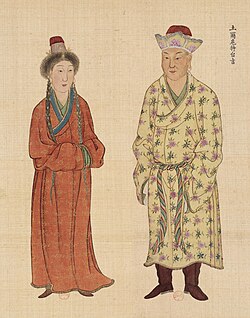
Due to harsh treatment by Russian governors, most Torghuts eventually migrated back to Dzungaria and western Mongolia, departing en masse on January 5, 1771, about that event there is a lively narrative by Thomas De Quincey, written in 18371.2 While the first phase of their movement became the Old Torghuts, the Qing called the later Torghut immigrants "New Torghut". The size of the departing group has been variously estimated between 150,000 and 400,000 people, with perhaps as many as six million animals (cattle, sheep, horses, camels and dogs).3 Beset by raids, thirst and starvation, approximately 85,000 survivors made it to Dzungaria, where they settled near the Ejin River with the permission of the Qing Emperor.3 The Torghuts were coerced by the Qing into giving up their nomadic lifestyle and to take up sedentary agriculture instead as part of a deliberate policy by the Qing to enfeeble them.
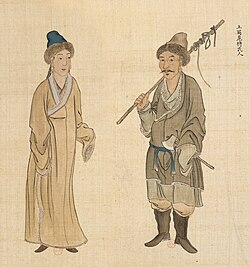
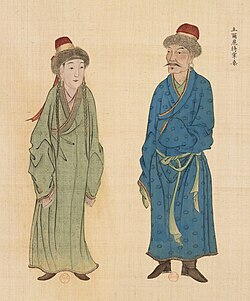
A group of around 70,000 Torghuts was left behind in Russia, since (according to legend) the Volga River was not frozen and they could not cross it to join their comrades.3 This group became known as the Kalmyk, or "remnant",3 although the name may predate these events. However, Muslims called the Kalmyks before. In any case, the remnant population doubles their numbers by 1930.3 Torghut-Kalmyk archers under the command of the notable Russian general Mikhail Kutuzov clashed with the French army of Napoleon in 1812.4
In 1906, the Qing put western Mongolia's New Torghuts under the Altai district. One New Torghut prince opposed independence in Mongolia and fled to Xinjiang in 1911–12. However, the others were reincorporated into Mongolia's far western Khovd Province. Torghut forces assisted the Russians in the Soviet Invasion of Xinjiang.
An exhibition in memorial to the Torghut exodus from the Volga to the Qing Empire is found at the Potala Palace, Chengde.
Language
Modern notable Torghuts in Mongolia
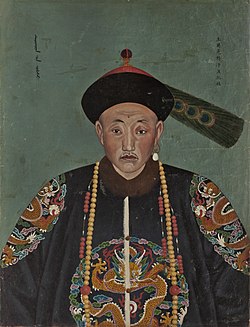
- Shiileg, a hero of Mongolia
- Badam, a hero of Mongolia
- Purevjal, a famous Mongolian singer
- Luvsan, a hero of Labor of Mongolia
- Otgontsagaan, a hero of Labor of Mongolia
- Batlai, a hero of Labor of Mongolia
- Tuvshin, a hero of Labor of Mongolia
- Baadai, a hero of Labor of Mongolia
References
References
- Dunnell, Ruth W.; Elliott, Mark C.; Foret, Philippe; Millward, James A (2004). New Qing Imperial History: The Making of Inner Asian Empire at Qing Chengde. Routledge. ISBN 1134362226. Retrieved 10 March 2014.
- Millward, James A. (1998). Beyond the Pass: Economy, Ethnicity, and Empire in Qing Central Asia, 1759-1864 (illustrated ed.). Stanford University Press. ISBN 0804729336. Retrieved 10 March 2014.
- Perdue, Peter C (2009). China Marches West: The Qing Conquest of Central Eurasia (reprint ed.). Harvard University Press. ISBN 978-0674042025. Retrieved 22 April 2014.
- Ram Rahul-March of Central Asia Indus Publishing, 2000 ISBN 81-7387-109-4
- Johan Elverskog-Our Great Qing:The Mongols, Buddhism and the State in Late Imperial China ISBN 0-8248-3021-0
- Wang Jinglan, Shao Xingzhou, Cui Jing et al. Anthropological survey on the Mongolian Tuerhute tribe in He shuo county, Xinjiang Uigur autonomous region // Acta Anthropologica Sinica. Vol. XII, No. 2. May, 1993. p. 137-146.
- Санчиров В. П. О Происхождении этнонима торгут и народа, носившего это название // Монголо-бурятские этнонимы: cб. ст. — Улан-Удэ: БНЦ СО РАН, 1996. C. 31–50. - in Russian
- Ovtchinnikova O., Druzina E., Galushkin S., Spitsyn V., Ovtchinnikov I. An Azian-specific 9-bp deletion in region V of mitochondrial DNA is found in Europe // Medizinische Genetic. 9 Tahrestagung der Gesellschaft für Humangenetik, 1997, p. 85.
- Galushkin S.K., Spitsyn V.A., Crawford M.H. Genetic Structure of Mongolic-speaking Kalmyks // Human Biology, December 2001, v.73, no. 6, pp. 823–834.
- Хойт С.К. Генетическая структура европейских ойратских групп по локусам ABO, RH, HP, TF, GC, ACP1, PGM1, ESD, GLO1, SOD-A // Проблемы этнической истории и культуры тюрко-монгольских народов. Сборник научных трудов. Вып. I. Элиста: КИГИ РАН, 2009. с. 146-183. - in Russian
- [hamagmongol.narod.ru/library/khoyt_2008_r.htm Хойт С.К. Антропологические характеристики калмыков по данным исследователей XVIII-XIX вв. // Вестник Прикаспия: археология, история, этнография. No. 1. Элиста: Изд-во КГУ, 2008. с. 220–243.]
- Хойт С.К. Кереиты в этногенезе народов Евразии: историография проблемы. Элиста: Изд-во КГУ, 2008. – 82 с. ISBN 978-5-91458-044-2 (Khoyt S.K. Kereits in enthnogenesis of peoples of Eurasia: historiography of the problem. Elista: Kalmyk State University Press, 2008. – 82 p. (in Russian))
- [hamagmongol.narod.ru/library/khoyt_2012_r.htm Хойт С.К. Калмыки в работах антропологов первой половины XX вв. // Вестник Прикаспия: археология, история, этнография. No. 3, 2012. с. 215–245.]
- Boris Malyarchuk, Miroslava Derenko, Galina Denisova, Sanj Khoyt, Marcin Wozniak, Tomasz Grzybowski and Ilya Zakharov Y-chromosome diversity in the Kalmyks at theethnical and tribal levels // Journal of Human Genetics (2013), 1–8.
- Thomas De Quincey. "The Revolt of the Tartars". Blackwood's Edinburgh magazine v.42 1837 Jul-Dec. Hathi Trust. Retrieved 28 May 2026.
- Perdue 2009, p. 295.
- DeFrancis, John. In the Footsteps of Genghis Khan. University of Hawaii Press, 1993.
- Michel Hoàng, Ingrid Cranfield-Genghis Khan, p.323