Ñuu Tnoo-Huahi Andehui | |
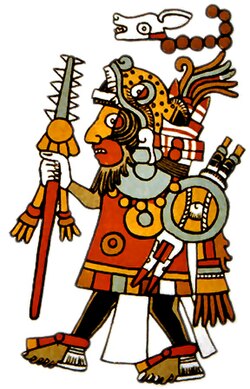 Eight Deer Jaguar Claw (Iya Nacuaa Teyusi Ñaña, 1063 - 1115), Lord of Tilantogo | |
Tilantongo Location within Mexico | |
| Location | Oaxaca, Mexico |
|---|---|
| Region | Oaxaca |
| Coordinates | 17°15′N 97°17′W / 17.250°N 97.283°W / 17.250; -97.283 |
| History | |
| Periods | Postclassic |
| Cultures | Mixtec |
| Site notes | |
| Discovered | 1960s |
| Archaeologists | Alfonso Caso |
Tilantongo was a Mixtec city-state and Postclassic political centre in the Mixteca Alta region of the modern-day state of Oaxaca, which is now visible as an archeological site near the modern town of Santiago Tilantongo.12

Toponymy
Tilantongo seems to be the Nahuatl translation of the original Mixtec name. Tillantonco meaning 'at the small black place' (tlilli 'black)', -ton diminutive, -co locative). In Mixtec, this site was known as Ñuu Tnoo-Huahi Andehui meaning 'Black Town-Temple of Heaven.'1 Although, modern day speakers of the local variant simply call the town ÑūTnúu, The Black Town (Also referenced to as the Charred Town, Burnt Town, and other names).
History
Archeological excavations conducted by Alfonso Caso in the 1960s suggest that Tilantongo is among the oldest settlements in Oaxaca with architecture from the preclassic Monte Albán I phase. Preclassic and Classic remains were found at Monte Negro and the Postclassic settlement was located in the present day town of Tilantongo, slightly north of the Classic settlement.
The documentary record shows that Tilantongo was an important Mixtec polity in the Postclassic period. Mixtec picture codices, such as the Codex Zouche-Nuttall and Codex Bodley, tell the history of Lord 8 Deer who ruled Tilantongo in the eleventh century, and how he linked the Tilantongo dynasty with the central Mexican Toltecs.3
References
References
- Pohl, John M.D. (2002). The Legend of Lord Eight Deer: An Epic of Ancient Mexico. Oxford; New York: Oxford University Press. ISBN 978-0-19-514019-4. OCLC 47054677.
- Spores, Ronald (1967). The Mixtec Kings and Their People. Norman, Oklahoma: University of Oklahoma Press. ISBN 0-8061-1091-0.