 Rendering of the Tianhe core module | |
| Module statistics | |
|---|---|
| COSPAR ID | 2021-035A |
| Part of | Tiangong space station |
| Launch date | 29 April 2021, 03:23:15 UTC (11:23:15 CST) |
| Launch vehicle | Long March 5B (5B-Y2) |
| Mass | 22,500 kg (49,600 lb) |
| Length | 16.6 m (54 ft) |
| Width | 4.2 m (14 ft) |
| Pressurised volume | 113 m3 (4,000 cu ft) Habitable: 51 m3 (1,800 cu ft) |
References: 1234567
 Insignia | |
| Configuration | |
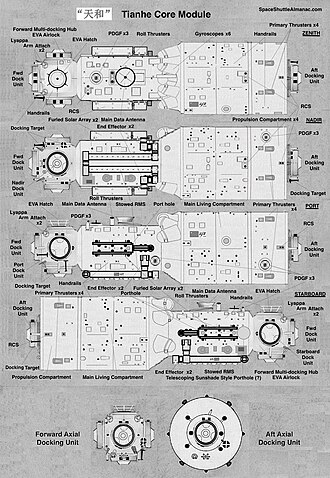 Diagram of the Tianhe module | |
Tianhe (Chinese: 天和; pinyin: Tiānhé; lit. 'Harmony of the Heavens'),89 officially the Tianhe core module (Chinese: 天和核心舱), is the first module to launch of the Tiangong space station. It was launched into orbit on 29 April 2021,7 as the first launch of the final phase of Tiangong program, part of the China Manned Space Program (Project 921).24
Tianhe follows the earlier Tiangong-1 and Tiangong-2 space laboratories.10 It is the first module of a third-generation Chinese modular space station. Other examples of modular stations include the Soviet/Russian Mir and the International Space Station. Operations will be controlled from the Beijing Aerospace Flight Control Center.4
In 2018, a fullscale mockup of Tianhe was publicly presented at China International Aviation & Aerospace Exhibition in Zhuhai.1112 In October 2020, China selected 18 new astronauts ahead of the space station construction to participate in the country's space station project.13
Functions and systems
The core module provides life support and living quarters for three crew members, and provides guidance, navigation, and orientation control for the station. The module also provides the station's power, propulsion, and life support systems. The module consists of three sections: habitable living quarters, a non-habitable service section, and a docking hub.4 The living quarters have a volume of 51 cubic metres (1,800 cu ft) of habitable space, compared to only 15 cubic metres (530 cu ft) for Tiangong-1.14
The living quarters include a kitchen, toilet, fire control equipment, air processing and control equipment, computers, scientific apparatus, and ground communications equipment.4 The station has a large robotic arm called the Core Module Manipulator (CMM).415 The CMM has a wide range of mobility with seven axis of motion, the ability to be elongated, and crawl along the hull.1617 According to the latest reports, its ability is similar to Canadarm 2.18
Electrical power is provided by two steerable solar power arrays, which use photovoltaic cells to produce electricity. Energy is stored to power the station when it moves into the Earth's shadow. Tianzhou resupply ships replenish fuel for the module's propulsion engines for station-keeping to counter the effects of atmospheric drag.19 There are 4 ion engines for propulsion.20
Structure
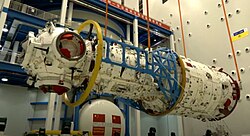
The forward docking hub has four ports: forward, port, starboard, and nadir (towards Earth). The Mengtian and Wentian modules are semi-permanently attached to the port and starboard ports, respectively. The forward and nadir ports are used by visiting crewed Shenzhou spacecraft, while the aft-facing port at the other end of the module is used by Tianzhou cargo spacecraft.15 The forward, nadir, and aft ports are equipped with equipment for automated rendezvous and docking.
Each experiment module was designed to carry a mechanical arm similar to the Russian Lyappa arm used on the Mir space station. New modules would initially dock at the forward port before being relocated to the port or starboard port by the arm.
During the early stages of station assembly, the zenith port served as the station's extravehicular activity (EVA) hatch, with the docking hub acting as an airlock.21 This role became unnecessary after the addition of the Wentian module, which includes a dedicated EVA airlock.
Earlier first-generation space stations, including the Soviet Salyut 1, NASA's Skylab, and Tiangong-1, were not designed for routine resupply missions. Later stations such as Salyut 6, Salyut 7, and Mir introduced multiple docking ports to support long-term crewed operations and resupply missions.22 The modular design of the Tiangong space station allows additional modules to be added or removed over time.23 The station was designed for routine resupply and has a planned service life of at least 10 years.1524
The module is 16.6 m (54 ft) long, with a maximum diameter of 4.2 m (14 ft) and an on-orbit mass of 22,500 kg (49,600 lb).65
Launch
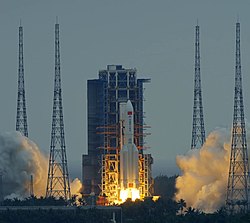
On 14 January 2021, CMSA announced the beginning of the construction phase for China's three-module space station. The core module, Tianhe, passed a flight acceptance review. This core module provides living space and life support for astronauts and houses the outpost's power and propulsion elements.2526
Tianhe launched on 29 April 2021, at 03:23:15 UTC atop a Long March 5B launch vehicle from the Wenchang Spacecraft Launch Site.6 After the core module was put into orbit, the empty first stage of its launch vehicle entered a temporary, uncontrolled failing orbit.27 Some concerns were raised over possible damage from debris of the uncontrolled re-entry: observations showed the rocket was tumbling, which complicates predictions about an eventual landing area, although the most likely outcome was a maritime impact. Parallels were made with respect to a previous launch in May 202028 which reportedly caused some damage in the Côte d'Ivoire.29 The rocket re-entered over the Arabian peninsula on 9 May at 02:24 UTC,30 landing in the Indian Ocean west of the Maldives according to the CMSA, with much of it having reportedly burned up prior to impact.note 1 United States Space Command confirmed the re-entry location.31note 2
The first spacecraft scheduled that visited the Tianhe core module was the Tianzhou 2 cargo resupply spacecraft on 29 May 2021, followed by Shenzhou 12, carrying a crew of three to the station on 17 June 2021.7 Tianzhou 3 and Shenzhou 13 were launched to the station on 20 September 2021 and 15 October 2021 respectively.3334
Dockings
- All dates are UTC. Dates are the earliest possible dates and may change.
- Forward ports are at the front of the station according to its normal direction of travel and orientation (attitude). Aft is at the rear of the station, used by spacecraft to boost the station's orbit. Nadir is closest to the Earth, zenith is on top. Port is to the left if pointing one's feet towards the Earth and looking in the direction of travel; starboard to the right.
- Key
| Launch (UTC) | Docking (UTC) | Undocking (UTC) | Result | Spacecraft/Module | Location | Durationa |
|---|---|---|---|---|---|---|
| 29 April 2021 03:23:1535 |
N/a | N/a | Success | Tianhe | N/a | N/a |
| 29 May 2021 12:55:2936 |
29 May 2021 21:0137 |
27 March 2022 07:59 |
Tianzhou 2 | Tianhe portb | 301d, 10h, 58m | |
| 17 June 2021 01:22:2738 |
17 June 2021 07:5439 |
16 September 2021 00:56 40 |
Shenzhou 12 | Tianhe forward | 90d, 14h, 8m | |
| 20 September 2021 07:10:114142 |
20 September 2021 14:0843 |
17 July 2022 02:59 |
Tianzhou 3 | Tianhe forwardc | 299d, 12h, 51m | |
| 15 October 2021 16:23:564445 |
15 October 2021 22:5646 |
15 April 2022 16:4447 |
Shenzhou 13 | Tianhe nadir | 181d, 14h, 46m | |
| 9 May 2022 17:56:3748 |
10 May 2022 00:54 |
9 November 2022 06:55 |
Tianzhou 4 | Tianhe aft | 183d, 6h, 1m | |
| 5 June 2022 02:44:1049 |
5 June 2022 09:42 |
4 December 2022 03:01 |
Shenzhou 14 | Tianhe nadir | 181d, 14h, 11m | |
| 24 July 2022 06:22:325051 |
24 July 2022 19:1352 |
N/a | Wentian | Tianhe starboardd | N/a | |
| 31 October 2022 07:37:2351 |
31 October 2022 20:27 |
N/a | Mengtian | Tianhe porte | N/a | |
| 12 November 2022 02:03:125354 |
12 November 2022 04:10 |
11 September 2023 08:46 |
Tianzhou 5 | Tianhe forwardf | 303d, 4h, 36m | |
| 29 November 2022 15:08:1755 |
29 November 2022 21:4256 |
3 June 2023 13:29 |
Shenzhou 15 | Tianhe forward | 185d, 13h, 56m | |
| 10 May 2023 13:22:5157 |
10 May 2023 21:16 |
12 January 2024 08:02 |
Tianzhou 6 | Tianhe aft | 246d, 10h, 46m | |
| 30 May 2023 01:31:1357 |
30 May 2023 08:29 |
30 October 2023 12:3758 |
Shenzhou 16 | Tianhe nadir | 153d, 2h, 15m | |
| 26 October 2023 03:14:0259 |
26 October 2023 09:46 |
30 April 2024 00:4360 |
Shenzhou 17 | Tianhe forward | 186d, 13h, 9m | |
| 17 January 2024 14:27:3061 |
17 January 2024 17:46 |
10 November 2024 08:30 |
Tianzhou 7 | Tianhe aft | 297d, 14h, 44m | |
| 25 April 2024 12:59:0062 |
25 April 2024 19:3263 |
3 November 2024 08:12 |
Shenzhou 18 | Tianhe nadir | 191d, 11h, 8m | |
| 29 October 2024 20:27:3464 |
30 October 2024 03:00 |
29 April 2025 20:00 |
Shenzhou 19 | Tianhe forward | 181d, 17h | |
| 15 November 2024 15:13:1864 |
15 November 2024 18:32 |
8 July 2025 07:09 |
Tianzhou 8 | Tianhe aft | 234d, 12h, 37m | |
| 24 April 2025 09:176566 |
24 April 2025 15:49 |
18 January 2026, 16:23 |
Partial failureg | Shenzhou 20 | Tianhe nadir | 269d, 7h, 6m |
| 14 July 2025 21:346766 |
14 July 2025 21:34 |
6 May 2026 08:34 |
Success | Tianzhou 9 | Tianhe aft | 295d, 11h |
| 31 October 2025 15:446866 |
31 October 2025 19:2269 |
14 November 2025 06:49 |
Success | Shenzhou 21 | Tianhe forward | 13d, 11h, 27mh |
| 25 November 2025 12:1170 |
25 November 2025 15:5071 |
29 May 2026 06:44 |
Success | Shenzhou 22 | Tianhe forward | 184d, 14h, 54m |
| 11 May 2026 00:1472 |
11 May 2026 05:1172 |
TBA | In progress | Tianzhou 10 | Tianhe aft | 30d, 5h, 51m (in progress) |
| 24 May 2026 15:08 |
24 May 2026 18:45 |
TBA | In progress | Shenzhou 23 | Tianhe nadir | 16d, 11h, 20m (in progress) |
Maneuvers
On 1 July 2021, the space station performed a maneuver in response to a possible close encounter with the Starlink-1095 communications satellite.73 Another maneuver was carried out on 21 October of the same year in response to a possible collision with Starlink-2305.73
Gallery
-
 Tianhe core module full-scale mockup
 -
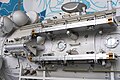 Folded solar panel on Tianhe core module full-scale mockup
Notes
Notes
- China Manned Space Engineering Office (CMSEO) reported landing coordinates are 72.47 degrees of longitude east and 2.65 degrees of latitude north – 2°39′N 72°28′E / 2.65°N 72.47°E / 2.65; 72.47.3130
- 'Space-Track.org', on its Twitter feed, stated that based on data from the 18th Space Control Squadron of the United States Space Force, the CZ-5B core stage that launched the Tianhe core module fell into the Indian Ocean north of the Maldives.32
- Duration of a spacecraft is calculated from the moment of docking with the Tianhe core module to the moment of undocking with the station.
- Initially docked to aft port, moved to forward port on 18 September 2021, and then again to portside port on 6 January 2022
- Initially docked to aft port, moved to forward port on 20 April 2022
- Initially docked to forward port, it was moved to starboard berth on 30 September 2022 by the Indexing Robot Arm
- Initially docked to forward port, it was moved to the port berth on 3 November 2022 by the Indexing Robot Arm
- Initially docked to aft port, from 5 May 2023, it was free-flying and co-orbiting the space station, then redocked to forward port on 5 June 2023
- Launched crewed, but landed uncrewed due to cracks in spacecraft's porthole caused by external space debris impact. Crew landed via Shenzhou 21.
- Landed with Shenzhou 20 crew due to cracks in Shenzhou 20 spacecraft's porthole caused by external space debris impact. Crew will land via Shenzhou 22.
References
References
- "China expects to complete space station by 2023". China Daily. 25 September 2013. Retrieved 29 June 2016.
- "中国载人航天工程标识及空间站、货运飞船名称正式公布" [CMSE logo and space station and cargo ship name officially announced] (in Chinese (China)). China Manned Space Engineering Office. 31 October 2013. Archived from the original on 4 December 2013. Retrieved 29 June 2016.
- Ping, Wu (June 2016). "China Manned Space Programme: Its Achievements and Future Developments" (PDF). China Manned Space Engineering Office. Retrieved 28 June 2016.
- Ping, Wu (23 April 2016). "空间站工程研制进展" [Space Station Project Development Progress] (PDF). China Manned Space Engineering. Archived from the original (PDF) on 14 September 2016. Retrieved 29 June 2016.
- 朱光辰 (2022). "我国载人航天器总体构型技术发展". 航天器工程. 第31卷 (第6期): 47.
- "China assembling rocket to launch first space station module". SpaceNews. 18 February 2020. Retrieved 19 February 2021.
- Barbosa, Rui C. (1 March 2021). "China preparing to build Tiangong station in 2021, complete by 2022". NASASpaceFlight.com. Retrieved 1 March 2021.
- "China launches space station core module Tianhe". Xinhua. 29 April 2021.
- "Planned space station details made public". China Daily. 26 April 2018.
The core module, Tianhe, or Harmony of Heavens
- Graham, William (23 March 2021). "Twenty years after deorbit, Mir's legacy lives on in today's space projects". NASASpaceFlight.com. Retrieved 27 July 2022.
- "航天控制中心" [Aerospace Control Center] (in Chinese (China)). China Manned Space Engineering Office. 17 September 2008. Archived from the original on 21 May 2012. Retrieved 29 June 2016.
- "天和一号核心舱(TianHe-1)" [TianHe core module (TianHe-1)]. chinaspaceflight.com (in Chinese). 7 June 2016. Archived from the original on 19 June 2016. Retrieved 30 June 2016.
- "China selects 18 new astronauts ahead of space station construction". SpaceNews. 2 October 2020. Retrieved 4 October 2020.
- Clark, Stephen. "Assembly of Chinese space station begins with successful core module launch – Spaceflight Now".
- "China launches Tianhe module, start of ambitious two-year station construction effort". NASASpaceFlight.com. 28 April 2021. Retrieved 1 May 2021.
- Fallahiarezoodar, Nasim; Zhu, Zheng H. (2 July 2025). "Review of Autonomous Space Robotic Manipulators for On-Orbit Servicing and Active Debris Removal". Space: Science & Technology. 5. doi:10.34133/space.0291. ISSN 2692-7659.
- "China's Tiangong Space Station robotic arm revealed".
- 刘明. "Robotic arm utilizes top technologies". www.chinadaily.com.cn. Retrieved 8 July 2021.
- David, Leonard (7 March 2011). "China Details Ambitious Space Station Goals". SPACE.com. Retrieved 9 March 2012.
- "China's New Space Station is Powered by Ion Thrusters". 23 June 2021.
- Cite error: The named reference
NSF202104282was invoked but never defined (see the help page). - "Space Station Evolution: 6 Amazing Orbital Outposts". SPACE.com. 12 May 2013. Retrieved 1 May 2021.
- "China's Space Station and the ISS Compared As Tianhe Module Arrives in Earth's Orbit". Newsweek. 30 April 2021. Retrieved 1 May 2021.
- "China launches Tianhe, future living quarters for space station planned for 2022". South China Morning Post. Retrieved 1 May 2021.
- Wall, Mike (7 January 2021). "China plans to launch core module of space station this year". SPACE.com. Retrieved 11 February 2021.
- Jones, Andrew (10 February 2021). "China's first space station module is ready for flight". SPACE.com. Retrieved 11 February 2021.
- Clark, Stephen (9 May 2020). "U.S. military tracking unguided re-entry of large Chinese rocket". Spaceflight Now. Retrieved 12 February 2021.
- Smith, Adam (4 May 2021). "Chinese rocket "tumbling to Earth" and could land anywhere". The Independent. Retrieved 5 May 2021.
There are fears that the rocket could land on an inhabited area; the last time a Long March rocket was launched in May 2020, debris was reported falling on villages in the Ivory Coast. The speed of the rocket means scientists still do not yet know when it will fall, but it is likely to do so before 10 May 2021.
- "Ivory Coast villagers in shock after they find a debris that fell from the sky". Daily Nation. May 2020. Retrieved 4 May 2021.
- China Manned Space Agency (CMSa) (9 May 2021). "长征五号B遥二运载火箭末级残骸已再入大气层". Archived from the original on 9 May 2021.
- "'Irresponsible': Nasa chides China as rocket debris lands in Indian Ocean". The Guardian. Reuters. 9 May 2021. Retrieved 9 May 2021.
- "@18SPCS confirms that CZ-5B ..." Twitter. 8 May 2021. Retrieved 9 May 2021.
- "【2021年9月待定】长征七号 • 天舟三号货运飞船 • LongMarch 7 Y4 • Tianzhou-3". spaceflightfans.cn (in Chinese). 21 April 2021. Archived from the original on 26 April 2021. Retrieved 25 April 2021.
- "长征二号F/G Y13 • 神舟十三号载人飞船 • LongMarch 2F/G Y13 • Shenzhou-13". spaceflightfans.cn (in Chinese). 21 April 2021. Archived from the original on 2 May 2021. Retrieved 25 April 2021.
- Clark, Stephen (29 April 2021). "Assembly of Chinese space station begins with successful core module launch". Spaceflight Now. Archived from the original on 18 June 2021. Retrieved 18 June 2021.
- Graham, William (29 May 2021). "China launches Tianzhou 2, first cargo mission to new space station". NASASpaceFlight.com. Archived from the original on 24 April 2022. Retrieved 4 June 2021.
- Jones, Andrew (29 May 2021). "Tianzhou-2 docks with China's space station module". SpaceNews. Retrieved 29 May 2021.
- Clark, Stephen (17 June 2021). "Chinese astronauts enter Tiangong space station for first time". Spaceflight Now. Archived from the original on 18 June 2021. Retrieved 18 June 2021.
- "Chinese astronauts enter Tiangong space station for first time". Spaceflight Now. 17 June 2021. Archived from the original on 17 December 2021. Retrieved 3 February 2022.
- "神舟十二号载人飞船撤离空间站组合体". China Manned Space (in Chinese). 16 September 2021. Archived from the original on 16 October 2021. Retrieved 16 September 2021.
- Wall, Mike (17 September 2021). "China rolls out rocket for Tianzhou 3 cargo mission ahead of Monday launch (photos)". Space.com. Archived from the original on 5 October 2021. Retrieved 5 October 2021.
- "【2021年9月待定】长征七号 • 天舟三号货运飞船 • LongMarch 7 Y4 • Tianzhou-3". spaceflightfans.cn (in Chinese). 21 April 2021. Archived from the original on 26 April 2021. Retrieved 25 April 2021.
- "Tianzhou-3 spacecraft docks with Chinese space station". spacenews.com. 20 September 2021. Retrieved 21 September 2021.
- "关于神舟十三号发射观摩暨"少年宇航技师"训练营活动延期的通知". csaspace.org.cn. Archived from the original on 20 September 2021. Retrieved 23 September 2021.
- "China expected to name woman for next space station crew". scmp.com. 22 September 2021. Archived from the original on 24 September 2021. Retrieved 23 September 2021.
- "China's Shenzhou 13 crew enters space station for 6-month stay". scmp.com. 16 October 2021. Archived from the original on 15 October 2021. Retrieved 16 October 2021.
- "神舟十三号载人飞船撤离空间站组合体". China Manned Space (in Chinese). 16 April 2022. Archived from the original on 16 April 2022. Retrieved 16 April 2022.
- China Spaceflight [@CNSpaceflight] (16 March 2022). "According to a travel agency, Long March 7 Y5 will launch Tianzhou 4 on MAY 10" (Tweet) – via Twitter.
- China Spaceflight [@CNSpaceflight] (6 April 2022). "Shenzhou 14 to be launched by Long March 2F Y14 on June.05 2022" (Tweet) – via Twitter.
- "SCIO briefing about China's progress on space station construction | english.scio.gov.cn". english.scio.gov.cn. Archived from the original on 30 September 2022. Retrieved 18 April 2022.
- "飞行任务时间表出炉!" [The mission schedule is out!]. Shaoxing (in Chinese). 17 April 2022. Archived from the original on 4 August 2022. Retrieved 17 April 2022.
- 杨希 (25 July 2022). "China's Wentian lab module docks with Tianhe core module combination". China.org.cn. Archived from the original on 27 July 2022. Retrieved 3 August 2022.
- China Spaceflight [@CNSpaceflight] (18 September 2022). "The next cargo spacecraft to resupply China Space Station, Tianzhou-5, has arrived at Wenchang for launch on Nov. 06. It also carries a 4U cubesat CAS-10 (XW-4) and will deploy on ~Dec. 15" (Tweet) – via Twitter.
- China Spaceflight [@CNSpaceflight] (18 April 2022). "key takeaways from the press conference: 7 launches in total from Wenchang [...] 11/.. CZ7 Tianzhou-5 [...]" (Tweet) – via Twitter.
- China Spaceflight [@CNSpaceflight] (8 October 2022). "Updated schedule of missions to China Space Station in 2022" (Tweet) – via Twitter.
- China Spaceflight [@CNSpaceflight] (29 November 2022). "Breaking. #Shenzhou15 has docked at Tianhe Core Module's forward port at 21:42UTC" (Tweet) – via Twitter.
- "Basic Situation of Manned Space Missions in 2023". 15 February 2023. Archived from the original on 15 February 2023. Retrieved 3 March 2023.
- Andrew Jones [@AJ_FI] (30 October 2023). "The Shenzhou 16 spacecraft carrying Jing Haipeng, Zhu Yangzhu and Gui Haichao separated from Tiangong space station at 1237 UTC today, CMSA has just announced. Spacecraft set to reenter and land in the desert near Jiuquan spaceport ~0010 UTC Oct. 31" (Tweet) – via X (formerly Twitter).
- China 'N Asia Spaceflight [@CNSpaceflight] (19 October 2023). "Long March 2F Y17 with Shenzhou-17 on the top has been rolled out to the launch pad in Jiuquan. The launch of 3 astronauts is expected to happen on October 26" (Tweet) – via X (formerly Twitter).
- "Re: Shenzhou-17 – CZ-2F/G – Jiuquan – October 26, 2023 (03:14:02.491 UTC) Reply #109". nasaspaceflight.com. 30 April 2024. Retrieved 30 April 2024.
- "Announcement of the 2024 Manned Space Flight Mission Logo Collection Campaign". 31 August 2023. Retrieved 19 January 2024.
- "Re: Shenzhou-18 – CZ-2F/G – Jiuquan – April 25, 2024 (12:59 UTC) Reply #38". nasaspaceflight.com. 25 April 2024. Retrieved 25 April 2024.
- "神舟十八号载人飞船与空间站组合体完成自主快速交会对接". Xinhua. 25 April 2024. Retrieved 25 April 2024.
- "CHINESE LAUNCH MANIFEST". Retrieved 10 September 2024.
- "Long March 2F/G | Shenzhou 20".
- "Xinhua Headlines: Chinese astronauts return to Earth safely, experiencing busy, joyful space life".
- 李, 国利; 黎, 云 (14 July 2025). "天舟九号货运飞船发射任务取得圆满成功". XINHUAnet.com. Retrieved 14 July 2025.
- 李, 国利; 黄, 一宸 (31 October 2025). "神舟二十一号载人飞船发射取得圆满成功 我国2025年载人航天发射任务圆满收官". XINHUAnet.com. Retrieved 31 October 2025.
- Jones, Andrew (31 October 2025). "Shenzhou-21 completes rapid docking with Tiangong space station 3.5 hours after launch". spacenews.com. Retrieved 31 October 2025.
- Josh Dinner (24 November 2025). "China to launch an empty Shenzhou 22 spacecraft to help stranded astronauts on Tiangong space station". Space. Retrieved 25 November 2025.
- "Shenzhou-22 spaceship docks with space station combination". www.ecns.cn. Retrieved 25 November 2025.
- Jones, Andrew (11 May 2026). "Tianzhou-10 cargo spacecraft arrives at Tiangong space station". SpaceNews. Retrieved 11 May 2026.
- Permanent Mission of China to the United Nations (3 December 2021). Information furnished in conformity with the Treaty on Principles Governing the Activities of States in the Exploration and Use of Outer Space, including the Moon and Other Celestial Bodies (PDF) (Report). Vienna: United Nations Office for Outer Space Affairs. pp. 1‒2. Retrieved 28 December 2021.
from 19 April 2020, the Starlink-1095 satellite had … an average altitude of around 555 km. Between 16 May and 24 June 2021, … maneuvered continuously to an orbit of around 382 km … close encounter … on 1 July 2021. … the China Space Station took the initiative to conduct an evasive maneuver in the evening of that day … On 21 October 2021, the Starlink-2305 satellite had a subsequent close encounter … the maneuver strategy was unknown [so] the China Space Station performed an evasive manoeuvre