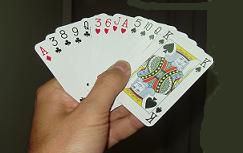
In the game of contract bridge, a three suiter (or three-suited hand) denotes a hand containing at least four cards in three of the four suits. As a bridge hand contains thirteen cards, only two hand patterns can be classified as three suiters: 4-4-4-1 and 5-4-4-0.
In natural bidding systems, strong three suiters are often difficult to describe, as — following the likely response of partner in the short suit — they do not allow for a high-level notrump rebid, nor for a reverse bid. Some systems therefore use dedicated opening bids to describe strong three-suited hands (e.g. the 2♦ opening in the Roman system).
The standard treatment to describe a three-suited hand after an opposing opening in a suit is the takeout double. Conventions like the Kantar cuebid1 and Cansino2 can be used to introduce a three-suited hand after an opposing 1NT opening.
External links
External links
- Ryall, Chris. "Bridge: Two level openings, 2 clubs as "strong unbalanced", Handling 4441 types". Chris Ryall - Bridge. Retrieved 31 July 2013.
Notes
Notes
- Manley (2011), page 294.
- Manley (2011), page 272.
References
References
- Manley, Brent; Horton, Mark; Greenberg-Yarbro, Tracey; Rigal, Barry, eds. (2011). The Official Encyclopedia of Bridge (7th ed.). Horn Lake, MS: American Contract Bridge League. ISBN 978-0-939460-99-1.