 Title page for The History of Java (1817) | |
| Author | Thomas Stamford Raffles |
|---|---|
| Language | English |
| Published | 1817 |
| Publisher | John Murray |
| Publication place | United Kingdom |
| Pages | vol. 1: xlviii + 479 vol. 2: cclx + 288 |
| OCLC | 741754581 |
The History of Java is a book written by Sir Thomas Stamford Raffles and published in 1817.1
Background
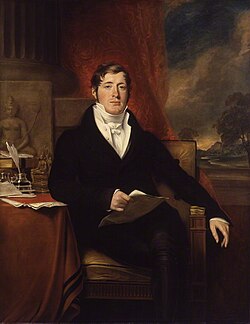
In 1811 Raffles was appointed as lieutenant governor of Java. ‡ 1 During his short reign, British Java saw a surge of archaeological surveys and government attention on local culture, art and history. Raffles was an enthusiast of the island's history, which he published later in 1817.2
Summary
The History of Java was published in two volumes. The first volume describes the physical features of Java island, as well as the Javanese people and their language. The second volume focuses on the island's religion, ruins and arts, and a record of Java history up to 1811. Half of the pages in the second volume are appendices.1
Publication history
The first edition was limited to 900 copies and contained 64 etched or aquatint plates, of which 10 were hand-coloured aquatints by William Daniell depicting Javanese life and costume. A second edition followed in 1830.
The book was reprinted by the Oxford University Press in 1965,3 and in 2010 from a digital master by the Cambridge University Press.‡ 2
Reception
In 1817, the Quarterly Review criticized how The History of Java is arranged, saying it "... is not the best, either for perspicuity or compression" and claiming the books could be shorter.1 They however praised how the Javanese language and its literatures are described in detail.
Charles A. Fisher said the book is a monumental work by Raffles, appreciating the depth of detail and care for culture, which was rare for someone in a colonial position. At the same time he lamented how at that time the British public viewed Raffles tenure in Java as a failure compared to his role in Singapore.3
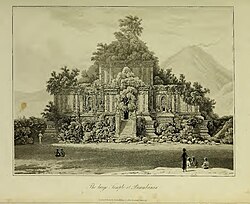

Sarah Tiffin argued that illustrations of candi in the book followed the picturesque trend of making the ruins more beautiful than they actually were, such as by adding lush vegetation.4
Legacy
Between 1 February and 28 April 2019 an exhibition was held in the Asian Civilisations Museum in Singapore featuring many items from Raffles private collections that were illustrated and discussed in the book.5 And in May 2019, Tang Holdings donated Raffles' own copy of The History of Java to the National Museum of Singapore.6
In 2019 ruins were found in Blitar, East Java. The excavation teams suspect they are the remnants of Candi Gedog, which was mentioned in The History of Java. The confirmation is difficult, as there are only written descriptions of the candi. They suspect that Candi Gedog was mostly intact in Raffles time, but became covered in lahar after the Kelud eruption in 1901.7
Gallery
- Weapons
-
 Varieties of Javanese keris
 -
 Machetes, maces, bow and arrows, blowpipe, sling
 -
 Keris
Keris -
 Short swords, shields, and a matchlock gun
 -
 Weapons and standards
- Batik
-
 A Javanese man in court dress
 -
 A Javanese chief, in his ordinary dress
 -
 A Javanese man in war dress
 -
 A Javanese man of the lower class
 -
 A Javanese ronggeng dancer
References
References
- "Review of The History of Java by Thomas Stamford Raffles". The Quarterly Review. 17: 72–96. April 1817. Archived from the original on 22 February 2021. Retrieved 17 March 2017.
- Carey, Peter (2008). The Power of Prophecy: Prince Dipanagara and the End of an Old Order in Java, 1785-1855.
- Fisher, Charles A. (1967). "Review of The History of Java; Our Tropical Possessions in Malayan India". Modern Asian Studies. 1 (1): 104–106. ISSN 0026-749X. Retrieved 11 May 2026.
- Tiffin, Sarah (2009). "Java's Ruined candis and the British Picturesque Ideal". Bulletin of the School of Oriental and African Studies, University of London. 72 (3): 525–558. ISSN 0041-977X. Retrieved 13 May 2026.
- Adrian, Lim (1 January 2019). "New exhibition seeks to revisit Raffles' other facets". The Straits Times. Retrieved 11 May 2026.
- Lim, Kristelynn (14 May 2019). "Tang Holdings donates largest private Raffles memorabilia collection to National Museum". The Straits Times. ISSN 0585-3923. Retrieved 15 May 2026.
- Riady, Erliana (5 September 2019). "Candi di Blitar Ini Ditulis Raffles dalam Buku History of Java, Benarkah?" [This Candi in Blitar was described by Raffles in his book History of Java, is it true?]. detik.com (in Indonesian). Retrieved 14 May 2026.
Primary sources
In the text, these references are preceded by a double dagger (‡):
- Sir Thomas Stamford Raffles (1830). The History of Java. J. Murray. pp. xxiii. Retrieved 12 August 2022.
- Raffles, Thomas Stamford (2010). A History of Java Volume 1 (Repr. d. Ausg. London 1817 ed.). Cambridge: Cambridge University Press. ISBN 9781108023443.
External links
External links
- Media related to The History of Java (book) at Wikimedia Commons
- The History of Java by Sir Stamford Raffles at the Internet Archive.
- The History of Java restored ebook at Google Books.