| Familial male-limited precocious puberty | |
|---|---|
| Other names | Familial sexual precocity |
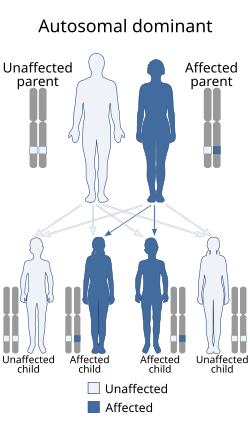 | |
| Male-limited precocious puberty has an autosomal dominant pattern of inheritance. However, only males are affected; females with the mutant gene are not affected. | |
| Specialty | Endocrinology  |
Familial male-limited precocious puberty, often abbreviated as FMPP, also known as familial sexual precocity or gonadotropin-independent testotoxicosis,1 is a form of gonadotropin-independent precocious puberty in which boys experience early onset and progression of puberty.2 Signs of puberty can develop as early as an age of 1 year.
The spinal length in boys may be short due to a rapid advance in epiphyseal maturation. It is an autosomal dominant1 condition with a mutation of the luteinizing hormone (LH) receptor. As FMPP is a gonadotropin-independent form of precocious puberty, gonadotropin-releasing hormone agonists (GnRH agonists) are ineffective. Treatment is with drugs that suppress or block the effects of gonadal steroidogenesis, such as cyproterone acetate, ketoconazole, spironolactone, and testolactone.3 Alternatively, the combination of the androgen receptor antagonist bicalutamide and the aromatase inhibitor anastrozole may be used.4
Robert King Stone, personal physician to American president Abraham Lincoln, described the first case of FMPP in 1852.5
See also
See also
References
References
- Online Mendelian Inheritance in Man (OMIM): 176410
- Traggiai C, Stanhope R (2003). "Disorders of pubertal development". Best Pract Res Clin Obstet Gynaecol. 17 (1): 41–56. doi:10.1053/ybeog.2003.0360. PMID 12758225.
- Reiter EO, Norjavaara E (2005). "Testotoxicosis: current viewpoint". Pediatr Endocrinol Rev. 3 (2): 77–86. PMID 16361981.
- Kreher NC, Pescovitz OH, Delameter P, Tiulpakov A, Hochberg Z (Sep 2006). "Treatment of familial male-limited precocious puberty with bicalutamide and anastrozole". The Journal of Pediatrics. 149 (3): 416–20. doi:10.1016/j.jpeds.2006.04.027. PMID 16939760.
- Tao, Ya-Xiong (November 2008). "Constitutive activation of G protein-coupled receptors and diseases: Insights into mechanisms of activation and therapeutics". Pharmacology & Therapeutics. 120 (2). Elsevier: 129–148. doi:10.1016/j.pharmthera.2008.07.005. PMC 2668812. PMID 18768149.