| Teredolites | |
|---|---|
| |
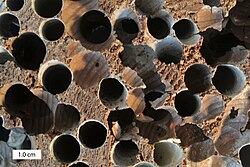
| Teredolites; an ichnogenus formed by boring bivalves in wood. | |
Trace fossil classification 
| |
| Ichnofamily: | †Gastrochaenolitidae |
| Ichnogenus: | †Teredolites Leymerie, 1842 |
| Type ichnospecies | |
| Teredolites clavatus Leymerie, 1842
| |
| Synonyms12 | |
| |
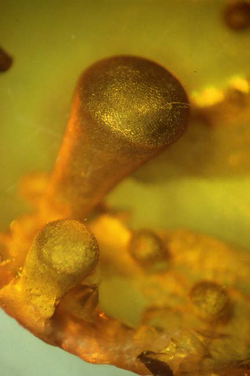
Teredolites is an ichnogenus of trace fossil, characterized by borings in substrates such as wood or amber.
Club-shaped structures rimming mid-Cretaceous Burmese amber were formerly identified as the fungal sporocarps Palaeoclavaria burmitis. A 2018 study re-identified the structures as domichnia (crypts) bored in the amber nodules by bivalves of the pholadid subfamily Martesiinae. The borings are comparable with Teredolites clavatus and Gastrochaenolites lapidicus .3 Due to the substrate of the Myanmar borings being amber, the term 'amberground' was coined.
References
References
- Wisshak, M.; Knaust, D.; Bertling, M. (2019). "Bioerosion ichnotaxa: review and annotated list". Facies. 65 (2): 24. Bibcode:2019Faci...65...24W. doi:10.1007/s10347-019-0561-8.
- Bolotov, I. N.; Aksenova, O. V.; Vikhrev, I. V.; Konopleva, E. S.; Chapurina, Y. E.; Kondakov, A. V. (2021). "A new fossil piddock (Bivalvia: Pholadidae) may indicate estuarine to freshwater environments near Cretaceous amber-producing forests in Myanmar". Scientific Reports. 11 (1) 6646. Bibcode:2021NatSR..11.6646B. doi:10.1038/s41598-021-86241-y. PMC 7988128. PMID 33758318.
- Smith, R. D. A.; Ross, A. J. (2018). "Amberground pholadid bivalve borings and inclusions in Burmese amber: implications for proximity of resin-producing forests to brackish waters, and the age of the amber". Earth and Environmental Science Transactions of the Royal Society of Edinburgh. 107 (2–3): 239–247. doi:10.1017/S1755691017000287. S2CID 204250232.