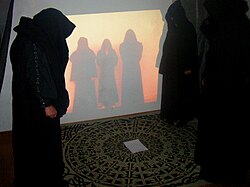
Technopaganism, as described by Victoria Dos Santos, is "a term encompassing a variety of practices and expressions related to contemporary paganism, popular culture, and spiritual pursuits in digital environments."1 The Internet, for instance, is considered by some technopagans to have spiritual significance or unique magical applications.23
Definition
Technopaganism is concerned with spiritual and magical aspects of technology and, sometimes, the interconnections between technology and society. Dos Santos classified technopaganism into two types: the first pertains to the adaptation of various neopagan currents to online environments (e.g., via virtual communities or collaborative software), while the second comprises a body of neopagan beliefs and practices greatly influenced by information and communications technology and "deeply merged with cybernetic culture".2
A notable instance of technopagan adaptation of neopagan practices is the creation and distribution of virtual Books of Shadows and sacred texts through the Internet;24 similarly, virtual world platforms such as Second Life and VRChat2 are used to connect with others and conduct rituals.5
Beliefs
A common element of technopaganism is the adaptation of neopagan beliefs, such as animism, to technology and cyberspace. Dos Santos writes that a fundamental aspect of technopagan animism is "a dialogic relationship with the digital environment itself."2 In a 1995 Wired article, technopagan Mark Pesce describes how, upon first using NCSA Mosaic, he realized that the World Wide Web was the first emergent property of the Internet: "It's displaying all the requisite qualities – it came on very suddenly, it happened everywhere simultaneously, and it's self-organizing. I call that the Web eating the Net." He went on to create VRML, with one of his motivations having been to bring about a spatial dimension of the Web.3
See also
See also
References
References
- Dos Santos Bustamante, Victoria Vanessa (2022-06-06). Technopaganism: A semiotic approach to digital religious phenomena (PDF). iris.unito.it (Doctorate thesis). Retrieved 2024-11-10.
- Dos Santos, Victoria (2023-11-03). "(Techno)Paganism: An Exploration of Animistic Relations with the Digital". Religions. 14 (11): 1382. doi:10.3390/rel14111382. ISSN 2077-1444.
- Davis, Erik (1995-07-01). "Technopagans". Wired. ISSN 1059-1028. Retrieved 2022-10-08.
- Cowan, Douglas E. (2004-11-18). Cyberhenge: Modern Pagans on the Internet (illustrated ed.). Psychology Press. ISBN 978-0-415-96910-9.
- Warren, E. E.; Ellwood, Taylor (2021-10-07). TechnoWitch: Ancient Wisdom, Digital Tools. 978-1-7345786-2-1. ISBN 978-1-7345786-2-1.
Further reading
Further reading
- Erik Davis. TechGnosis : Myth, Magic & Mysticism in the Age of Information. Harmony, 1998. ISBN 0-517-70415-3
- Mark Dery. "Deus Ex Machina: Technopaganism," in Escape Velocity: Cyberculture at the End of the Century. Grove/Atlantic, 1996. ISBN 978-0-8021-3520-9.
- Raven Kaldera and Tannin Schwartzstein. The Urban Primitive: Paganism in the Concrete Jungle. Llewellyn, 2002. ISBN 0-7387-0259-5
- Lisa Mc Sherry. The Virtual Pagan. Red Wheel Weiser, 2002. ISBN 978-1578632534
- Christopher Penczak. City Magick: Urban rituals, spells and shamanism. Weiser, 2001. ISBN 1-57863-206-4
- Steven Vedro. "Digital Dharma: Expanding Consciousness in the Infosphere". Quest, 2007. ISBN 978-0-8356-0859-6.
External links
External links
- A Druid Fellowship - Technopagan SIG (Special Interest Group) at the Wayback Machine (archived April 22, 2023)