| TBCE |
|---|
|
|
| Identifiers |
|---|
| Aliases | TBCE, HRD, KCS, KCS1, pac2, tubulin folding cofactor E, PEAMO |
|---|
| External IDs | OMIM: 604934; MGI: 1917680; HomoloGene: 37744; GeneCards: TBCE; OMA:TBCE - orthologs |
|---|
| Gene location (Mouse) |
|---|
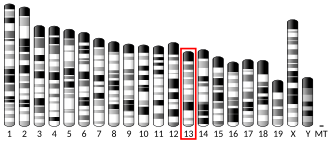 | | Chr. | Chromosome 13 (mouse)1 |
|---|
| | Band | 13 A1|13 5.29 cM | Start | 14,172,534 bp1 |
|---|
| End | 14,214,223 bp1 |
|---|
|
|
|
|
| Wikidata |
|
Tubulin-specific chaperone E is a protein that in humans is encoded by the TBCE gene.45
Cofactor E is one of four proteins (cofactors A, D, E, and C) involved in the pathway leading to correctly folded beta-tubulin from folding intermediates. Cofactors A and D are believed to play a role in capturing and stabilizing beta-tubulin intermediates in a quasi-native confirmation. Cofactor E binds to the cofactor D/beta-tubulin complex; interaction with cofactor C then causes the release of beta-tubulin polypeptides that are committed to the native state. Two transcript variants encoding the same protein have been found for this gene.5
The TBCE gene is either deleted or mutated in Sanjad-Sakati Syndrome
References
References
Further reading
Further reading
- Lewis SA, Tian G, Vainberg IE, Cowan NJ (1996). "Chaperonin-mediated folding of actin and tubulin". J. Cell Biol. 132 (1–2): 1–4. doi:10.1083/jcb.132.1.1. PMC 2120700. PMID 8567715.
- Parvari R, Diaz GA, Hershkovitz E (2007). "Parathyroid development and the role of tubulin chaperone E". Horm. Res. 67 (1): 12–21. doi:10.1159/000095944. PMID 17008776.
- Tian G, Lewis SA, Feierbach B, et al. (1997). "Tubulin subunits exist in an activated conformational state generated and maintained by protein cofactors". J. Cell Biol. 138 (4): 821–32. doi:10.1083/jcb.138.4.821. PMC 2138046. PMID 9265649.
- Parvari R, Hershkovitz E, Kanis A, et al. (1998). "Homozygosity and linkage-disequilibrium mapping of the syndrome of congenital hypoparathyroidism, growth and mental retardation, and dysmorphism to a 1-cM interval on chromosome 1q42-43". Am. J. Hum. Genet. 63 (1): 163–9. doi:10.1086/301915. PMC 1377236. PMID 9634513.
- Diaz GA, Khan KT, Gelb BD (1999). "The autosomal recessive Kenny-Caffey syndrome locus maps to chromosome 1q42-q43". Genomics. 54 (1): 13–8. doi:10.1006/geno.1998.5530. PMID 9806825.
- Roobol A, Sahyoun ZP, Carden MJ (1999). "Selected subunits of the cytosolic chaperonin associate with microtubules assembled in vitro". J. Biol. Chem. 274 (4): 2408–15. doi:10.1074/jbc.274.4.2408. PMID 9891010.
- Parvari R, Hershkovitz E, Grossman N, et al. (2002). "Mutation of TBCE causes hypoparathyroidism-retardation-dysmorphism and autosomal recessive Kenny-Caffey syndrome". Nat. Genet. 32 (3): 448–52. doi:10.1038/ng1012. PMID 12389028. S2CID 23979186.
- Martin N, Jaubert J, Gounon P, et al. (2002). "A missense mutation in Tbce causes progressive motor neuronopathy in mice". Nat. Genet. 32 (3): 443–7. doi:10.1038/ng1016. PMID 12389029. S2CID 7279049.
- Bommel H, Xie G, Rossoll W, et al. (2003). "Missense mutation in the tubulin-specific chaperone E (Tbce) gene in the mouse mutant progressive motor neuronopathy, a model of human motoneuron disease". J. Cell Biol. 159 (4): 563–9. doi:10.1083/jcb.200208001. PMC 2173089. PMID 12446740.
- Strausberg RL, Feingold EA, Grouse LH, et al. (2003). "Generation and initial analysis of more than 15,000 full-length human and mouse cDNA sequences". Proc. Natl. Acad. Sci. U.S.A. 99 (26): 16899–903. Bibcode:2002PNAS...9916899M. doi:10.1073/pnas.242603899. PMC 139241. PMID 12477932.
- Gevaert K, Goethals M, Martens L, et al. (2004). "Exploring proteomes and analyzing protein processing by mass spectrometric identification of sorted N-terminal peptides". Nat. Biotechnol. 21 (5): 566–9. doi:10.1038/nbt810. PMID 12665801. S2CID 23783563.
- Ota T, Suzuki Y, Nishikawa T, et al. (2004). "Complete sequencing and characterization of 21,243 full-length human cDNAs". Nat. Genet. 36 (1): 40–5. doi:10.1038/ng1285. PMID 14702039.
- Gerhard DS, Wagner L, Feingold EA, et al. (2004). "The status, quality, and expansion of the NIH full-length cDNA project: the Mammalian Gene Collection (MGC)". Genome Res. 14 (10B): 2121–7. doi:10.1101/gr.2596504. PMC 528928. PMID 15489334.
- Rual JF, Venkatesan K, Hao T, et al. (2005). "Towards a proteome-scale map of the human protein-protein interaction network". Nature. 437 (7062): 1173–8. Bibcode:2005Natur.437.1173R. doi:10.1038/nature04209. PMID 16189514. S2CID 4427026.
- Kimura K, Wakamatsu A, Suzuki Y, et al. (2006). "Diversification of transcriptional modulation: large-scale identification and characterization of putative alternative promoters of human genes". Genome Res. 16 (1): 55–65. doi:10.1101/gr.4039406. PMC 1356129. PMID 16344560.
- Gregory SG, Barlow KF, McLay KE, et al. (2006). "The DNA sequence and biological annotation of human chromosome 1". Nature. 441 (7091): 315–21. Bibcode:2006Natur.441..315G. doi:10.1038/nature04727. PMID 16710414.
- Kortazar D, Fanarraga ML, Carranza G, et al. (2007). "Role of cofactors B (TBCB) and E (TBCE) in tubulin heterodimer dissociation". Exp. Cell Res. 313 (3): 425–36. doi:10.1016/j.yexcr.2006.09.002. PMID 17184771.



