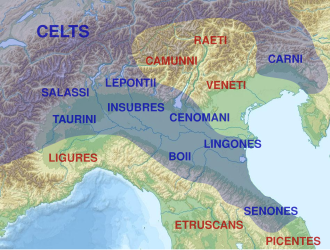
The Taurini were a Ligurian or Celto-Ligurian tribe dwelling in the upper valley of the river Po, around present-day Turin, during the Iron Age and the Roman period.
Name
They are mentioned as Taurĩnoí (Ταυρῖνοί) by Polybius (2nd c. BC),1 Taurini by Livy (late 1st c. BC),2 Taurinoí (Ταυρινοί) by Strabo (early 1st c. AD),3 Taurinorum by Pliny (1st c. AD),4 and as Taurínōn (Ταυρίνων; var. Ταυρικῶν, Ταυρινῶν) by Ptolemy (2nd c. AD).56
The ethnic name Taurini can be translated as 'the tribe of the bull'.7 It can either derive from an archaic form of the metathesized Celtic noun taruos ('bull'), or a non-Celtic Ligurian form.86
Geography
The Taurini lived between the Dora Riparia and the upper Po river.9 Their territory was located east of the Iemerii, west of the Libicii and Iadatini.10
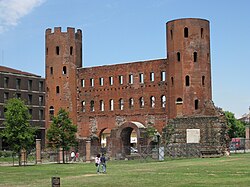
Their original capital, Taurasia, was destroyed by the Carthaginians after they opposed in vain Hannibal's march into Italy in 218 BC. It was refounded by the Romans after 25 BC as Colonia Augusta Taurinorum (modern Turin), at the confluence of the Dora and Po. The settlement was hit by a fire in 69 AD.911
History
They were involved in Rome's wars against the Celts at the end of the 4th century BC.9
In 218 BC, they were attacked by Hannibal, who had allied with their long-standing enemies, the Insubres. Their chief town was captured by Hannibal's forces after a three-day siege.12
Culture
The ethnic identity of the Taurini is unclear. They have been variously described as Celts, Ligurians, or more likely, Celticized Ligurians.911
References
References
- Polybius. Historíai, 3:60:8.
- Livy. Ab Urbe Condita Libri, 5:34:8; 21:38:5.
- Strabo. Geōgraphiká, 4:6:6; 4:6:12.
- Pliny. Naturalis Historia, 3:123.
- Ptolemy. Geōgraphikḕ Hyphḗgēsis, 3:1:31.
- Falileyev 2010, s.v. Taurini.
- de Bernardo Stempel 2006, p. 46.
- Delamarre 2003, p. 291.
- Sartori 2006.
- Talbert 2000, Map 39: Mediolanum.
- Salmon & Potter 2015.
- Chisholm 1911.
Bibliography
- de Bernardo Stempel, Patrizia (2006). "From Ligury to Spain: Unaccented *yo > (y)e in Narbonensic votives ('gaulish' DEKANTEM), Hispanic coins ('iberian' -(sk)en) and some theonyms". Palaeohispanica. 6: 45–58. ISSN 1578-5386.
- Delamarre, Xavier (2003). Dictionnaire de la langue gauloise: Une approche linguistique du vieux-celtique continental. Errance. ISBN 9782877723695.
- Falileyev, Alexander (2010). Dictionary of Continental Celtic Place-names: A Celtic Companion to the Barrington Atlas of the Greek and Roman World. CMCS. ISBN 978-0955718236.
- Salmon, Edward Togo; Potter, T. W. (2015). "Augusta Taurinorum". Oxford Research Encyclopedia of Classics. doi:10.1093/acrefore/9780199381135.013.972. ISBN 978-0-19-938113-5.
- Sartori, Antonio (2006). "Taurini". Brill's New Pauly. doi:10.1163/1574-9347_bnp_e1201630.
- Talbert, Richard J. A. (2000). Barrington Atlas of the Greek and Roman World. Princeton University Press. ISBN 978-0691031699.
Further reading
Further reading
- This article incorporates text from a publication now in the public domain: Chisholm, Hugh, ed. (1911). "Taurini". Encyclopædia Britannica. Vol. 26 (11th ed.). Cambridge University Press. p. 455.