  | |
| Observation data Epoch J2000.0 Equinox J2000.0 (ICRS) | |
|---|---|
| Constellation | Centaurus1 |
| Right ascension | 12h 37m 42.164s2 |
| Declination | −48° 32′ 28.70″2 |
| Apparent magnitude (V) | +3.863 |
| Characteristics | |
| Spectral type | A0 V4 or A1 IVnn5 |
| U−B color index | +0.043 |
| B−V color index | +0.063 |
| Astrometry | |
| Radial velocity (Rv) | +5.5±2.36 km/s |
| Proper motion (μ) | RA: −186.081 mas/yr2 Dec.: −6.757 mas/yr2 |
| Parallax (π) | 24.2953±0.53 mas2 |
| Distance | 134 ± 3 ly (41.2 ± 0.9 pc) |
| Absolute magnitude (MV) | +0.831 |
| Details | |
| Mass | 2.317 M☉ |
| Radius | 2.78 R☉ |
| Luminosity | 398 L☉ |
| Surface gravity (log g) | 4.02±0.147 cgs |
| Temperature | 10,533±3587 K |
| Rotational velocity (v sin i) | 296.8±3.89 km/s |
| Age | 1327 Myr |
| Other designations | |
| τ Cen, CD−47°7745, HD 109787, HIP 61622, HR 4802, SAO 22356010 | |
| Database references | |
| SIMBAD | data |
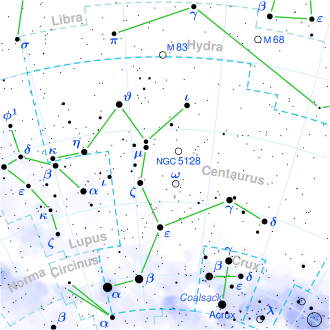
Tau Centauri is a solitary11 star in the southern constellation of Centaurus. Its name is a Bayer designation that is Latinized from τ Centauri, and abbreviated Tau Cen or τ Cen. This star is visible to the naked eye with an apparent visual magnitude of +3.86.3 The distance to this star, based upon an annual parallax shift of 24.3 mas,2 is 131 light years. It makes a star system with Gamma Centauri at 98% probability, both separated by 1.7 ly (0.53 pc).12
This is an A-type star with stellar classifications of A0 V4 or A1 IVnn,5 indicating it may be a main sequence star or a more evolved subgiant star. It is around 132 million years old7 and is spinning rapidly with a projected rotational velocity of 296.8 km/s.9 This is giving the star an oblate shape, with an estimated equatorial girth that is 30% larger than the polar radius.13 The star has an estimated 2.3 times the mass of the Sun7 and 2.7 times the Sun's radius.8
References
References
- Anderson, E.; Francis, Ch. (2012), "XHIP: An extended hipparcos compilation", Astronomy Letters, 38 (5): 331, arXiv:1108.4971, Bibcode:2012AstL...38..331A, doi:10.1134/S1063773712050015. XHIP record for this object at VizieR.
- Vallenari, A.; et al. (Gaia collaboration) (2023), "Gaia Data Release 3. Summary of the content and survey properties", Astronomy and Astrophysics, 674: A1, arXiv:2208.00211, Bibcode:2023A&A...674A...1G, doi:10.1051/0004-6361/202243940, S2CID 244398875. Gaia DR3 record for this source at VizieR.
- Mermilliod, J.-C. (1986), "Compilation of Eggen's UBV data, transformed to UBV (unpublished)", Catalogue of Eggen's UBV Data, SIMBAD Astronomical Database, Bibcode:1986EgUBV........0M.
- Lagrange, A.-M.; et al. (February 2009), "Extrasolar planets and brown dwarfs around A-F type stars. VI. High precision RV survey of early type dwarfs with HARPS", Astronomy and Astrophysics, 495 (1): 335–352, arXiv:0809.4636, Bibcode:2009A&A...495..335L, doi:10.1051/0004-6361:200810105, S2CID 62894956.
- Gray, R. O.; Garrison, R. F. (July 1989), "The late A-type stars - Refined MK classification, confrontation with Stromgren photometry, and the effects of rotation", Astrophysical Journal Supplement Series, 70 (4): 623–636, Bibcode:1989ApJS...70..623G, doi:10.1086/191349.
- de Bruijne, J. H. J.; Eilers, A.-C. (October 2012), "Radial velocities for the HIPPARCOS-Gaia Hundred-Thousand-Proper-Motion project", Astronomy & Astrophysics, 546: 14, arXiv:1208.3048, Bibcode:2012A&A...546A..61D, doi:10.1051/0004-6361/201219219, S2CID 59451347, A61.
- David, Trevor J.; Hillenbrand, Lynne A. (2015), "The Ages of Early-Type Stars: Strömgren Photometric Methods Calibrated, Validated, Tested, and Applied to Hosts and Prospective Hosts of Directly Imaged Exoplanets", The Astrophysical Journal, 804 (2): 146, arXiv:1501.03154, Bibcode:2015ApJ...804..146D, doi:10.1088/0004-637X/804/2/146, S2CID 33401607.
- McDonald, I.; et al. (October 2017), "Fundamental parameters and infrared excesses of Tycho-Gaia stars", Monthly Notices of the Royal Astronomical Society, 471 (1): 770–791, arXiv:1706.02208, Bibcode:2017MNRAS.471..770M, doi:10.1093/mnras/stx1433, ISSN 0035-8711.
- Díaz, C. G.; et al. (July 2011), "Accurate stellar rotational velocities using the Fourier transform of the cross correlation maximum", Astronomy & Astrophysics, 531: A143, arXiv:1012.4858, Bibcode:2011A&A...531A.143D, doi:10.1051/0004-6361/201016386, S2CID 119286673.
- "tau Cen". SIMBAD. Centre de données astronomiques de Strasbourg. Retrieved 2017-01-13.
- De Rosa, R. J.; et al. (January 2014), "The VAST Survey - III. The multiplicity of A-type stars within 75 pc", Monthly Notices of the Royal Astronomical Society, 437 (2): 1216–1240, arXiv:1311.7141, Bibcode:2014MNRAS.437.1216D, doi:10.1093/mnras/stt1932, S2CID 88503488.
- Shaya, Ed J.; Olling, Rob P. (January 2011), "Very Wide Binaries and Other Comoving Stellar Companions: A Bayesian Analysis of the Hipparcos Catalogue", The Astrophysical Journal Supplement, 192 (1): 2, arXiv:1007.0425, Bibcode:2011ApJS..192....2S, doi:10.1088/0067-0049/192/1/2, S2CID 119226823
- Belle, G. T. (2012), "Interferometric observations of rapidly rotating stars", The Astronomy and Astrophysics Review, 20 (1): 51, arXiv:1204.2572, Bibcode:2012A&ARv..20...51V, doi:10.1007/s00159-012-0051-2, S2CID 119273474.