| Tarsius1 Temporal range: Eocene to recent
| |
|---|---|
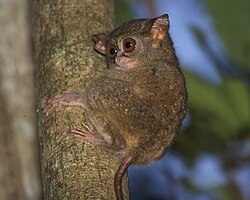
| |
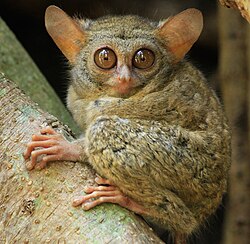
| Gursky's spectral tarsier | |
Scientific classification 
| |
| Kingdom: | Animalia |
| Phylum: | Chordata |
| Class: | Mammalia |
| Infraclass: | Placentalia |
| Order: | Primates |
| Family: | Tarsiidae |
| Genus: | Tarsius Storr, 1780 |
| Type species | |
| Lemur tarsier Erxleben, 1777
| |
| Species | |
| |
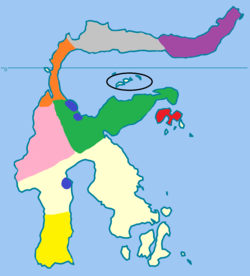
| Distribution and range of Tarsius supriatnai and other tarsier species in Sulawesi, Indonesia: | |
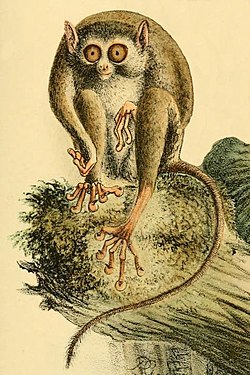
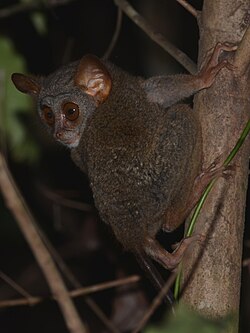
Tarsius is a genus of tarsiers, small primates native to islands of Maritime Southeast Asia, with almost all of its species found on Sulawesi Island. Until 2010, all tarsier species were typically assigned to this genus, but a revision of the family Tarsiidae restored the generic status of Cephalopachus and created a new genus Carlito.1
All members of Tarsius are found on Sulawesi, while Cephalopachus is found on Sundaland and Carlito in Greater Mindanao.
Species
| Common name | Scientific name and subspecies | Range | Size and ecology | IUCN status and estimated population |
|---|---|---|---|---|
| Dian's tarsier | T. dentatus Miller & Hollister, 1921 |
Central Sulawesi, Indonesia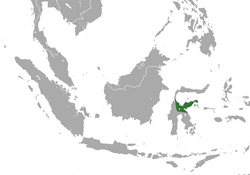
|
Size: 11–12 cm (4–5 in) long, plus 13–28 cm (5–11 in) tail23 Habitat: Forest4 Diet: Insects, as well as small vertebrates2 |
VU
|
| Gursky's spectral tarsier
|
T. spectrumgurskyae Shekelle, Groves, Maryanto & Mittermeier, 2017 |
Northeastern Sulawesi (in purple)
|
Size: About 14 cm (6 in) long, plus 21–27 cm (8–11 in) tail5 Habitat: Forest6 Diet: Insects, as well as small vertebrates6 |
VU
|
| Jatna's tarsier | T. supriatnai Shekelle, Groves, Maryanto & Mittermeier, 2017 |
Northern Sulawesi (in gray)
|
Size: About 14 cm (6 in) long, plus 23–25 cm (9–10 in) tail5 Habitat: Forest7 Diet: Insects, as well as small vertebrates7 |
VU
|
| Lariang tarsier | T. lariang Groves & Merker, 2006 |
Central Sulawesi
|
Size: About 12 cm (5 in) long, plus 12–21 cm (5–8 in) tail8 Habitat: Forest9 Diet: Insects, as well as small vertebrates9 |
DD
|
| Makassar tarsier
|
T. fuscus Fischer von Waldheim, 1804 |
Southern Sulawesi (in yellow)
|
Size: 12–13 cm (5 in) long, plus 24–26 cm (9–10 in) tail10 Habitat: Forest and caves11 Diet: Insects, as well as small vertebrates10 |
VU
|
| Niemitz's tarsier | T. niemitzi Shekelle, Groves, Maryanto, Mittermeier, Salim & Springer, 2019 |
Northern Sulawesi (circled in black)
|
Size: About 14 cm (6 in) long, plus 24–26 cm (9–10 in) tail12 Habitat: Forest13 Diet: Insects, as well as small vertebrates13 |
EN
|
| Peleng tarsier | T. pelengensis Sody, 1949 |
Eastern Sulawesi
|
Size: 12–14 cm (5–6 in) long, plus 25–27 cm (10–11 in) tail14 Habitat: Forest15 Diet: Insects, as well as frogs, lizards, and other small vertebrates15 |
EN
|
| Pygmy tarsier | T. pumilus Miller, Hollister, 1921 |
Central Sulawesi
|
Size: 8–11 cm (3–4 in) long, plus 20–21 cm (8 in) tail1617 Habitat: Forest18 Diet: Arthropods and insects, as well as small vertebrates16 |
EN
|
| Sangihe tarsier
|
T. sangirensis Meyer, 1897 |
Sangir Island, southeastern Philippines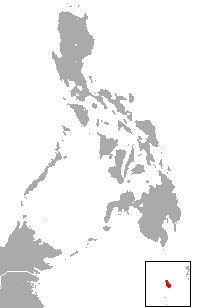
|
Size: 12–13 cm (5 in) long, plus about 30 cm (12 in) tail19 Habitat: Forest and inland wetlands20 Diet: Insects, as well as birds, lizards, and other small vertebrates19 |
EN
|
| Siau Island tarsier
|
T. tumpara Shekelle, Groves, Merker & Supriatna, 2008 |
Siau Island, north of Sulawesi | Size: 10–15 cm (4–6 in) long, plus about 20 cm (8 in) tail21 Habitat: Forest22 Diet: Arthropods, as well as small vertebrates22 |
CR
|
| Spectral tarsier | T. tarsier (Erxleben, 1777) |
Sulawesi
|
Size: 9–14 cm (4–6 in) long, plus 20–26 cm (8–10 in) tail23 Habitat: Forest24 Diet: Insects, as well as lizards, bats, and other small vertebrates23 |
VU
|
| Wallace's tarsier | T. wallacei Merker, Driller, Dahruddin, Wirdateti, Sinaga, Perwitasari-Farajallah & Shekelle, 2010 |
Northern Sulawesi (in orange)
|
Size: 11–13 cm (4–5 in) long, plus 23–27 cm (9–11 in) tail25 Habitat: Forest and inland wetlands26 Diet: Insects, as well as small vertebrates25 |
VU
|


As of 2018, Fossilworks also recognizes the following additional extinct species:27
- †Tarsius eocaenus Beard et al., 199428
- †Tarsius sirindhornae Chaimanee et al., 201129
References
References
- Groves, C.; Shekelle, M. (2010). "The Genera and Species of Tarsiidae". International Journal of Primatology. 31 (6): 1071–1082. doi:10.1007/s10764-010-9443-1. S2CID 21220811.
- Yang, Liubin (2007). "Tarsius dentatus". Animal Diversity Web. University of Michigan. Retrieved August 28, 2023.
- Supriatna, p. 49
- Shekelle, M. (2020). "Tarsius dentatus". IUCN Red List of Threatened Species. 2020 e.T21489A17977790. doi:10.2305/IUCN.UK.2020-3.RLTS.T21489A17977790.en.
- Shekelle, M.; Groves, C. P.; Maryanto, I.; Mittermeier, R. A. (2017). "Two new tarsier species (Tarsiidae, Primates) and the biogeography of Sulawesi, Indonesia". Primate Conservation. 31: 61–69.
- Shekelle, M. (2020). "Tarsius spectrumgurskyae". IUCN Red List of Threatened Species. 2020 e.T162336422A162336580. doi:10.2305/IUCN.UK.2020-3.RLTS.T162336422A162336580.en.
- Shekelle, M. (2022) [errata version of 2020 assessment]. "Tarsius supriatnai". IUCN Red List of Threatened Species. 2020 e.T162336881A220971513. doi:10.2305/IUCN.UK.2020-3.RLTS.T162336881A220971513.en.
- Supriatna, p. 45
- Shekelle, M; Salim, M.; Merker, S. (2020). "Tarsius lariang". IUCN Red List of Threatened Species. 2020 e.T136319A17978130. doi:10.2305/IUCN.UK.2020-3.RLTS.T136319A17978130.en.
- Supriatna, pp. 40–41
- Shekelle, M. (2020). "Tarsius fuscus". IUCN Red List of Threatened Species. 2020 e.T162369593A162369616. doi:10.2305/IUCN.UK.2020-3.RLTS.T162369593A162369616.en.
- Shekelle, M.; Groves, C. P.; Maryanto, I/; Mittermeier, R. A.; Salim, A/; Springer, M/ S. (2019). "A new tarsier species from the Togean Islands of Central Sulawesi, Indonesia, with references to Wallacea and conservation on Sulawesi". Primate Conservation. 33: 1–9. S2CID 204801433.
- Shekelle, M. (2020). "Tarsius niemitzi". IUCN Red List of Threatened Species. 2020 e.T162337005A171341769. doi:10.2305/IUCN.UK.2020-3.RLTS.T162337005A171341769.en.
- Supriatna, p. 53
- Shekelle, M. (2020). "Tarsius pelengensis". IUCN Red List of Threatened Species. 2020 e.T21494A17977515. doi:10.2305/IUCN.UK.2020-3.RLTS.T21494A17977515.en.
- Ford, Trevor (2011). "Tarsius pumilus". Animal Diversity Web. University of Michigan. Retrieved August 28, 2023.
- Supriatna, pp. 42–43
- Shekelle, M; Salim, A. (2020). "Tarsius pumilus". IUCN Red List of Threatened Species. 2020 e.T21490A17977980. doi:10.2305/IUCN.UK.2020-3.RLTS.T21490A17977980.en.
- Minich, Miriam (2017). "Tarsius sangirensis". Animal Diversity Web. University of Michigan. Retrieved August 28, 2023.
- Shekelle, M. (2020). "Tarsius sangirensis". IUCN Red List of Threatened Species. 2020 e.T21493A17977351. doi:10.2305/IUCN.UK.2020-3.RLTS.T21493A17977351.en.
- Downey, Kathleen (March 2019). "Siau Island Tarsier, Tarsius tumpara". New England Primate Conservancy. Retrieved September 20, 2023.
- Shekelle, M; Salim, A. (2020). "Tarsius tumpara". IUCN Red List of Threatened Species. 2020 e.T179234A17977202. doi:10.2305/IUCN.UK.2020-3.RLTS.T179234A17977202.en.
- Mogk, Kenzie (2012). "Tarsius tarsier". Animal Diversity Web. University of Michigan. Retrieved August 28, 2023.
- Shekelle, M. (2020). "Tarsius tarsier". IUCN Red List of Threatened Species. 2020 e.T162369551A17978304. doi:10.2305/IUCN.UK.2020-3.RLTS.T162369551A17978304.en.
- Supriatna, pp. 47–48
- Merker, S.; Shekelle, M. (2020). "Tarsius wallacei". IUCN Red List of Threatened Species. 2020 e.T195277A17977659. doi:10.2305/IUCN.UK.2020-3.RLTS.T195277A17977659.en.
- "Tarsius Storr 1780 (tarsier)". Paleobiology Database. Retrieved 24 November 2018.
- Beard, K. Christopher; Qi, Tao; Dawson, Mary R.; Wang, Banyue; Li, Chuankuei (1994). "A diverse new primate fauna from middle Eocene fissure-fillings in southeastern China". Nature. 368 (6472): 607. Bibcode:1994Natur.368..604B. doi:10.1038/368604a0. PMID 8145845. S2CID 2471330.
- Chaimanee, Y.; Lebrun, R.; Yamee, C.; Jaeger, J.-J. (2010). "A new Middle Miocene tarsier from Thailand and the reconstruction of its orbital morphology using a geometric-morphometric method". Proceedings of the Royal Society B: Biological Sciences. 278 (1714): 1956–1963. doi:10.1098/rspb.2010.2062. PMC 3107645. PMID 21123264.
Sources
Sources
- Groves, Colin P. (2005). Wilson, Don E.; Reeder, DeeAnn M. (eds.). Mammal Species of the World. Vol. 1 (3rd ed.). Johns Hopkins University Press. ISBN 978-0-8018-8221-0.
- Supriatna, Jatna (2022). Field Guide to the Primates of Indonesia. Springer Nature. ISBN 978-3-03-083206-3.