
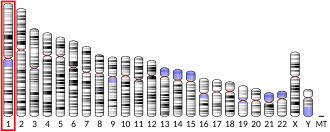





Syntaxin-binding protein 3 is a protein that in humans is encoded by the STXBP3 gene.56
Interactions
Syntaxin binding protein 3 has been shown to interact with STX27 and STX4.78
References
References
- GRCh38: Ensembl release 89: ENSG00000116266 – Ensembl, May 2017
- GRCm38: Ensembl release 89: ENSMUSG00000027882 – Ensembl, May 2017
- "Human PubMed Reference:". National Center for Biotechnology Information, U.S. National Library of Medicine.
- "Mouse PubMed Reference:". National Center for Biotechnology Information, U.S. National Library of Medicine.
- Reed GL, Houng AK, Fitzgerald ML (April 1999). "Human platelets contain SNARE proteins and a Sec1p homologue that interacts with syntaxin 4 and is phosphorylated after thrombin activation: implications for platelet secretion". Blood. 93 (8): 2617–26. doi:10.1182/blood.V93.8.2617. PMID 10194441.
- "Entrez Gene: STXBP3 syntaxin binding protein 3".
- Schraw TD, Lemons PP, Dean WL, Whiteheart SW (August 2003). "A role for Sec1/Munc18 proteins in platelet exocytosis". The Biochemical Journal. 374 (Pt 1): 207–17. doi:10.1042/BJ20030610. PMC 1223584. PMID 12773094.
- Widberg CH, Bryant NJ, Girotti M, Rea S, James DE (September 2003). "Tomosyn interacts with the t-SNAREs syntaxin4 and SNAP23 and plays a role in insulin-stimulated GLUT4 translocation". The Journal of Biological Chemistry. 278 (37): 35093–101. doi:10.1074/jbc.M304261200. PMID 12832401.
Further reading
Further reading
- Maruyama K, Sugano S (January 1994). "Oligo-capping: a simple method to replace the cap structure of eukaryotic mRNAs with oligoribonucleotides". Gene. 138 (1–2): 171–4. doi:10.1016/0378-1119(94)90802-8. PMID 8125298.
- Gengyo-Ando K, Kitayama H, Mukaida M, Ikawa Y (November 1996). "A murine neural-specific homolog corrects cholinergic defects in Caenorhabditis elegans unc-18 mutants". The Journal of Neuroscience. 16 (21): 6695–702. doi:10.1523/JNEUROSCI.16-21-06695.1996. PMC 6579271. PMID 8824310.
- Suzuki Y, Yoshitomo-Nakagawa K, Maruyama K, Suyama A, Sugano S (October 1997). "Construction and characterization of a full length-enriched and a 5'-end-enriched cDNA library". Gene. 200 (1–2): 149–56. doi:10.1016/S0378-1119(97)00411-3. PMID 9373149.
- Baccon J, Pellizzoni L, Rappsilber J, Mann M, Dreyfuss G (August 2002). "Identification and characterization of Gemin7, a novel component of the survival of motor neuron complex". The Journal of Biological Chemistry. 277 (35): 31957–62. doi:10.1074/jbc.M203478200. PMID 12065586.
- Widberg CH, Bryant NJ, Girotti M, Rea S, James DE (September 2003). "Tomosyn interacts with the t-SNAREs syntaxin4 and SNAP23 and plays a role in insulin-stimulated GLUT4 translocation". The Journal of Biological Chemistry. 278 (37): 35093–101. doi:10.1074/jbc.M304261200. PMID 12832401.
- Brandenberger R, Wei H, Zhang S, Lei S, Murage J, Fisk GJ, Li Y, Xu C, Fang R, Guegler K, Rao MS, Mandalam R, Lebkowski J, Stanton LW (June 2004). "Transcriptome characterization elucidates signaling networks that control human ES cell growth and differentiation". Nature Biotechnology. 22 (6): 707–16. doi:10.1038/nbt971. PMID 15146197. S2CID 27764390.
- Fu J, Naren AP, Gao X, Ahmmed GU, Malik AB (February 2005). "Protease-activated receptor-1 activation of endothelial cells induces protein kinase Calpha-dependent phosphorylation of syntaxin 4 and Munc18c: role in signaling p-selectin expression". The Journal of Biological Chemistry. 280 (5): 3178–84. doi:10.1074/jbc.M410044200. PMID 15576373.
- Hodgkinson CP, Mander A, Sale GJ (June 2005). "Identification of 80K-H as a protein involved in GLUT4 vesicle trafficking". The Biochemical Journal. 388 (Pt 3): 785–93. doi:10.1042/BJ20041845. PMC 1183457. PMID 15707389.