| Synalpheus | |
|---|---|
| |
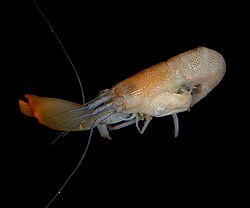
| Synalpheus fritzmuelleri | |
Scientific classification 
| |
| Kingdom: | Animalia |
| Phylum: | Arthropoda |
| Clade: | Pancrustacea |
| Class: | Malacostraca |
| Order: | Decapoda |
| Suborder: | Pleocyemata |
| Infraorder: | Caridea |
| Family: | Alpheidae |
| Genus: | Synalpheus Bate, 1888 |
| Type species | |
| Synalpheus falcatus Bate, 1888 1
| |
| Species | |
|
See species list | |
| Synonyms | |
|
List
| |
Synalpheus is a genus of snapping shrimp of the family Alpheidae, presently containing more than 160 species; new ones are described on a regular basis, and the exact number even of described species is disputed.
Taxonomy
Although the genus Zuzalpheus was proposed for S. gambarelloides, S. brooksi, and their closest relatives, this has not been adopted and is not considered a monophyletic clade within the genus Synalpheus.234
Over 160 species are recognised in the genus Synalpheus. For a complete listing, see List of Synalpheus species.
Distribution
In the narrower sense, Synalpheus occur in the eastern Pacific where they are most plentiful and probably originated, and to a lesser extent in the Atlantic and the Indian Ocean; the species placed in Zuzalpheus occur mainly in the western Atlantic where their lineage probably originated, and to a lesser extent in the eastern Atlantic and Indian Ocean, and the eastern Pacific. It may thus be that the closure of the Isthmus of Panama in the Piacenzian (about 3 million years ago) was a key factor in separating the two lineages, as species referred to Synalpheus sensu stricto are most plentiful in the western Pacific.4
Behaviour and ecology
Snapping
The snapping behaviour of Synalpheus is rather well studied. In Synalpheus parneomeris, peak to peak source levels of 185–190 dB re 1 μPa at 1 m were measured, depending on the size of the claw.5
Eusociality
The only known eusocial aquatic species occur within the genus Synalpheus. The species known to be eusocial are S. brooksi, S. chacei, S. elizabethae, S. filidigitus, S. rathbunae, S. regalis,2 S. microneptunus,6 and S. duffyi as well as potentially S. riosi.7 The level of eusociality exhibited differs between species, with highly eusocial species having one reproducing female, or queen, per colony. Some species, including S. brooksi and S. rathbunae, may have up to a dozen reproducing females in a single colony. Species with many reproducing females see higher levels of reproductive competition.8
Eusociality has evolved at least three times within Synalpheus.39 It appears that there were multiple rapid radiations between 3 and 9 mya from which the ancestors of these eusocial species appeared.9 Eusociality is thought to have arisen due to competition for space, because among the species that host Synalpheus, empty sponges are rarely found.10 The evolution of eusociality is also linked to a species filling a generalist role in their ecosystem, which is true of all Synalpheus species which exhibit eusocial behavior.11It also appears that kin selection was necessary for this evolution to occur because the only species in which eusociality has appeared are non-dispersing shrimp that hatch directly into crawling individuals.12 Until recently, eusocial species of Synalpheus have appeared in far greater abundance than, and appear to outcompete, less social species for space in sponges.1013
References
References
- Arthur Anker; Sammy De Grave (2008). "Zuzalpheus Ríos and Duffy, 2007: a junior synonym of Synalpheus Bate, 1888 (Decapoda: Alpheidae)" (PDF). Journal of Crustacean Biology. 28 (4): 735–740. doi:10.1651/07-2969.1. S2CID 86161073.
- Rubén Ríos & J. Emmett Duffy (2007). "A review of the sponge-dwelling snapping shrimp from Carrie Bow Cay, Belize, with description of Zuzalpheus, new genus, and six new species (Crustacea: Decapoda: Alpheidae)" (PDF). Zootaxa. 1602: 1–89. doi:10.11646/zootaxa.1602.1.1.
- J. Emmett Duffy; Cheryl L. Morrison; Rubén Ríos (2000). "Multiple origins of eusociality among sponge-dwelling shrimps (Synalpheus)" (PDF). Evolution. 54 (2): 503–516. doi:10.1111/j.0014-3820.2000.tb00053.x. PMID 10937227. S2CID 1088840. Archived from the original (PDF) on 2003-06-07.
- Margarita Hermoso-Salazar; Mary Wicksten; Juan J. Morrone (2008). "Phylogenetic analysis of the Paulsoni species group (Decapoda: Alpheidae) from the American Pacific, with implications for the phylogenetic classification of the genus Synalpheus" (PDF). Zootaxa. 1744: 19–30. doi:10.11646/zootaxa.1744.1.2.
- W. W. L. Au; K. Banks (1998). "The acoustics of the snapping shrimp Synalpheus parneomeris in Kaneohe Bay". Journal of the Acoustical Society of America. 103 (1): 41–47. Bibcode:1998ASAJ..103...41A. doi:10.1121/1.423234.
- Hultgren, Kristin M.; Macdonald III, Kenneth s; Duffy, J. Emmett (2011). "Sponge-dwelling snapping shrimps (Alpheidae: Synalpheus) of Barbados, West Indies, with a description of a new eusocial species" (PDF). Zootaxa. 2834: 1–16. doi:10.11646/zootaxa.2834.1.1.
- Anker, Arthur; Toth, Eva (2008). "A preliminary revision of the Synalpheus paranuptunus Coutiere, 1909 species complex (Crustacea: Decapoda: Alpheidae)" (PDF). Zootaxa. 1915: 1–28. doi:10.11646/zootaxa.1915.1.1. S2CID 86215392.
- Bornbusch, Sarah L.; Lefcheck, Jonathan S.; Duffy, J. Emmett (2018-03-14). Lutermann, Heike (ed.). "Allometry of individual reproduction and defense in eusocial colonies: A comparative approach to trade-offs in social sponge-dwelling Synalpheus shrimps". PLOS ONE. 13 (3) e0193305. doi:10.1371/journal.pone.0193305. ISSN 1932-6203. PMC 5851585. PMID 29538466.
- Morrison, Cheryl L; Rios, Ruben; Duffy, J Emmett (May 2004). "Phylogenetic evidence for an ancient rapid radiation of Caribbean sponge-dwelling snapping shrimps (Synalpheus)". Molecular Phylogenetics and Evolution. 30 (3): 563–581. Bibcode:2004MolPE..30..563M. doi:10.1016/S1055-7903(03)00252-5. PMID 15012939.
- Brooks, Katherine C.; Maia, Rafael; Duffy, J. Emmett; Hultgren, Kristin M.; Rubenstein, Dustin R. (December 2017). Westneat, David (ed.). "Ecological generalism facilitates the evolution of sociality in snapping shrimps". Ecology Letters. 20 (12): 1516–1525. doi:10.1111/ele.12857. ISSN 1461-023X. PMID 28980422.
- Duffy, J. Emmett; Macdonald, Kenneth S. (4 November 2009). "Kin structure, ecology and the evolution of social organization in shrimp: a comparative analysis". Proceedings of the Royal Society B: Biological Sciences. 277 (1681): 575–584. doi:10.1098/rspb.2009.1483. PMC 2842683. PMID 19889706.
- Duffy, J. Emmett; Macdonald III, Kenneth S.; Hultgren, Kristin M.; Chak, Tin Chi Solomon; Rubenstein, Dustin R. (13 February 2013). "Decline and local extinction of Caribbean eusocial shrimp". PLOS ONE. 8 (2) e54637. Bibcode:2013PLoSO...854637D. doi:10.1371/journal.pone.0054637. PMC 3572134. PMID 23418429.
Further reading
Further reading
- Kristin M. Hultgren, Kenneth S. MacDonald III & J. Emmett Duffy (2011). "Sponge-dwelling snapping shrimps (Alpheidae: Synalpheus) of Barbados, West Indies, with a description of a new eusocial species" (PDF). Zootaxa. 2834: 1–16. doi:10.11646/zootaxa.2834.1.1.