
A temazcal [temasˈkal] is a type of sweat lodge, which originated with indigenous peoples in Mesoamerica. The term temazcal comes from the Nahuatl language, either from the words teme (to bathe) and calli (house), or from the word temāzcalli [temaːsˈkalːi] (house of heat).1
Overview
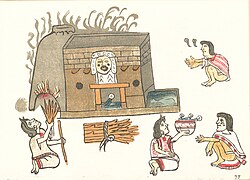
In ancient Mesoamerica it was used as part of a curative ceremony thought to purify the body after exertion such as after a battle or a ceremonial ball game. It was also used for healing the sick, improving health, and for women to give birth. It continues to be used today in Indigenous cultures of Mexico and Central America that were part of the ancient Mesoamerican region for spiritual healing and health enrichment reasons.
The temazcal is usually a permanent structure, unlike sweat lodges of other regions. It has various construction styles differing by region: from volcanic rock and cement, adobe mud bricks, even wood, mud, and cloth can be utilized. It may be a circular dome made to represent the uterus, although rectangular ones have been found at certain archeological sites, such as the Cross Group in Palenque, Mexico.2 To produce steam, water is poured over heated volcanic stones, which will not crack and explode like other rocks in confined high temperature areas. The stones may be heated with fire from an outside port or placed in a pit located in the center or near a wall of the temazcal. In the modern day, the temazcal is used by indigenous midwifes (comadronas) to assist women before, during, and after childbirth.3
Notes
Notes
- Iliadis, Theodoros (2024). "The Quest to Consume the Authentic Other: The Mexican Temazcal as a Case-Study Analysis of Experiential Consumption in the Periphery of Neoliberalism". Refubium. doi:10.17169/refubium-46813.
- Houston, Stephen D. (1996). "Symbolic Sweatbaths of the Maya: Architectural Meaning in the Cross Group at Palenque, Mexico". Latin American Antiquity. 7 (2): 132–151. doi:10.2307/971614. ISSN 1045-6635.
- Space and Spatial Analysis in Archaeology. University of Calgary Press. 2006.