
In North American broadcasting, a superstation is a terrestrial television station that has its broadcast range extended outside of their originating media market via communications satellite to multichannel television providers, including cable and direct broadcast satellite. These stations, which had no network affiliation and operated as independents, were popularized from the late 1970s to the early 1990s with offerings of reruns, movies, local play-by-play sports coverage and, in some cases, local newscasts. These signals were also popular among C-band satellite subscribers in rural areas where broadcast signals could not be picked up off-air.
Superstation is defined by the Federal Communications Commission (FCC) as a television station that is additionally transmitted via satellite.1 Further legislation, in particular the Satellite Home Viewer Improvement Act of 1999, narrowed this definition further to specify the station must not have a network affiliation.23 Superstations either have an active or passive classification: active superstations intentionally seek retransmission via an outside provider, while passive superstations are involuntarily retransmitted without the station's consent.45 Superstation can also refer to major network affiliates uplinked by satellite to providers like Primetime 24 and Netlink USA.6
The television stations commonly recognized as superstations are the following:
- KTLA Los Angeles
- KTVT Dallas–Fort Worth (1984–1994)
- KTVU San Francisco (1978–1980)
- KWGN-TV Denver
- WGN-TV Chicago (1978–2014)
- WOR-TV/WWOR-TV New York (1979–1996)
- WPIX New York City
- WSBK-TV Boston
- WTCG/WTBS Atlanta (1976–2007)
- CHAN-TV Vancouver, British Columbia
- CHCH-TV Hamilton, Ontario
- CITV-TV Edmonton, Alberta
"Superstation" is most closely associated with the concept's progenitor, WTCG in Atlanta. After previously extending their reach to cable systems in the southeastern United States through microwave relay, WTCG became the first television station to be uplinked to a satellite in 1976. Renamed WTBS in 1979, it promoted itself as "the Superstation" and later as "Superstation WTBS". The availability of superstations began to decline after 1990, when the FCC reinstated syndication exclusivity rules, forcing superstations to license content for national distribution or seek alternate programming from their parent stations. The distributor for WWOR's superstation feed began operating it separately as the WWOR EMI Service, WGN's feed gradually evolved into WGN America, and WTBS's feed was relaunched as TBS.
Cable television and distant signals

The concept of extending a television station's range via pay television was not new. Early community antenna television (CATV) systems were restricted from retransmitting distant signals to communities no more than approximately 100 miles (160 km) from the closest signal; this was a detriment to many small communities too distant from any receivable signal.7 As a result, several communities in the Western United States began incorporating CATV systems using microwave relay systems that made it possible to retransmit broadcast signals over great distances. Starting in 1955, Inland Empire Microwave Co. began importing Spokane, Washington, station KHQ-TV (NBC) to a cable system in Richland via microwave relay; this was regarded as a technical feat given Richland's topography.8 The following year, Inland Microwave imported KREM-TV (ABC) to the same Richland system and imported KHQ, KREM and KXLY-TV (CBS) to a Pendleton, Oregon, system.910
Carter Mountain Transmission Corp. was a microwave relay firm in Cody, Wyoming, that started importing distant signals for CATV systems.11 In 1959, Carter Mountain sought to retransmit KTWO-TV (NBC) in Casper, Wyoming, along with KOOK-TV (CBS) and KGHL-TV (ABC) in Billings, Montana, to CATV systems in Riverton, Lander and Thermopolis, all within the signal range of KWRB-TV in Riverton.12 While the Federal Communications Commission (FCC) initially granted the permit without a vote, KWRB owner Chief Washakie TV protested to the FCC, which issued a stay in 1960 pending an evidentiary hearing after determining KWRB was at risk of folding. This stay extended to five other CATV systems, including one in Helena, Montana, that imported Spokane stations, which caused the city's lone television station, KXLJ-TV, to go dark.131415 The FCC rejected the Carter Mountain permit by majority vote in December 1961; dissenting commissioner John S. Cross called the decision a "bad law" and "sets an undesirable precedent".12 This denial was unanimously affirmed by the D.C. Court of Appeals161718 which the U.S. Supreme Court declined to hear19 and became known as the "Carter Mountain Doctrine".20
Two separate lawsuits helped enable the expansion of "proto-superstations". The first was filed in July 1961 by United Artists and WSTV in Steubenville, Ohio, over Fortnightly Corp. importing television stations from Pittsburgh and Wheeling, West Virginia, to systems in Fairmont and Clarksburg, West Virginia;21 the U.S. Supreme Court ruled in 1968 in Fortnightly Corp. v. United Artists Television, Inc. that distant signal retransmission did not constitute a "performance" and was not subject to copyright liability.2223 The second lawsuit was filed by CBS in December 1964 over similar importation of larger-market stations by TelePrompTer Corporation to their small-market systems.24 Judge Constance Baker Motley of the U.S. District Court for the Southern District of New York ruled in 1972 in favor of TelePrompTer based on the Supreme Court's framework in Fortnightly v. United Artists.25
The FCC instituted a broad package of cable industry regulations in February 1972. Cable systems in the top 100 markets were now allowed to carry distant signals "as a matter of right" and could import as many as two out-of-market stations; systems in smaller markets, excluding undefined markets, were restricted to carry three network affiliates and one independent. Also implemented were syndication exclusivity (syndex) rules compelling cable systems to blackout any and all syndicated programming on imported distant signals if they were also aired on an in-market station.26 The FCC adjusted these rules in August 1975, allowing systems to import signals in the overnight hours or after a local must-carry station's nightly sign-off, effectively operating as a timeshare.27 By December 1975, the FCC repealed "leapfrogging rules" limiting cable systems to select distant signals based on closeness to the respective system; the FCC's Cable Television Bureau argued superstations were unlikely to form due to a lack of evidence that television stations economically benefited from cable carriage.28
Section 111 of the Copyright Act of 1976, passed by Congress on October 1, 1976, provided cable systems and satellite carriers with a compulsory license allowing them to retransmit copyrighted programming from any over-the-air stations across the country, regardless of the station's consent.29 To administer these royalty fee payments and rates, the U.S. Copyright Office established the Copyright Royalty Tribunal (CRT).3031
The proto-superstations
Eastern Microwave Inc. (EMI) was established in 1961 in Oneonta, New York, both to import distant signals and connect network affiliates in Upstate New York.323334 The following year, EMI began relaying WPIX in New York City, chosen due to their heavy sports presence, to CATV systems in Oneonta and surrounding areas.35 In March 1965, EMI started distributing WPIX, WNEW-TV and WOR-TV to systems in Canajoharie and Carthage.36 Newhouse Broadcasting, a subsidiary of Advance Publications, acquired EMI with five Upstate New York cable systems in 1965.3337 Largely attributed to the station's acquisition of Minnesota Twins games, WTCN-TV in Minneapolis–Saint Paul found cable carriage by 1963 throughout Minnesota and Wisconsin.38 In the early 1970s, WTCN was available in North Dakota and Iowa.3940 KBMA-TV in Kansas City, Missouri, had a cable footprint in 1972 that spanned 200,000 cable households in seven states.41 By 1981, KBMA's cable reach was 600,000 homes in six states.42
In 1962, H&B Microwave began importing WGN-TV in Chicago to Dubuque FM-TV Cable in Dubuque, Iowa, owing to the station's local sports presence;43 WFLD, also in Chicago, was added by Dubuque FM-TV after that station added the Chicago White Sox.44 WGN soon began to be imported via microwave to other cable systems throughout the Midwest, and by 1978, enjoyed carriage on 574 systems and a footprint of 8.6 million subscribers.45 Christian Broadcasting Network's WYAH-TV in Virginia Beach enjoyed significant regional coverage as their emphasis on religious fare, alongside reruns and classic movies, qualified it as a specialty channel and exempt from "leapfrogging rules".4647 WYAH and CBN's KXTX-TV in Dallas–Fort Worth continued to be available extensively on cable into the early 1980s,48 years after CBN uplinked a cable channel of their own to satellite.4950 Gaylord Broadcasting also began allowing its independents to be distributed to cable systems in their respective regions.
Two Cleveland independents, WKBF-TV and WUAB, attained regional coverage on cable systems; when WKBF shut down in 1975, WUAB and WKBD-TV in Detroit51 inherited much of WKBF's footprint.5253 In 1970, KTXL in Sacramento, California, extended its reach to systems in Reno, Nevada;54 by 1975, KTXL was available in Salt Lake City55 and—at night—as far away as Rapid City, South Dakota, the following year.56
WTCG, the first national superstation
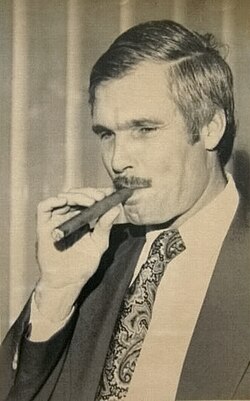
WTCG, an independent station in Atlanta, began expanding its reach to cable systems via microwave in 1972 when owner Ted Turner was approached by Andy Goldman, marketing director for TelePrompTer's systems in Alabama that boasted 200,000 subscribers; Goldman regarded WTCG's fare—including Atlanta Braves and Atlanta Hawks telecasts, reruns and movies57—as "a product worth someone putting up $4.95 for".58 While WTCG did not receive compensation from these systems, it did profit substantially from direct response advertising, whose revenue grew alongside WTCG's cable footprint. WTCG was eventually distributed to other parts of the Southeastern United States including Tennessee, North Carolina, South Carolina and Florida.59 The station had been billing itself as "Super 17" since Turner took ownership in 1970, originally as a tongue-in-cheek reference as the station had, until 1973, consistently lost money.6061
Goldman, who became TelePrompTer's vice president of marketing, informed Turner in 1975 of premium cable service Home Box Office (HBO)'s plans to transmit nationwide using communications satellites, elevating it from a regional pay television channel.6263 Turner learned through research that WTCG could be uplinked via their transmitter to satellite and made available to cable and C-band satellite services across the country, providing cable operators desiring additional channels with his programming,6465 all while being a cost-effective alternative from microwave and telephone landlines.66 HBO was uplinked for the first time to carry the "Thrilla in Manila" boxing match on October 1, 1975.67 The following month, at the 1975 Western Cable Show in Anaheim, California, Turner announced that WTCG was looking at a satellite uplink of their own; KTXL owner Jack Matranga also disclosed his station's interest in being uplinked.68
After signing a deal with RCA American Communications for transponder space, Turner established Southern Satellite Systems (SSS) as a common carrier uplink provider to serve as WTCG's redistributor.69 Turner raised enough capital to support SSS through loans by First Chicago Bank, Chase Bank and Chemical Bank, and pension funds like TIAA.64 To bypass FCC rules requiring a common carrier need to be a middleman between WTCG and cable providers, Turner sold SSS in March 1976 to former Western Union vice president of marketing Edward L. Taylor for $1.70 After the deal closed, Turner and SSS signed an agreement to uplink WTCG to Satcom 1, while SSS leased a Series 8000 Satellite Earth Terminal from Scientific Atlanta.71 In making the announcement, Turner suggested WTCG could potentially become the impetus for a fourth television network,72 an idea he continued to hold into the early 1980s.73 While testifying before the House Subcommittee on Communication in June 1976, Turner advocated for cable systems to be able to import additional signals to benefit the consumer, and saw WTCG as a safe, family-friendly alternative leaning on classic movies and sports.74
WTCG first used a satellite uplink on October 27, 1976, to feed an Atlanta Hawks–Los Angeles Lakers game back to the station via a newly constructed earth station in North Atlanta.6175 After winning approval from the FCC to serve as a common carrier for WTCG on December 17, 1976,76 SSS uplinked the station to four cable systems in Grand Island, Nebraska, Newport News, Virginia, Troy, Alabama, and Newton, Kansas, at 1 p.m. ET (12 p.m. CT).77 In its approval, the FCC praised the uplink proposal by SSS as "an innovative combination of new technology and established practices".78 SSS initially charged cable systems 10 cents per subscriber to transmit WTCG full-time and 2 cents per subscriber to carry it as an overnight, post-sign-off timeshare,6177 which WTCG itself did not earn any profit from.79 By June 1977, WTCG was available to 800,000 homes in 17 states,61 and was available on TelePrompTer's New York City systems in October 1978.79 At that time, WTCG's rate card was adjusted to better reflect the national cable audience;80 by 1982, the station had sales offices in Atlanta, New York and Chicago.81
His station was already one of only a few stations offering programming 24 hours a day, and it was sending out 30 movies a week from a 2,700-film library he had quietly built up, along with reruns that now range from Leave It to Beaver to All in the Family to a recently purchased block of 174 hours of high class BBC and Time-Life programming. The sports teams were secure -- he owned them.
No wonder the sudden network flowered: Turner was exporting Atlanta like Holland exports tulips, with one big difference. You have to pay for the tulips.
WTCG's growing availability on cable led the Motion Picture Association of America (MPAA), concerned about potential financial losses on programs distributed by MPAA members that aired on superstations, to petition the FCC in 1977 for an investigation.83 The MPAA was supported by the National Association of Broadcasters (NAB) along with Kelly Broadcasting, McGraw-Hill Broadcasting and Taft Television & Radio Company; WHIZ-TV in Zanesville, Ohio, considered superstations as "threatening" and the FCC's approval of them as "unconstitutional".84 The MPAA also lodged an effort to deny SSS's application to grant an expansion of WTCG's service to Puerto Rico, Alaska and Canada.83 In turn, Turner vowed to air increased amounts of highbrow and educational programming over WTCG and institute twice-hourly news updates beyond the bare minimum of news the station had been notorious for.85
By May 1978, WTCG was being received by 1.5 million households in 45 states, increasing by 100,000 households per month;82 by the end of that year, the station was available through cable systems in all 50 states.80 WTCG changed its call sign to WTBS on August 27, 1979, alongside with a corporate name change to Turner Broadcasting System.86 Turner also registered a trademark on "Superstation".8788 With the renaming, reports surfaced that the personnel Turner hired to launch CNN in the summer of 1980 were also considering a nightly newscast over WTBS.89 In both 1982 and 1983, Turner Broadcasting garnered half of the advertising revenue generated by the entire cable industry.90 WTBS remained the most widely distributed superstation throughout the 1980s: in 1987, WTBS was available to 41.6 million cable and satellite subscriber households nationwide.91
Aside from Turner's use of WTBS to help launch his other cable ventures, SSS used the WTBS signal for the national distribution of teletext. By 1982, SSS was distributing services from United Press International, Reuters, Dow Jones, and View Weather for extraction by cable operators to be displayed as their own channels.92 In 1982, Keyfax, a national teletext magazine from Field Enterprises, debuted on the WTBS vertical blanking interval (VBI)93 using the British teletext standard, World System Teletext.94 In 1985, SSS switched to offering Electra, a service of Taft Broadcasting.95
Other emerging superstations
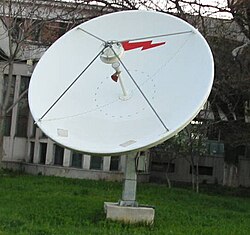
On October 25, 1978, the FCC implemented an "open entry" policy for satellite carriers wanting to uplink local television stations, and began reviews on existing applications. The next day, the FCC gave approval to four different carriers to uplink WGN-TV: United Video Satellite Group, Inc., SSS, American Microwave & Communications and Midwestern Relay Company. The FCC's decision to grant all four applications was based off of wanting to bring "a diversity of service" to the public.80 The "open entry" policy elicited "anger to passive resistance" among program distributors, who were concerned about not being properly compensated for shows airing on superstations.96 The FCC also repealed a requirement for cable systems to request waivers to carry distant signals, instead compelling local stations who would object to submit proof of economic harm; this policy change was seen as a significant deregulation move allowing additional superstations to be created.97
Satellite Communication Systems (SCS), a joint venture of Holiday Inns and SSS, sought to retransmit KTVU in Oakland–San Francisco.4598 SSS also applied to uplink KTTV in Los Angeles and WPIX in New York City, while both EMI and United Video applied to uplink WOR-TV and WSBK-TV in Boston; EMI planned to rebroadcast WCBS-TV whenever WOR would sign-off in the overnight hours.80 SSS withdrew from uplinking WGN-TV after falling into a lease dispute with RCA over their assigned Satcom transponder, prompting United Video to assert uplink responsibilities.99 WGN-TV was uplinked to Satcom-3 by United on November 9, 1978, and within one week, was available to an estimated 200 cable systems and 1.5 million subscribers throughout the country.100 After learning WGN would be uplinked, Turner said, "Hallelujah, I'm looking for them".80 Despite the added exposure the station was provided, WGN-TV sought to market itself to the Chicago market, deriving no money from United Video; this stance was also to avoid the risk of paying national advertising rates to program syndicators.101 The uplink resulted in the NCAA withdrawing a package of college basketball games from WGN, which were offered to a competing Chicago station.102
KTVU was uplinked next on December 16, 1978, by SCS onto a Satcom-1 transponder.103 Holiday Inns Inc. withdrew from the SSS partnership by April 1979, leaving the latter to handle uplink and promotional responsibilities for KTVU.104 SCS was unsuccessful in marketing KTVU at the level of WTBS or WGN-TV,101 and by April 1980, Warner-Amex Satellite Entertainment purchased SCS specifically for KTVU's transponder space. Warner-Amex sought the satellite space for its own cable channels, including Star Channel, Nickelodeon and MTV.105 United uplinked a Chicago classical music radio station, WFMT, to Satcom I in May 1979 as a cable radio feed; this allowed WFMT to be available throughout the United States and over two dozen countries overseas including the Soviet Union and China. Other than some limited revenue from a scant number of national advertisers, WFMT earned no extra revenue from its expanded distribution.106107
In March 1979, Metromedia filed an objection to the FCC over ASN Inc.'s request to uplink KTTV as an "involuntary superstation" and sought to halt any further proceedings on superstation signals. Metromedia claimed such retransmission violated the Communications Act which required the station owner's consent, even though Section 111 of the 1976 Copyright Act allowed such importation.108 The NAB filed a concurrent petition (joined by the MPAA, the NBA, the NHL, MLB Commissioner Bowie Kuhn, Tribune and ABC) urging the FCC to conduct an expedited rulemaking limiting the reach of superstations, claiming they threatened to undermine local stations by taking away the exclusivity of syndicated programming.108 ASN ceased operations over financial issues, rendering the KTTV petition moot.109
| Channel | Total cable households, 1987 | Total cable households, 1983 | |||||||
|---|---|---|---|---|---|---|---|---|---|
| WTBS | |||||||||
| WGN-TV | |||||||||
| WOR-TV | |||||||||
| WPIX † | |||||||||
| KTVT † | |||||||||
|
† WPIX and KTVT were both uplinked to satellite in 1984. | |||||||||
EMI, who had already distributed WOR-TV via microwave throughout much of the Northeastern U.S., uplinked the station to transponder 17 of Satcom I in April 1979 for nationwide distribution.110 EMI also received approval to retransmit WSBK pending a future Satcom launch later in 1979111 but upon learning they could only access one transponder, EMI selected WOR over WSBK following an internal survey.112 As EMI was a part of Advance's cable division, 22 out of the 23 cable systems Advance operated carried the WOR superstation feed.113 WOR's distribution, while broad, was still regionally scattered and paced far behind WTBS and WGN into the 1990s.114
After acquiring WPIX's retransmission rights from Southern Satellite Systems, United Video uplinked WPIX on May 1, 1984, over Westar V.115 United also uplinked KTVT over Satcom IV on July 1, 1984, with Gaylord Broadcasting's support; Gaylord believed cable systems could be persuaded to upgrade from receiving KTVT over microwave.116 KTVT's transponder was relocated to Spacenet III in December 1988.117 EMI uplinked KTLA and WSBK on February 15, 1988, for regional distribution via Satcom I-R; both stations were selected for their local sports coverage and were scrambled from the onset using the Videocipher II encryption system.118 Tribune, which also owned KTLA, opposed the uplink when notified by EMI but had no legal recourse. An EMI representative told KTLA station manager Michael Eigner, "we understand your reluctance, but we're going to do it anyway".119 United Video took over for marketing KTLA's superstation feed by that April.120 By 1993, United Video accounted for two-thirds of parent company UVSG's cash flow, aided by Tribune receiving compensation by the cable systems via copyright fees.121
The lack of legal recourse by television stations led two different companies, Primetime 24 and Netlink USA, to uplink network affiliates for cable systems and home dish markets in areas without a, or any, network affiliate.6 Primetime 24 was a package of WABC-TV (ABC), WBBM-TV (CBS) and WXIA-TV (NBC), while Netlink distributed KUSA (ABC), KCNC-TV (NBC), KMGH-TV (CBS), KRMA (PBS) and KWGN-TV, all in Denver; WNYW-TV (Fox) was also uplinked to gauge cable company and subscriber interest.122 Netlink replaced KWGN with KDVR (Fox), then re-uplinked KWGN by October 1987.123 Both services uplinked these stations without any permission or consent.122 In the early 1990s, the Denver Metro Convention and Visitors Bureau began running advertisements on the Netlink-uplinked stations, resulting in rise in international tourism; a 1994 mail-in contest with a grand prize of a trip to Denver yielded entries from Canada, Mexico, Belize, Costa Rica, Guatemala, Honduras and Nicaragua.124
Deregulation and copyright law
The FCC repealed their remaining distant signal importation and syndex rules by a 4–3 majority vote on July 22, 1980, determining local stations "are not adversely affected" out-of-market stations imported on cable. Malrite Broadcasting sued the FCC in the Eastern District of New York, claiming the repeals would "endanger young independents".125 The NAB and Field Communications also filed stay motions to the commission,126127 which were denied.128 The Eastern District unanimously affirmed the repeals on June 19, 1981,129130 which the U.S. Supreme Court declined to review.131
In April 1981, Tribune Broadcasting filed a copyright infringement suit against United Video in the Northern District of Illinois, charging United inserted teletext content from its Dow Jones business news service over the satellite feed's vertical blanking interval (VBI) during WGN's newscasts and other local programs in place of teletext listings data the station was relaying to United's Electronic Program Guide (EPG) service, in violation of the Copyright Act's passive carrier rules.132133 In October 1981, District Court Judge Susan Getzendanner denied an injunction and dismissed the case, determining United was not required to carry the station's teletext transmission.134 The U.S. Court of Appeals for the Northern District of Illinois disagreed, ruling in August 1982 that United Video must retransmit WGN-TV's VBI teletext where directly related to and part of the 9 p.m. news simulcast, noting that United had no grounds to claim the unseen teletext exempted it from copyright liability as the Copyright Act's definition of what constitutes as a public performance was broad enough to encompass indirect transmission through cable affiliates.135
By the fall of 1981, the MPAA, the NAB, sports leagues and copyright holders requested the Copyright Office raise royalty rates to compensate for losses incurred by distant signals and syndex deregulation.136137 The CRT responded on October 22, 1982, by enacting a 3.75 percent royalty fee of cable system's gross receipts for each distant signala along with a syndex surcharge on distant signals. Cable industry executives, lobbyists, and NCTA president Tom Wheeler objected to the increases, on concerns superstations would be removed from systems and independent stations benefitting from the extended audience would be harmed.138 The NCTA estimated about 6.3 million subscribers nationwide lost one or more distant signals from their cable system when the fees were imposed on March 15, 1983.139 Prior to this, various distant signals lost a combined 493 system clearances, with WTBS, WGN-TV and WOR-TV accounting for half of the losses. Many systems opted to replace distant signals with Cable Health Network, which added 1.2 million subscribers.140 Later estimates showed WTBS lost 320,000 subscribers, Eastern Microwave recouped around 200,000 subscribers for WOR, and United Video recouped around 600,000 of its CRT-related losses of 1.2 million subscribers by May.141
Impact on professional sports
While professional sports teams benefited heavily from exposure on superstations—namely, WTBS with the Braves and the Hawks, and WGN-TV with the Cubs, White Sox and Bulls—such coverage met resistance from both the National Basketball Association (NBA) and Major League Baseball (MLB). In particular, MLB regarded superstation carriage as detrimental towards the revenue from their national TV contracts.142b Former Tribune vice president John Madigan argued superstation telecasts actually helped attendance and that the leagues were using them as a scapegoat.144
The only federal restriction on sports events shown on superstations and other imported signals was the "same-game rule", enacted by the FCC in June 1975. This rule prohibited cable systems from retransmitting sporting events through a distant signal within a 35 miles (56 km) zone around the city of the home team's arena if the game is not airing on local television. A subsequent amendment required the broadcast rights-holder to inform local cable systems of any deletions no later than Monday of the preceding calendar week.145 The National Hockey League (NHL) suggested the protection zone be across a team's home market, while the National Football League (NFL) and MLB advocated for a 75-mile (121 km) zone. MLB also sought a 20-mile (32 km) zone around the cities of minor league franchises and a 35-mile (56 km) zone around a team's local television rightsholder.146147
In April 1981, Mets owner Doubleday Sports Inc. informed EMI the team was exercising all rights to Mets telecasts outside New York City, and WOR's superstation feed needed to prerecord all Mets telecasts for time-delay rebroadcast. EMI sued in United States District Court for the Northern District of New York, claiming WOR's superstation feed telecasts were not copyright infringement and thus should be exempt from any royalties.132 District Judge Neal P. McCurn ruled on March 12, 1982, that EMI and other satellite carriers were liable for royalty payments to program suppliers,112 but this ruling was reversed by the U.S. Second Circuit Court of Appeals that May, affirming EMI's stance as a "passive" carrier seeking to retransmit "a marketable station", thereby exempt from royalty fees under the Copyright Act; the U.S. Supreme Court declined review.148
MLB vs. superstations
Under MLB Commissioner Bowie Kuhn, the league imposed a tax on superstation telecasts through a 24–2 vote, with the Braves and Cubs dissenting. Kuhn's successor, Peter Ueberroth, implemented the tax as a revenue sharing plan; WTBS was the first to agree to this tax, with WGN, WPIX, WOR-TV and KTVT following suit.142149 WGN participated out of reluctance as their passive superstation status meant they had no accounting in place for their national audience.150 Ueberroth regarded superstations as "tearing baseball apart" infringing on other team's home markets and often outrating their local stations.142 KTVT's agreement came alongside Edward Gaylord (president of KTVT owner Gaylord Broadcasting) purchasing a minority stake in the Texas Rangers; Ueberroth invoked a "best interests of baseball" clause to overturn a prior rejection by American League owners of Gaylord's purchase.151152153 Gaylord had right of first refusal to purchase the Rangers outright,154 which he attempted to exercise once in 1986 and twice in 1989, all of which were rejected.155 The revenue sharing tax reflected each superstation's reach; by 1992, WTBS and WGN paid $12 million and $6 million, respectively, reflecting WTBS's 58 million subscribers and WGN's 35 million subscribers. WWORc and WPIX, by comparison, each paid $1 million.143
Fay Vincent, who took over as MLB Commissioner, petitioned the FCC in 1990 to redefine their non-duplication rules to force cable systems to blackout sports broadcasts on superstations, drawing criticism from Turner, Tribune and the NCTA.157158159 Vincent asked Congress in 1992 to repeal the compulsory copyright license and insert an amendment to the Cable Television Consumer Protection and Competition Act forcing superstations to enforce blackouts of sporting events if a conflict occurred with a local telecast of the same game.160 This spurred an on-air campaign by Turner that saw responses mostly in opposition by over 17,000 viewers.161162 Vincent implemented an MLB rule change to local broadcast agreements allowing ae team to terminate the contract if the station was retransmitted to more than 200,000 households outside of the team's territory.162 In July 1992, Vincent proposed to realign the National League (NL) by moving the Cubs and St. Louis Cardinals to the National League West, along with the Braves and Cincinnati Reds to the National League East, for the 1993 season. Tribune filed a breach of contract lawsuit against Vincent, claiming the proposal would dilute team rivalries, and force WGN-TV to carry an increased number of West Coast games with start times after 9 p.m. CT, threatening to depress advertising revenue.163164 U.S. District Judge Suzanne B. Conlon issued a preliminary injunction in favor of Tribune and the Cubs.165 Vincent lost a no confidence vote among MLB owners on September 4, 1992, and resigned as commissioner three days later.166167 Due to his departure, the proposed blackout amendment Vincent advocated for failed to advance in the Senate.168
The NBA vs. superstations
The NBA also undertook actions to limit superstation telecasts of the league's games. In 1982, the NBA prohibited telecasting by stations reaching at least 5 percent of all out-of-market cable households that conflicted with those shown on ESPN and USA Network. By 1985, the league imposed a 25-game per season limit on superstations, sixteen fewer than the 41-game maximum under existing NBA local broadcast rules.169 Then-NBA Commissioner David Stern issued a further reduction for superstations to a 20-game limit under concerns telecasts of the Bulls on WGN and the Hawks on WTBS would impact the league's contracts with NBC and ESPN. Tribune Broadcasting and the Bulls jointly sued the NBA over this reduction, claiming the limit was intended to phase out NBA telecasts over superstations completely, pushed by Stern without any owner input.170171172173
Four separate rulings were issued in favor of Tribune and the Bulls by Northern District of Illinois Judge Hubert L. Will,174 the Seventh Circuit Court of Appeals,175 the U.S. Supreme Court176 and again by Judge Will.177 Consequently, WGN-TV was allowed to air at least 30 Bulls telecasts over its local and national feeds between the 1992–93 and 1995–96 seasons.178179 A Seventh Circuit judiciary panel overturned their prior ruling on September 10, 1996,173 forcing WGN-TV to relegate the 35 Bulls games it was scheduled to air during the 1996–97 season exclusively to the Chicago area signal.180 The embargoed Bulls telecasts were supplanted on the superstation feed with alternate programming, at times also pre-empting WGN's 9 p.m. news on nights when Bulls games overran into the time slot.181182 A settlement reached between WGN, the Bulls and the NBA in December 1996 allowed the Chicago signal to carry 41 games for the remainder of the season while the superstation feed could air 12 games.183184185186 The ruling against WGN and the Bulls led Tele-Communications Inc. to remove WGN's superstation feed outright in December 1996, affecting around 3.5 million subscribers;187188 TCI later made a partial reversal and reinstated the superstation feed, but in Midwestern states only.189
WTBS and TNT Sports
Through Turner's TNT Sports division, WTBS was able to supplement their Atlanta sports broadcasts with more national fare. WTBS acquired a package of regular season NBA games involving the league's other teams, early round conference playoff games and the NBA draft beginning with the 1984–85 season and continuing until 2002, when the NBA cable rights shifted to co-owned TNT.190 Professional wrestling remained a staple over WTBS (and later also over TNT) until 2001, when World Championship Wrestling, a promotion Turner owned, was shut down.191192 WTBS also aired NCAA college football from 1981 to 1992 and again from 2002 to 2007,193194 various NASCAR races through 2001195 and the Goodwill Games.
Syndex implementation
On May 18, 1988, the FCC re-enacted Syndication Exclusivity rules, this time granting local television stations the ability to claim exclusive rights to syndicated programs and compel cable systems to blackout any out-of-market stations, including superstations, that carried said programs.196197198 The law also closed a terrestrial loophole allowing superstations to pay local single market rates for programs while also selling their extended coverage to advertisers.199200 The satellite television industry was largely exempt from syndex via the Satellite Home Viewer Act of 1988, as they served households without a local network affiliate.201202 A 1991 FCC inquiry over extending syndex to home dish services ended with the commission deeming it "technically and economically infeasible".203 The Satellite Home Viewer Improvement Act in 1999 allowed satellite providers the ability to carry local broadcast signals;204 the FCC was required to develop rules protecting them, much as had been the case with cable, and in 2000 approved network non-duplication, syndex, and sports blackout rules.205206207208
Several superstations sought to indemnify cable systems over potential blackouts. WTBS was able to license the majority of programming for both the Atlanta and superstation feeds and called themselves "100% blackout-free".209 United Video and Tribune made efforts to clear as much of WGN-TV's programming on the superstation feed as possible, and United Video had in place a contingency plan to lease a second satellite for any blacked-out shows. Conversely, WWOR carried popular reruns including Kate & Allie, The Cosby Show and Knight Rider that were heavily susceptible to syndex claims.210 EMI opted to purchase programs to replace those over WWOR that would be unavailable outside of the New York City market due to syndex, estimated at 15 to 20 hours of preemptions a week.211 Many of the acquired programs were sourced from WWOR's then-owner MCA Inc. alongside shows from the Christian Science Monitor's television service.212 When the WWOR EMI Service launched on January 1, 1990, fifteen programs on WWOR's lineup were not cleared.213 By 1991, EMI programmed seven hours a day on the WWOR EMI Service and handled all advertising during those hours; WGN's superstation feed had five hours of alternate programming per day, but were sourced by WGN itself.214
WGN and WTBS saw little negative impact to their distribution following the syndex implementation, with WGN benefiting from provider removals of other superstations during the early 1990s. WWOR both lost 500,000 subscribers and added 1 million households; while WWOR lost carriage on some cable systems in favor of TNT, other systems removed WSBK in favor of the WWOR EMI Service.215 In several cases, regional superstations which had no replacement feed for blackouts were removed outright due to syndex.216217 This resulted in complaints from cable subscribers over the loss of regional sports play-by-play. One Providence, Rhode Island, cable system removed WPIX upon the syndex rollout, but later set up a local channel to rebroadcast WPIX's Yankees telecasts in exchange for full-time copyright fees to United Video. This followed public pressure from Providence City Council and the Rhode Island Department of Public Utilities and Carriers.218
The WWOR EMI Service and WPIX each saw their distribution erode during the early 1990s, as cable systems that carried either superstation began replacing them with WGN's national feed.219220 KTVT lost its superstation status altogether in 1994 after affiliating with CBS as a result of a nationwide television affiliation realignment; 500,000 subscribers, mostly in Texas, were affected.221
Evolution and decline
WWOR-TV and WGN-TV's superstation feeds were affected by the concurrent launches of UPN and The WB. In December 1993, Time Warner allowed Tribune and United Video to carry The WB over WGN-TV's national feed, and WGN-TV signed up as a WB charter affiliate.222 WGN-TV's signing also resulted in The WB programming one night per week instead of two to accommodate WGN's sports commitments; WB shows over the superstation feed would be blacked out in any markets with an existing WB affiliate.223224 By August 1995, Tribune purchased an ownership stake in The WB.225 The superstation feed dropped The WB in October 1999 in favor of acquired programming after the network's affiliate base grew to a point the satellite feed was redundant.226227
In direct contrast, WWOR-TV affiliated with UPN as then-owner United Television was also a co-owner of the network.228 However, the WWOR EMI Service was restricted from carrying UPN, leading it to run alternate shows in prime time. This restriction was not extended to WSBK, whose audience was limited to New England.229 The WWOR EMI Service was shut down on December 31, 1996, by Advance Entertainment Corporation (renamed from EMI230) in response to a forthcoming increase in royalties fees from the CRT.231 By then, all of WWOR's popular shows were inaccessible on the EMI Service, with the replacement fare seen as "inferior" by comparison.232 About 12.5 million cable subscribers were affected.231 The satellite transponder was sold to Discovery Networks for Animal Planet.233
Tribune assumed responsibilities for WGN's superstation feed from Gemstar–TV Guide International, which acquired United Video, in 2002.234 Aside from local newscasts and some sports play-by-play, WGN's superstation feed increasingly relied less on WGN-TV as fewer syndicated programs were able to be given national clearance. Following a bankruptcy and leveraged buyout-driven managerial change at Tribune in 2008, WGN's superstation feed was rebranded as WGN America amid plans to convert it to a basic cable channel.235 WGN America dropped all remaining WGN-TV simulcasts on December 15, 2014;236237 the following month, WGN America was introduced to Chicago-area cable systems for the first time.238239
Time Warner, by then the parent of WTBS owner Turner Broadcasting System, converted WTBS's superstation feed to basic cable channel TBS on January 1, 1998.240 This conversion required approval from ESPN for TBS to retain broadcast rights to the Braves, only now as a national contract and without Turner paying superstation royalties;241 Time Warner acquired broadcast rights to feature films for both TBS and TNT as a potential backup had an agreement not been reached.242 As a basic cable channel, TBS could collect subscriber fees not available as a superstation; as this also required renegotiations among cable providers, a Cox Communications official projected "a total windfall" for Turner but at increased costs.240 WTBS continued simulcasting TBS outside of separate Atlanta-based advertising, public affairs and E/I programming, but separated from TBS on October 1, 2007, when its call sign was changed to WPCH-TV and adopted a different program lineup.243244
Canada
The emergence of superstations and pay television via satellite in the United States created a cross-border issue in Canada, where reception for home use in remote communities proliferated despite being illegal.245246 When Canadian Radio-television and Telecommunications Commission (CRTC) chairman John Meisel threatened to prosecute people who owned an earth station, the British Columbian provincial government installed one of their own in defiance; British Columbia communications minister Pat McGeer considered the CRTC's demand "as bad as living behind the Iron Curtain".247 After seeking applications from Canadian common carriers to uplink Canadian signals, the CRTC awarded permits on April 14, 1981, to Canadian Satellite Communications (Cancom), the Inuit Tapirisat for Eskimo-related programming, and the Dene for satellite radio. Cancom uplinked CHAN-TV (BCTV/CTV) in Vancouver, independent stations CITV-TV in Edmonton and CHCH-TV in Hamilton, Ontario, and several radio stations including the national CKO network.248 TCTV, a feed of CFTM-TV in Montreal with some alternate programming, was also uplinked.249 Cancom was authorized in 1984 to uplink WDIV-TV (NBC), WJBK-TV (CBS), WTVS (PBS) and WXYZ-TV (ABC), all in Detroit;250251 in March 1987, United Video began marketing the Detroit uplinks to U.S. cable systems.91
Some people say, 'But doesn't it shock you with all the murders and violence and stuff on their news?' and I say, 'Just because we live in the North in a small place doesn't mean we've never seen anything.' I mean, violence is all over the world, not just Detroit.
By 1984, amid concerns satellite dishes and video tape recorders were driving television viewers away from Canadian content, the CRTC—now chaired by former Cancom head André Bureau249—considered authorizing the Cancom stations to be available in cable systems across Canada.252 The proposal was seen as a needed financial boost to Cancom, who initially expected to break-even by 1989.248249 The CBC, CTV, TVA and the Global Television Network urged a delay amid concerns these stations would engage in bidding wars for imported U.S. programs.249252 The CRTC approved the proposal on March 22, 1985, with Bureau saying the move was necessary to help address the added influence of American superstations.253 By April 4, the CRTC authorized WTBS, WGN-TV, WPIX and WOR-TV for distribution on cable systems alongside BET and Satellite Program Network, a move meant to dissuade unlicensed satellite use.254255 The Atlanta feed of WTBS was authorized for uplink instead of the superstation feed,256 thus, when WTBS separated from TBS in 2007, the CRTC re-authorized WPCH-TV for distribution instead.257258 The Detroit network affiliates were also exclusively authorized for national distribution, resulting in cable subscribers in Winnipeg, Halifax, Nova Scotia, and Regina, Saskatchewan, to view only them instead of local over-the-air U.S. network affiliates.250259
After the Canadian government and the U.S. State Department agreed to a system for royalty fees, the FCC and CRTC jointly authorized WTBS and WGN-TV to be available on cable systems across Canada.260 WSBK-TV was awarded authorization to be uplinked on April 29, 1991,261 despite The Sports Network arguing WSBK's sports coverage would directly compete against them.262 KTLA was authorized on July 17, 1991,263 and KWGN was granted authorization on July 22, 1997.264 When WJBK switched affiliations to Fox in December 1994, Cancom replaced it with WTOL, the CBS affiliate in Toledo, Ohio.265 WJBK's removal came despite the CRTC allowed Fox stations to be imported on cable systems,266 as Fox was still deemed an "optional service" in larger markets.267 In smaller markets, WUHF in Rochester, New York, was uplinked for Fox programming.268 In 1998, WWJ-TV, which replaced WJBK as Detroit's CBS outlet, replaced WTOL on Cancom.269
The CRTC authorizes five of the six designated American superstations for carriage on domestic multichannel television providers. Under CRTC rules first implemented on October 26, 1983, all authorized American superstations typically are received mainly through a subscription to one or more domestic premium channels; this was to help domestic programming services, particularly independently-owned and specialty services. Superstations included in Section "B" of the CRTC's Part II eligible services list are mandated to be packaged with premium services; however, under a related rule that allows for one superstation of the provider's choice to be carried on a non-premium tier, some television providers have chosen to offer either TBS/WPCH-TV, WGN-TV or WSBK in a specialty tier.270271
Notes
Notes
- This fee only applied if the cable system's semi-annual revenue exceeded $214,000.
- In 1992, ESPN televised 175 baseball games as part of a broader $100 million per year deal at a per-game cost of $571,428, approximately 12 times more than what WTBS, WGN, WWOR and WPIX paid cumulatively that year (435 games for an annual fee of $20 million or a per-game cost of $46,000).143
- Renamed from WOR-TV in 1987.156
References
References
- "§119. Limitations on exclusive rights: Secondary transmissions of distant television programming by satellite". U.S. Government Publishing Office. Archived from the original on January 21, 2019. Retrieved April 29, 2019.
- "Code of Federal Regulations 47 CFR 76.120". U.S. Government Publishing Office. October 1, 2017. Retrieved April 29, 2019.
- "NOTICE OF PROPOSED RULEMAKING: Implementation of the Satellite Home Viewer Improvement Act of 1999". Federal Communications Commission. January 7, 2000. Retrieved April 29, 2019.
- Mullen, Megan. "Superstation". Museum of Broadcast Communications. Archived from the original on February 3, 2014. Retrieved April 29, 2019.
- "The state of the superstations". Broadcasting. Vol. 97, no. 4. July 23, 1979. p. 29. ProQuest 1014692976.
- "Affiliate superstations on the way". Broadcasting. Vol. 111, no. 23. December 8, 1986. p. 52. ProQuest 1014734844.
- "Distant Signals". Museum of Broadcast Communications. Archived from the original on February 3, 2014. Retrieved April 30, 2019.
- "Other Areas Eyeing Richland TV Operation". Tri-City Herald. Pasco, Washington. September 20, 1955. p. 15. Retrieved May 15, 2026 – via Newspapers.com.
- "TV Cable Firm Plans Application". Tri-City Herald. Pasco, Washington. March 20, 1956. p. 11. Retrieved May 15, 2026 – via Newspapers.com.
- "Microwave Station". The Register-Guard. Eugene, Oregon. Associated Press. September 7, 1956. p. 5. Retrieved May 15, 2026 – via Newspapers.com.
- "Cody, Worland Get 'Live' TV". The Billings Gazette. Billings, Montana. December 20, 1956. p. 21. Retrieved May 15, 2026 – via Newspapers.com.
- "Microwave Denial Cites Economics". Broadcasting. Vol. 62, no. 8. February 19, 1962. pp. 126–127.
- "FCC grants five microwave protests". Broadcasting. Vol. 58, no. 21. May 23, 1960. p. 85.
- "Helena Television Station Suspends Operations Sunday". The Independent-Record. Helena, Montana. February 2, 1959. p. 5. Archived from the original on February 27, 2022. Retrieved February 27, 2022 – via Newspapers.com.
- "Helena Television Viewers May Lose Programs From Spokane Under FCC Order". The Independent-Record. Helena, Montana. June 26, 1959. p. 1. Retrieved May 15, 2026 – via Newspapers.com.
- "Court Denies Expansion Of Cable Video Systems". The Casper Tribune. Casper, Wyoming. Associated Press. May 23, 1963. p. 1. Retrieved May 15, 2026 – via Newspapers.com.
- "FCC Upheld in CATV Case". Broadcasting. Vol. 64, no. 21. May 27, 1963. p. 64.
- Carter Mountain Transmission Corporation, Appellant, v. Federal Communications Commission, Appellee. Joseph P. Ernst and Mildred V. Ernst, d/b/a Chief Washakie TV, Intervenor., 321 F.2d 359 (DC Cir. 1963).
- "High Court Backs FCC". Broadcasting. Vol. 65, no. 26. December 23, 1963. p. 60.
- Gross, Leslie (December 17, 1964). "Carter Mountain Doctrine Curbs CATV". The Daily Sentinel. Grand Junction, Colorado. p. 2. Retrieved May 15, 2026 – via Newspapers.com.
- "At Deadline: WSTV Inc. challenges CATV use of signal". Broadcasting. July 10, 1961. p. 9.
- Fortnightly Corp. v. United Artists Television, Inc., 392 U.S. 390 (1968).
- "Is CATVs future in FCC's hands?". Broadcasting. June 24, 1968. pp. 19–22.
- "CBS files suit on CATV copyright clearance". Broadcasting. December 14, 1964. p. 9.
- "All signals, local or far, up for grabs by CATV's". Broadcasting. May 8, 1972. pp. 19–20.
-
- "The FCC delivers on cable". Broadcasting. Vol. 82, no. 6. February 7, 1972. pp. 17, 18, 40, 44.
- "In full text: The FCC's basic rules for CATV". Broadcasting. Vol. 82, no. 6. February 7, 1972. pp. 21–36.
- "In Brief". Broadcasting. Vol. 89, no. 8. August 25, 1975. p. 30.
- "Cable gets boost with deletion of leapfrogging rule". Broadcasting. Vol. 89, no. 25. December 22, 1975. p. 23.
- "Copyright is out of Congress". Broadcasting. Vol. 91, no. 14. October 4, 1976. pp. 24–25.
- "Title 37: Patents, Trademarks, and Copyrights: PART 256—ADJUSTMENT OF ROYALTY FEE FOR CABLE COMPULSORY LICENSE". United States Copyright Office. Archived from the original on May 27, 2014. Retrieved January 11, 2015.
- "Rate Adjustment for Satellite Carrier Compulsory License" (PDF). United States Copyright Office. Archived from the original (PDF) on January 6, 2015. Retrieved January 11, 2015.
-
- "State-Wide Hookup: Caslam Plans Television Link". The Oneonta Star. October 17, 1961. p. 5. Archived from the original on May 18, 2026. Retrieved May 16, 2026 – via Newspapers.com.
- "New Firm Seen Separate Entity". The Oneonta Star. October 17, 1961. p. 5. Archived from the original on May 17, 2026. Retrieved May 16, 2026 – via Newspapers.com.
- "Oneonta, Sidney, Delhi Video Systems Sold to Newhouse: Transaction Also Includes Eastern Microwave Sale". The Oneonta Star. March 19, 1965. p. 5. Retrieved May 16, 2026 – via Newspapers.com.
- Bickel, Bob (March 30, 1981). "Tall surprise riles Lima group". Democrat and Chronicle. pp. 1B, 3B. Retrieved May 16, 2026 – via Newspapers.com.
-
- "WPIX Signals In Tier Soon Via TV Cable". Press and Sun-Bulletin. Binghamton, New York. October 18, 1962. p. 5. Retrieved May 16, 2026 – via Newspapers.com.
- "Cable TV To Seek Rate Boost". Press and Sun-Bulletin. Binghamton, New York. October 18, 1962. p. 5. Archived from the original on May 17, 2026. Retrieved May 16, 2026 – via Newspapers.com.
- "For the Record". Broadcasting. February 15, 1965. p. 100.
- "Newhouse Buys 5 TV Cable Firms". Press and Sun-Bulletin. Binghamton, New York. March 19, 1965. p. 3. Archived from the original on May 18, 2026. Retrieved May 16, 2026 – via Newspapers.com.
- "WTCN's Advice to Indie Stations: Bring Professional Ball Club Into Town, Then Grab Up All TV Rights". Variety. Vol. 230, no. 13. May 22, 1963. pp. 27, 48. ProQuest 964059933.
- Larson, Virgil (January 19, 1975). "Cable TV Here to Offer Twin City Station". The Forum. Fargo, North Dakota. p. D8. Retrieved May 24, 2026 – via Newspapers.com.
- "Minneapolis Station Now On Cable TV". Des Moines Tribune. December 23, 1974. p. 5. Retrieved May 24, 2026 – via Newspapers.com.
- "KMBA-TV [sic] (Channel 4 in Salina) to carry KC Royals baseball games". The Salina Journal. March 12, 1972. p. 13. Retrieved May 24, 2026 – via Newspapers.com.
- Nicely, Steve (August 27, 1981). "Spacious building awaits KBMA's growth". The Kansas City Times. Kansas City, Missouri. p. C-2. Archived from the original on February 2, 2023. Retrieved January 31, 2023 – via Newspapers.com.
- Murphy, Ken (July 8, 1962). "Screens TV". The Courier. Waterloo, Iowa. pp. 16, 15. Archived from the original on May 18, 2026. Retrieved May 16, 2026 – via Newspapers.com.
- "A 'good cause' permits leapfrogging: FCC allows CATV's in New York, Iowa and Indiana to pick up more-distant stations". Broadcasting. Vol. 76, no. 23. June 9, 1969. pp. 46–47.
- "WGN-TV, KTVU may be the next super stations". Broadcasting. Vol. 95, no. 15. October 9, 1978. p. 30.
- Walker, Ruth (October 27, 1977). "New Religious Station Also To Offer Comedies". Aiken Standard. Aiken, South Carolina. pp. 1A, 16A. Retrieved May 17, 2026 – via Newspapers.com.
- Durden, Douglas (February 15, 1981). "Viewing TV: Television Listings Exhibit a New Look". Richmond Times-Dispatch. p. K7. Archived from the original on May 19, 2026. Retrieved May 17, 2026 – via Newspapers.com.
- "Cable industry mounting counterattack on CRT". Broadcasting. Vol. 103, no. 21. November 22, 1982. pp. 24–25. ProQuest 1014701042.
- "Gospel To Reach to Ends of Earth: Satellite Is Key to Worldwide Communications". Daily Press. Newport News, Virginia. September 17, 1976. p. 5:Special Section. Archived from the original on May 18, 2026. Retrieved May 17, 2026 – via Newspapers.com.
- "Earth Station Transmits TV Signal: Martians Have Not Landed In Taylor". The Taylor Daily Press. Taylor, Texas. July 20, 1977. p. 1. Retrieved May 17, 2026 – via Newspapers.com.
- Hine, M.J. (April 18, 1975). "North Central Cable asks FCC for station replacement". The News-Messenger. Fremont, Ohio. p. 13. Archived from the original on September 14, 2022. Retrieved September 14, 2022 – via Newspapers.com.
- "Cable TV gets okay to add 43". The Daily Reporter. Dover, Ohio. June 3, 1975. p. B1. Archived from the original on September 14, 2022. Retrieved September 14, 2022 – via Newspapers.com.
- "WKBF Ceases Broadcasts, WUAB Substitutes Locally". The Times Recorder. Zanesville, Ohio. April 25, 1975. p. 1B. Archived from the original on September 14, 2022. Retrieved September 13, 2022 – via Newspapers.com.
- "Cable System Improved By Community Antenna". Nevada State Journal. Reno, Nevada. March 29, 1970. p. 45. Archived from the original on August 15, 2025. Retrieved July 24, 2025 – via Newspapers.com.
- "18 Channels Enough? Cable TV Begins S.L. Broadcasts". The Ogden Standard-Examiner. Ogden, Utah. January 22, 1975. p. 15. Archived from the original on August 16, 2025. Retrieved July 24, 2025 – via Newspapers.com.
- "We're Celebrating!". Rapid City Journal (Advertisement). Rapid City, South Dakota. March 14, 1976. p. 7. Retrieved July 24, 2025 – via Newspapers.com.
- "Rates Boosted By Cable TV". The Huntsville Times. September 26, 1974. p. 13. Retrieved May 17, 2026 – via Newspapers.com.
- Goldberg & Goldberg 1995, p. 135.
- Goldberg & Goldberg 1995, pp. 135–136.
- Goldberg & Goldberg 1995, p. 168.
- Woodford, Carol (June 19, 1977). "WTCG Is Fast-Growing Station". The Columbus Ledger. Associated Press. p. 1:Green Sheet. Retrieved May 17, 2026 – via Newspapers.com.
- Goldberg & Goldberg 1995, p. 161.
- Auletta 2004, pp. 33–34.
- Goldberg & Goldberg 1995, p. 162.
- Auletta 2004, p. 34.
- Williams 1981, pp. 79–80.
- FCC Internet Services Staff. "Communications History – Home Box Office". Federal Communications Commission. Archived from the original on February 2, 2007. Retrieved October 5, 2012.
- "Broadcasters eye satellite feed to distant cables". Broadcasting. Vol. 89, no. 22. December 1, 1975. p. 47.
- Allen, Frederick (October 28, 1976). "WTCG Kicks Off Its 'Satellite Age'". The Atlanta Constitution. pp. 1G. Archived from the original on May 18, 2026. Retrieved May 16, 2026 – via Newspapers.com.
- Goldberg & Goldberg 1995, pp. 163–164.
- "Turner cranks up for satellite feed". Broadcasting. March 22, 1976. p. 118.
- Hopkins, Sam (March 18, 1976). "What's Next? New Braves Owner Eyes Fourth National TV Net". The Atlanta Constitution. pp. 3D. Archived from the original on May 18, 2026. Retrieved May 16, 2026 – via Newspapers.com.
- Williams 1981, p. 11.
- Goldberg & Goldberg 1995, pp. 167–169.
- Allen, Frederick (October 28, 1976). "WTCG Kicks Off Its 'Satellite Age'". The Atlanta Constitution. p. 1G. Archived from the original on May 18, 2026. Retrieved May 17, 2026 – via Newspapers.com.
- "FCC allows CATV satellite". The Morning Star. Associated Press. December 18, 1976. p. B5. Retrieved May 17, 2026 – via Newspapers.com.
- "Atlanta TV goes national via satellite". Broadcasting. December 20, 1976. pp. 24–25.
- Tigerman 1982, p. 52.
- Fabrikant, Geri (October 27, 1978). "Turner's WTCG obtains cable tie in New York City". The Hollywood Reporter. Vol. 253, no. 46. pp. 1, 3. ProQuest 2598156336.
- "Superstation breakthrough". Broadcasting. Vol. 95, no. 18. October 30, 1978. pp. 25–26. ProQuest 1014698151.
- Tigerman 1982, p. 53.
- Williams, Christian (February 11, 1979). "Super Station's Super Man". The Washington Post. Archived from the original on May 6, 2019. Retrieved April 29, 2019.
- "MPAA out to stop WTCG-type spread via cable, satellite". Broadcasting. Vol. 93, no. 9. August 29, 1977. p. 20.
- "Battle lines form as expected on petition against super stations". Broadcasting. Vol. 93, no. 17. October 24, 1977. pp. 40, 42.
- "Turner Chides Networks, Vows to Do Better". The Atlanta Journal. April 24, 1979. p. 4C. Retrieved May 18, 2026 – via Newspapers.com.
- Zeglin, Richard (August 8, 1979). "WTCG To Become WTBS On Aug. 27". The Atlanta Constitution. p. 7B. Retrieved May 18, 2026 – via Newspapers.com.
- "WTCG Changes Call Letters". The Columbus Ledger. Columbus, Georgia. August 26, 1979. p. 24:TV Book. Retrieved May 18, 2026 – via Newspapers.com.
- "Superstation name approved". The Times. Gainesville, Georgia. United Press International. August 22, 1979. p. 3D. Retrieved May 18, 2026 – via Newspapers.com.
- Denberg, Jeff (August 31, 1979). "Turner's Cable News Team Considering an 11 P.M. Report". The Atlanta Journal. p. 9D. Retrieved May 18, 2026 – via Newspapers.com.
- Salmans, Sandra (August 14, 1983). "Television's 'Bad Boy' makes good". The New York Times. p. 1:3. ISSN 0362-4331. Archived from the original on August 1, 2024. Retrieved May 21, 2026.
- "The Superstations". Broadcasting. Vol. 113, no. 22. November 30, 1987. pp. 47–50. ProQuest 1014723903.
- "Cable teletext service will be fed by satellite". Broadcasting. March 15, 1982. p. 144. ProQuest 962703184.
- "National Teletext Service Preems". Variety. December 1, 1982. p. 47. ProQuest 1438355559.
- "NCI joins with Keyfax". Broadcasting. March 7, 1983. p. 104. ProQuest 963245927.
- "Taft Offers Natl. Teletext Service To WTBS Viewers". Variety. January 30, 1985. pp. 51, 54. ProQuest 1438430406.
- "Closed Circuit: Spreading the product". Broadcasting. Vol. 95, no. 19. November 6, 1976. p. 7.
- "Distant signals closer and closer". Broadcasting. November 6, 1978. p. 24.
- "KTVU, WGN said becoming superstations from Nov. 1". The Hollywood Reporter. Vol. 253, no. 18. October 4, 1978. p. 18. ProQuest 2598192156.
- "SSS tangles with RCA over transponder for WGN-TV". Broadcasting. Vol. 95, no. 16. November 6, 1978. p. 30.
- "Cable Briefs: Ready customers". Broadcasting. Vol. 85, no. 25. December 18, 1978. p. 76.
- "Superstations: an independent phenomenon". Broadcasting. Vol. 104, no. 26. June 27, 1983. pp. 68, 70. ProQuest 963223656.
- Tigerman 1982, p. 54.
- "Up in the air in more ways than one". Broadcasting. December 18, 1978. p. 60.
- "Holiday network". Broadcasting. April 16, 1979. p. 7.
- Beerman, Frank (September 12, 1979). "Warner Cable Buys Satellite Firm That Carries Superstation KTVU". Variety. Vol. 296, no. 6. pp. 62, 80.
- "NCTA's cable programing pot pourri". Broadcasting. May 28, 1979. p. 51.
- Zorn, Eric (July 14, 1985). "The Little Station That Grew". Chicago Tribune. Archived from the original on November 11, 2019. Retrieved April 29, 2019.
- "Metromedia and NAB hit the FCC panic button over superstations". Broadcasting. March 25, 1979. pp. 62–63.
- "Battle rages at FCC over reluctant superstation". Broadcasting. July 23, 1979. pp. 28, 33, 44, 45.
- "In Sync: Superstations". Broadcasting. March 25, 1979. p. 110.
- "WOR-TV, WSBK to join ranks of U.S. superstations". The Hollywood Reporter. Vol. 255, no. 48. March 26, 1979. p. 1. ProQuest 2598136241.
- "Judge's ruling in Eastern Microwave case muddies copyright waters". Broadcasting. Vol. 102, no. 12. March 22, 1982. pp. 29–30. ProQuest 962728285.
- Tigerman 1982, p. 58.
- Gerard, Jeremy (September 16, 1989). "A Channel Innovates and Moves Up". The New York Times. Archived from the original on November 22, 2019. Retrieved April 29, 2019.
- Knoll, Steve (March 4, 1984). "WPIX to Join 'Superstations'". The New York Times. Retrieved April 29, 2019.
- "Another station aloft". Broadcasting. Vol. 106, no. 18. April 30, 1984. p. 10. ProQuest 1014713172.
- "Changing birds". Broadcasting. October 24, 1988. p. 49.
- "Two more join superstation ranks". Broadcasting. Vol. 114, no. 17. February 15, 1988. p. 60. ProQuest 1016912183.
- Sanders, Steve (February 23, 1988). "KTLA opposes superstation status". The Hollywood Reporter. Vol. 301, no. 13. p. 8. ProQuest 3303417600.
- "Satellite Footprints: United they stand". Broadcasting. Vol. 114, no. 17. April 25, 1988. p. 63.
- Foisie, Geoffrey (October 18, 1993). "United Video: making money as middleman". Broadcasting & Cable. Vol. 123, no. 42. pp. 36–37. ProQuest 1014759707.
- "Cable Show Notes". The Hollywood Reporter. Vol. 295, no. 3. December 5, 1986. p. 7. ProQuest 3303349851.
- "Cablecastings: Denver addition". Broadcasting. Vol. 113, no. 17. October 26, 1987. p. 101. ProQuest 1014722922.
- Connor, Chance (November 12, 1994). "Denver TV has far-flung reach: Costa Rica woman wins Colo. trip". The Denver Post. p. D1.
- "FCC now all but out of cable business". Broadcasting. Vol. 99, no. 4. July 28, 1980. pp. 25–27.
- "Washington Watch: Naturally". Broadcasting. Vol. 99, no. 8. August 25, 1980. p. 104.
- "NAB seeks FCC stay of repeal of last big cable rules". Broadcasting. Vol. 99, no. 13. September 29, 1980. p. 46.
- "NAB request for stay in cable case denied by FCC". Broadcasting. Vol. 99, no. 17. October 27, 1980. p. 46.
- "Appeals court upholds FCC repeal of distant-signal, exclusivity rules". Broadcasting. Vol. 99, no. 21. November 24, 1980. p. 29.
- "Distant signal rule goes into effect as NAB heads for Supreme Court". Broadcasting. Vol. 101, no. 1. July 6, 1981. p. 42.
- "Cable: It can't lose for winning". Broadcasting. Vol. 102, no. 3. January 18, 1982. pp. 27–29.
- "Interpreting the copyright act". Broadcasting. Vol. 100, no. 18. May 4, 1981. p. 57.
- "Sticky issue in WGN-United Video case". Broadcasting. September 7, 1981. p. 89.
- "In Brief". Broadcasting. October 12, 1981. p. 312.
- "Appeals court offers protection to WGN-TV's teletext signal". Broadcasting. August 16, 1982. pp. 29–30.
- "Washington Watch: Copyright request". Broadcasting. September 21, 1981. p. 58.
- "Washington Watch: NAB backs MPAA". Broadcasting. October 12, 1981. p. 74.
- "Cable industry mounting counterattack on CRT". Broadcasting. November 22, 1982. pp. 24–25.
- "Black Tuesday descends on cable industry". Broadcasting. March 21, 1983. pp. 61–62.
- Bedell, Sally (March 19, 1983). "How Copyright Fees Affect Cable TV". The New York Times. Archived from the original on May 24, 2015. Retrieved May 6, 2019.
- "Closed Circuit: False alarm?". Broadcasting. May 2, 1983. p. 7.
- White, Russ (April 7, 1985). "Ueberroth: Superstations are hazardous to baseball's health". Orlando Sentinel. p. D5. Retrieved May 12, 2026 – via Newspapers.com.
- Holtzman, Jerome (June 21, 1992). "Vincent tries some tenderness: Seeks middle ground in superstation dilemma". Chicago Tribune. p. 5:3. Archived from the original on May 17, 2026. Retrieved May 12, 2026 – via Newspapers.com.
- "Superstation issue hasn't been solved". Daily News. New York, New York. United Press International. April 19, 1987. p. 48. Retrieved May 13, 2026 – via Newspapers.com.
- "FCC on course for adopting same-game rule for importation of distant sports". Broadcasting. Vol. 88, no. 26. June 30, 1975. p. 30.
- "Same-game rule is out of bounds, say sports, broadcasters". Broadcasting. Vol. 89, no. 9. September 1, 1975. p. 63.
- "For the Record". Broadcasting. Vol. 89, no. 20. November 17, 1975. p. 73.
-
- "Court reverses Eastern Microwave". Broadcasting. Vol. 102, no. 21. May 24, 1982. pp. 73–74.
- "Eastern Microwave cleared by Supreme Court". Broadcasting. Vol. 102, no. 21. May 24, 1982. p. 73.
- "Turner and baseball come to terms". Broadcasting. Vol. 108, no. 4. January 28, 1985. pp. 33–34.
- Myslenski, Skip (January 29, 1985). "What's good for Ted Turner may not be so super for WGN". Chicago Tribune. p. 4:3. Archived from the original on May 18, 2026. Retrieved May 12, 2026 – via Newspapers.com.
- Meece, Volney (January 12, 1985). "Officials Feel Gaylord to Get OK on Rangers". The Oklahoman. pp. 29–30. Retrieved May 19, 2026 – via Newspapers.com.
-
- "Telecastings: Struck out". Broadcasting. Vol. 108, no. 4. January 28, 1985. pp. 99–100.
- "In Brief". Broadcasting. Vol. 108, no. 6. February 11, 1985. p. 96.
- "Commissioner Approves Rangers Purchase Proposal". The Oklahoman. Associated Press. February 9, 1985. p. 29. Retrieved May 12, 2026 – via Newspapers.com.
- "Rangers sale opens up question for Gaylord". Broadcasting. Vol. 115, no. 10. September 5, 1988. pp. 51–52.
- "Cablecastings: Ranger report". Broadcasting. Vol. 116, no. 15. April 10, 1989. p. 68.
- "WOR-TV now is WWOR-TV". The Jersey Journal and Jersey Journal. Jersey City, New Jersey. May 1, 1987. p. 6. Retrieved July 5, 2025 – via Newspapers.com.
- "Baseball Asks FCC for Local Exclusivity Against Superstations". Broadcasting. Vol. 119, no. 11. September 10, 1990. p. 95.
- "In Brief". Broadcasting. Vol. 119, no. 15. October 8, 1990. p. 97.
- "NCTA, Superstations Take Swing at Baseball's Exclusivity Protection Pitch". Broadcasting. Vol. 119, no. 16. October 15, 1990. p. 83.
- "The Press Box: Vincent blasts superstations". Chicago Tribune. April 30, 1992. p. 3:4. Retrieved May 12, 2026 – via Newspapers.com.
- Nidetz, Steve (August 28, 1992). "TV: Vincent's two-way problem". Chicago Tribune. p. 8:4. Retrieved May 12, 2026 – via Newspapers.com.
- Brown, Rich (August 10, 1992). "It's Root, Root, Root for the Out-of-Town Team". Broadcasting. Vol. 122, no. 33. p. 24.
- McClellan, Steve (July 13, 1992). "Cubs Balk at Vincent Move". Broadcasting & Cable. Vol. 122, no. 29. p. 10.
- Sandomir, Richard (August 25, 1992). "TV SPORTS; Chicago (Not in Standings) Now in First". The New York Times. p. 14:B. Archived from the original on April 1, 2019. Retrieved May 6, 2019.
- "Judge Backs Up Cubs in Dispute Against Baseball". Broadcasting & Cable. Vol. 122, no. 31. July 27, 1992. p. 4.
- Holtzman, Jerome (September 6, 1992). "Too many small-market owners are being shortsighted". Chicago Tribune. pp. 1, 14:3. Retrieved May 19, 2026 – via Newspapers.com.
- Holtzman, Jerome (September 8, 1992). "Vincent quits; may be last baseball czar". Chicago Tribune. pp. 1, 22:1. Retrieved May 19, 2026 – via Newspapers.com.
- Flint, Joe (September 14, 1992). "Vincent Departure Impacts MLB's Washington Agenda". Broadcasting. Vol. 122, no. 38. p. 68.
- "N.B.A. Expansion Unlikely for 1986–87". The New York Times. June 27, 1985. Archived from the original on April 1, 2019. Retrieved May 6, 2019.
- "WGN-TV Takes NBA to Court Over Superstation Rule". Broadcasting. Vol. 119, no. 19. November 5, 1990. p. 42.
- Sandomir, Richard (April 16, 1991). "TV SPORTS; Bulls, Superstations And Power Moves". The New York Times. Retrieved May 6, 2019.
- Nidetz, Steve; Gorman, John (October 27, 1990). "Bulls, WGN Sue NBA for Telecast Cut". Chicago Tribune. Archived from the original on April 1, 2019. Retrieved May 6, 2019.
- Fisher, Franklin M.; Maxwell, Christopher; Schouten, Evan Sue (1999). "The Economics of Sports Leagues – The Chicago Bulls Case". Marquette Sports Law Review. Retrieved May 6, 2019.
- Warren, James (January 27, 1991). "'Geraldo' Goes to Moscow". Chicago Tribune. Archived from the original on April 1, 2019. Retrieved May 6, 2019.
- Warren, James (April 15, 1992). "Bulls, WGN Big Winners in Court". Chicago Tribune. Archived from the original on April 1, 2019. Retrieved May 6, 2019.
- Brown, Rich (November 9, 1992). "High Court Rules for WGN in NBA Case". Broadcasting & Cable. Vol. 122, no. 46. p. 54.
- Sandomir, Richard (January 7, 1995). "PRO BASKETBALL; N.B.A. TV Limits Ruled Illegal". The New York Times. Retrieved May 6, 2019.
- Warren, James (February 21, 1992). "Bulls Get OK for 30 WGN Games in '92–93". Chicago Tribune. Archived from the original on April 1, 2019. Retrieved May 6, 2019.
- O'Connor, Matt (January 7, 1995). "Bulls Get More WGN Telecasts". Chicago Tribune. Archived from the original on April 1, 2019. Retrieved May 6, 2019.
- O'Connor, Matt (September 11, 1996). "Appeals Court Reverses Call on Bulls Telecasts". Chicago Tribune. Retrieved May 6, 2019.
- "WGN to Televise 35 Bulls Games—To Local Audience Only". Chicago Tribune. October 15, 1996. Archived from the original on April 1, 2019. Retrieved May 6, 2019.
- "No Bulls; Cable TV can't carry Chicago games". Post-Bulletin. Rochester, Minnesota. October 19, 1996. Archived from the original on April 1, 2019. Retrieved May 6, 2019.
- McConville, Jim (October 21, 1996). "WGN-TV/NBA headed back to court in 6-year-old case". Broadcasting & Cable. Vol. 126, no. 44. p. 45.
- Hirsley, Michael (December 13, 1996). "Bulls Return to National Picture". Chicago Tribune. Archived from the original on April 1, 2019. Retrieved May 6, 2019.
- "WGN-TV gets Christmas present". Broadcasting & Cable. Vol. 126, no. 53. December 30, 1996. p. 34.
- Bell, Brien C. "The Bulls Storm the Court(room): Chicago Professional Sports Limited Partnership v. The National Basketball Association" (PDF). UC Berkeley School of Law. Archived (PDF) from the original on October 12, 2021. Retrieved May 6, 2019.
- McConville, Jim (December 9, 1996). "TCI move not so super for superstations". Broadcasting & Cable. Vol. 126, no. 51. pp. 92, 94.
- Katz, Richard (December 2, 1996). "Networks on chopping block; TCI makes mincemeat of programmers' lineups". Multichannel News. Archived from the original on November 5, 2012. Retrieved February 24, 2011.
- Moss, Linda (March 29, 1998). "WGN Looks to Soar After Difficult Period". Multichannel News. Retrieved May 6, 2019.
- Farhi, Paul (September 11, 1988). "TV Sports Coverage Vaults to Profitability; NBC Wins Its Gold Before". The Washington Post. p. H.01.
- Higgins, John M. (March 19, 2001). "WCW on the ropes". Broadcasting & Cable. Vol. 131, no. 12. p. 8.
- Rutenberg, Jim (January 11, 2001). "Turner to Drop Wrestling, Shed Jobs". The New York Times. Archived from the original on September 22, 2018. Retrieved May 6, 2019.
- "Turner buys NCAA cable rights for $17.6 million". Broadcasting. Vol. 102, no. 5. February 1, 1982. p. 34.
- "Turner Cable TV Gets N.C.A.A. Football Pact". The New York Times. January 28, 1982. Archived from the original on October 19, 2009. Retrieved May 6, 2019.
- "Turner moving NASCAR from TBS to TNT". Newson6.com. Associated Press. March 28, 2001. Archived from the original on June 21, 2025. Retrieved June 21, 2025.
- "Syndex redux: FCC levels the playing field". Broadcasting. May 23, 1988. pp. 31–33.
- Storch, Charles (May 19, 1988). "FCC Reimposes Rule On TV Exclusivity". Chicago Tribune. Archived from the original on September 19, 2015. Retrieved May 6, 2019.
- "FCC Reinstates Exclusive Rights". Los Angeles Times. Reuters. May 18, 1988. Archived from the original on October 17, 2015. Retrieved May 6, 2019.
- Sweeney, Louise (May 26, 1988). "Same reruns on too many channels? FCC says no more. Panel's ruling considered defeat for cable operators". Christian Science Monitor. Archived from the original on September 23, 2015. Retrieved May 6, 2019.
- Chad, Norman (May 28, 1988). "'SyndEx' Spells Confusion Over Future Programming". The Washington Post. Archived from the original on October 19, 2019. Retrieved May 6, 2019.
- "Congress, in overtime, passes TVRO, children's ad bills". Broadcasting. Vol. 115, no. 17. October 24, 1988. pp. 26–28.
- "Network-SBN litigation all but settled by superstation bill". Broadcasting. Vol. 115, no. 18. October 31, 1988. pp. 60–61.
- "FCC Says No to Home Dish SyndEx". Broadcasting. Vol. 120, no. 4. January 28, 1991. p. 56.
- "FCC Adopts Network Nonduplication, Syndicated Exclusivity and Sports Blackout Rules for Satellite Carriers". Davis Wright Tremaine LLP. November 9, 2000. Retrieved May 6, 2019.
- McConnell, Bill (November 6, 2000). "Local TV gets shield from DBS". Broadcasting & Cable. Vol. 130, no. 46. p. 8. Archived from the original on October 24, 2019. Retrieved May 6, 2019.
- "FCC's Rules Cut TV Offerings of 2 Satellite Firms". Los Angeles Times. Bloomberg News. November 3, 2000. Archived from the original on October 21, 2019. Retrieved May 6, 2019.
- McClintock, Pamela (November 2, 2000). "FCC sets sat blackout rules; New law affects EchoStar, DirecTV programming". Variety. Retrieved May 6, 2019.
- "Commission Implements Satellite Home Viewer Improvement Act Sports Blackout and Program Exclusivity Rule Provisions for Satellite Carriers". Federal Communications Commission. November 2, 2000. Retrieved May 6, 2019.
- "Making WTBS 'blackout-free'". Broadcasting. Vol. 117, no. 5. July 31, 1989. pp. 40–41.
- "United Video and WGN-TV to keep station syndex-proof". Broadcasting. Vol. 116, no. 6. February 6, 1989. p. 31.
- "Safe syndex". Broadcasting. Vol. 117, no. 9. August 28, 1989. p. 6. ProQuest 1016927742.
- "Is Axel in or out?". The Boston Globe. December 29, 1989. p. 63. Retrieved November 23, 2021.
- Winfrey, Lee (December 24, 1989). "Rule pares the fare seen by cable viewers". The Philadelphia Inquirer. pp. 1-G, 9-G. Archived from the original on May 19, 2026. Retrieved May 10, 2026.
- "Operators get avails on WWOR". Broadcasting. Vol. 121, no. 8. August 19, 1991. pp. 39–40. ProQuest 1016942138.
- "Returns coming in after week one of syndex". Broadcasting. Vol. 118, no. 2. January 8, 1990. p. 137. ProQuest 1016935246.
- O'Kane, Dan (December 15, 1989). "That Dreaded Syndex Clause Guns Down Mavs, Rangers". Tulsa World. p. B3. Retrieved May 11, 2025 – via Newspapers.com.
- Pryweller, Joseph (November 25, 1989). "Local Stations Undergo Format Switch". Daily Press. Newport News, Virginia. pp. F1, F4. Retrieved May 6, 2019 – via Newspapers.com.
- Grossman, Andy (June 25, 1990). "Cherrypicked Answer To Baseball Blackout". Channels. Vol. 10, no. 9. p. 10.
- "WGN gains 2.2M subs; program appeal cited". Multichannel News. July 16, 1990. Archived from the original on September 24, 2015. Retrieved January 18, 2015.
- Umstead, R. Thomas (January 13, 1992). "Midwest systems switch out WWOR; cable television operators sign up WGN". Multichannel News. Archived from the original on November 5, 2012. Retrieved January 18, 2015.
- "Headendings: Empty Space at United Video". Broadcasting. Vol. 124, no. 39. September 26, 1994. p. 27. ProQuest 1014752499.
- Flint, Joe (December 6, 1993). "WB network signs WGN-TV". Broadcasting & Cable. Vol. 123, no. 49. p. 14.
- Allen, J. Linn (December 4, 1993). "WGN Affiliation for New Network". Chicago Tribune. Retrieved April 30, 2019.
- Burns, Greg (November 3, 1993). "Tribune's Network Tie Could Bench Its Sports". Chicago Sun-Times. Archived from the original on March 28, 2015. Retrieved July 20, 2013.
- Coe, Steve (August 21, 1995). "Tribune buys into Warner Bros. Network". Broadcasting & Cable. Vol. 125, no. 34. p. 14.
- Stroud, Michael (February 1, 1999). "WB affils cheer end of WGN feed". Broadcasting & Cable. Vol. 129, no. 5. p. 29.
- Moss, Linda (September 20, 1999). "WGN Drops WB, Adds Movies, Sitcoms". Multichannel News. Archived from the original on March 28, 2015. Retrieved June 22, 2013.
- McClellan, Steve (September 19, 1994). "Salhany's back and U/P's got her". Broadcasting. Vol. 124, no. 38. p. 18.
- Keveney, Bill (January 9, 1995). "Two networks not so easy to find locally". Hartford Courant. pp. E1–E2. Retrieved May 11, 2026 – via Newspapers.com.
- "Headendings". Broadcasting & Cable. Vol. 126, no. 41. September 30, 1996. p. 81. ProQuest 1016943041.
- McConville, Jim (January 6, 1997). "N.Y.'s WWOR loses super status; satellite distributor discontinues service contract with television station". Broadcasting & Cable. Vol. 127, no. 1. p. 118. ProQuest 225343044.
- Dempsey, John (December 30, 1996). "Animal Eats WWOR". Variety. Archived from the original on May 2, 2019. Retrieved April 30, 2019.
- Paikert, Charles (January 6, 1997). "Discovery dogs WWOR; Animal Planet gets leg up on Open Slots". Multichannel News. Archived from the original on November 5, 2012.
- Donohue, Steve (August 15, 2004). "Boylan-SEC Deal Cost $600K". Broadcasting & Cable. Retrieved April 29, 2019.
- Rosenthal, Phil (May 28, 2008). "New eyes on new WGN America". Chicago Tribune. Retrieved October 13, 2015.
- Marek, Lynne (May 30, 2014). "WGN America to drop Chicago sports". Crain's Chicago Business. Archived from the original on November 11, 2020. Retrieved June 27, 2014.
- Feder, Robert (February 5, 2014). "WGN news loses national platform". Chicago Tribune. Archived from the original on February 9, 2014. Retrieved February 7, 2014.
- Feder, Robert (December 15, 2014). "WGN America comes home to Chicago". Chicago Tribune. Archived from the original on December 30, 2014. Retrieved January 11, 2015.
- Gibbons, Kent (December 16, 2014). "WGN America Converts to Cable in Five Markets". Broadcasting & Cable. Archived from the original on January 28, 2015. Retrieved January 11, 2015.
- Petrozzello, Donna (December 8, 1997). "Counting down to the new TBS". Broadcasting & Cable. Vol. 127, no. 50. pp. 100–101.
- Petrozzello, Donna (August 4, 1997). "Conversion factors fall into place for WTBS". Broadcasting & Cable. Vol. 127, no. 32. p. 10.
- McClellan, Steve (April 21, 1997). "TBS to go basic, Braves or no". Broadcasting & Cable. Vol. 128, no. 17. p. 11.
- "WTBS to become Peachtree TV". Atlanta Business Chronicle. June 27, 2007. Archived from the original on October 12, 2007. Retrieved January 11, 2008.
- "Turner Pressroom". Turner Broadcasting System (Press release). Archived from the original on October 12, 2007.
- "Splashy Shows: Water plant is grabbing TV signals". The Globe and Mail. Canadian Press. January 3, 1980. p. T2. Retrieved May 19, 2026 – via Newspapers.com.
- Hunter, Nick (January 4, 1980). "Dishing out Northern TV". The Vancouver Sun. Canadian Press. p. 23L. Retrieved May 19, 2026 – via Newspapers.com.
- Oake, George (June 2, 1980). "B.C. gov't defies CRTC with illegal TV receiver". The Sault Star. Sault St. Marie, Ontario. p. 21. Retrieved May 19, 2026.
- Barrett, Tom (April 15, 1981). "CHAN-TV gets 'superstation status' in satellite decision". The Vancouver Sun. p. A10. Retrieved May 18, 2026 – via Newspapers.com.
- Adilman, Sid (March 23, 1985). "CRTC ruling paves way for 'superstations' across Canada". The Toronto Star. p. A8. Retrieved May 18, 2026 – via Newspapers.com.
- Bastien, Mark (December 15, 1990). "CRTC widening window on U.S. TV". Edmonton Journal. Canadian Press. p. B2. Retrieved May 18, 2026 – via Newspapers.com.
- "Canadian Radio-television and Telecommunications Commission Decision". Edmonton Journal (Public notice). May 2, 1984. p. E2. Retrieved May 19, 2026 – via Newspapers.com.
- "TV signal expansion delay urged". Calgary Herald. Canadian Press. November 29, 1984. p. D3. Retrieved May 18, 2026 – via Newspapers.com.
- Westell, Dan (March 23, 1985). "Underserved areas to get TV options". The Globe and Mail. pp. 1, 2. Retrieved May 18, 2026 – via Newspapers.com.
- Enchin, Harvey (April 5, 1985). "CRTC hearing to consider reform of cable TV rules". The Globe and Mail. p. B5. Retrieved May 19, 2026 – via Newspapers.com.
- "Public Notice CRTC 1985-72 – Optional Canadian and Non-Canadian Satellite Services". Canadian Radio-television and Telecommunications Commission. April 4, 1985. Archived from the original on February 14, 2019. Retrieved April 1, 2019.
- "Public Notice CRTC 1985-72 - Optional Canadian and Non-Canadian Satellite Services". Canadian Radio-television and Telecommunications Commission. April 4, 1985. Archived from the original on February 14, 2019. Retrieved April 7, 2019.
- Houston, William (October 5, 2007). "TBS throws a curveball to Canadian baseball fans". The Globe and Mail. p. S3. Retrieved May 19, 2026 – via Newspapers.com.
- "Broadcasting Public Notice CRTC 2007-132 - Renaming of WTBS Atlanta as WPCH-TV Atlanta on the lists of eligible satellite services". Canadian Radio-television and Telecommunications Commission. November 19, 2007. Archived from the original on April 17, 2010. Retrieved October 25, 2010.
- Austen, Ian (March 18, 1993). "Superstations spark $8.5 million lawsuit". The Toronto Star. p. B7. Retrieved May 18, 2026 – via Newspapers.com.
- "In Brief: Superstations Heading North". Broadcasting. Vol. 120, no. 18. May 6, 1991. p. 72. ProQuest 1014747583.
- "ARCHIVED – Public Notice CRTC 1991-46" (PDF). Canadian Radio-Television and Telecommunications Commission. April 29, 1991. p. 3. Retrieved May 6, 2019.
- Siklos, Richard (May 1, 1991). "Cable firms get superstations". National Post. p. 44 - Financial Post. Retrieved May 18, 2026 – via Newspapers.com.
- "ARCHIVED – Public Notice CRTC 1991-72". Canadian Radio-Television and Telecommunications Commission. July 17, 1991. Archived from the original on May 6, 2019. Retrieved May 6, 2019.
- "ARCHIVED – Public Notice CRTC 1997-96". Canadian Radio-Television and Telecommunications Commission. July 22, 1997. Archived from the original on May 6, 2019. Retrieved May 6, 2019.
- Davitt, Patrick (November 30, 1994). "Regina gets Toledo station Monday". The Leader-Post. Regina, Saskatchewan. p. B8. Retrieved May 21, 2026 – via Newspapers.com.
- "Canadian cablecos to do the FOX trot". Alberta Report / Newsmagazine. September 12, 1994. p. 43. EBSCOhost 9410267636.
- "N.S. cable firms say hello to Toledo". The Times-Transcript. Moncton, New Brunswick. Canadian Press. November 24, 1994. p. 21. Retrieved May 21, 2026 – via Canadian Press.
- Hutchinson, Jim (October 22, 1994). "Hang in, football fans — Fox-TV arrives in 5½ weeks". North Bay Nugget. North Bay, Ontario. p. C1. Retrieved May 21, 2026 – via Newspapers.com.
- "Public Notice CRTC 1998-64". The Globe and Mail (Public notice). July 23, 1998. p. A14. Retrieved May 22, 2026 – via Newspapers.com.
- "ARCHIVED – Public Notice CRTC 84-81". Canadian Radio-television and Telecommunications Commission. April 2, 1984. Archived from the original on April 20, 2019. Retrieved April 1, 2019.
- "Broadcasting Regulatory Policy CRTC 2010-312" (PDF). Canadian Radio-Television and Telecommunications Commission. May 27, 2010. p. 3. Archived (PDF) from the original on October 20, 2019. Retrieved May 6, 2019.
Further reading
Further reading
- Auletta, Ken (2004). Media Man: Ted Turner's Improbable Empire (1st ed.). New York: W. W. Norton & Company. ISBN 978-0393327496.
- Bibb, Porter (1993). Ted Turner: It Ain't As Easy as It Looks: The Amazing Story of CNN (1st ed.). New York: Crown Publishers. ISBN 978-1555662035.
- Goldberg, Robert; Goldberg, Gerald Jay (1995). Citizen Turner: The Wild Rise of an American Tycoon. New York: Harcourt Brace & Company. ISBN 0-15-118008-3.
- Tigerman, Stephen M. (Fall 1982). "The Growing Problem of Involuntary Superstations". The Journal of Arts, Management and Law. 12 (3). Heldref Publications: 51–66. doi:10.1080/07335113.1982.9942057. ProQuest 1300534009.
- Williams, Christian (1981). Lead, Follow or Get Out of the Way: The Story of Ted Turner. New York: Times Books. ISBN 978-0812910049.