The superformula is a generalization of the superellipse and was proposed by Johan Gielis in 2003.1 Gielis suggested that the formula can be used to describe many complex shapes and curves that are found in nature. Gielis has filed a patent application related to the synthesis of patterns generated by the superformula, which expired effective 2020-05-10.2
In polar coordinates, with the radius and the angle, the superformula is:
By choosing different values for the parameters and different shapes can be generated.
The formula was obtained by generalizing the superellipse, named and popularized by Piet Hein, a Danish mathematician.
2D plots
In the following examples the values shown above each figure should be m, n1, n2 and n3.
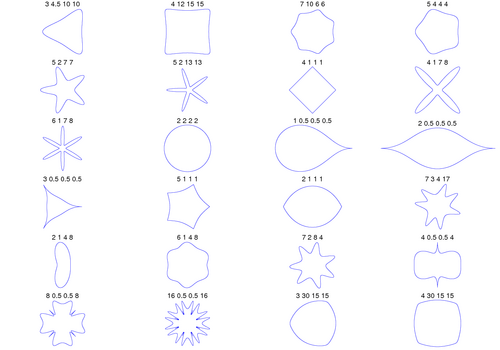
A GNU Octave program for generating these figures
function sf2d(n, a)
  u = [0:.001:2 * pi];
  raux = abs(1 / a(1) .* abs(cos(n(1) * u / 4))) .^ n(3) + abs(1 / a(2) .* abs(sin(n(1) * u / 4))) .^ n(4);
  r = abs(raux) .^ (- 1 / n(2));
  x = r .* cos(u);
  y = r .* sin(u);
  plot(x, y);
end
Extension to higher dimensions
It is possible to extend the formula to 3, 4, or n dimensions, by means of the spherical product of superformulas. For example, the 3D parametric surface is obtained by multiplying two superformulas r1 and r2. The coordinates are defined by the relations:
where (latitude) varies between −π/2 and π/2 and θ (longitude) between −π and π.
3D plots
3D superformula: a = b = 1; m, n1, n2 and n3 are shown in the pictures.


A GNU Octave program for generating these figures:
function sf3d(n, a)
  u = [- pi:.05:pi];
  v = [- pi / 2:.05:pi / 2];
  nu = length(u);
  nv = length(v);
  for i = 1:nu
    for j = 1:nv
      raux1 = abs(1 / a(1) * abs(cos(n(1) .* u(i) / 4))) .^ n(3) + abs(1 / a(2) * abs(sin(n(1) * u(i) / 4))) .^ n(4);
      r1 = abs(raux1) .^ (- 1 / n(2));
      raux2 = abs(1 / a(1) * abs(cos(n(1) * v(j) / 4))) .^ n(3) + abs(1 / a(2) * abs(sin(n(1) * v(j) / 4))) .^ n(4);
      r2 = abs(raux2) .^ (- 1 / n(2));
      x(i, j) = r1 * cos(u(i)) * r2 * cos(v(j));
      y(i, j) = r1 * sin(u(i)) * r2 * cos(v(j));
      z(i, j) = r2 * sin(v(j));
    endfor;
  endfor;
  mesh(x, y, z);
endfunction;
Generalization
The superformula can be generalized by allowing distinct m parameters in the two terms of the superformula. By replacing the first parameter with y and second parameter with z:3
This allows the creation of rotationally asymmetric and nested structures. In the following examples a, b, and are 1:

References
References
- Gielis, Johan (2003), "A generic geometric transformation that unifies a wide range of natural and abstract shapes", American Journal of Botany, 90 (3): 333–338, doi:10.3732/ajb.90.3.333, ISSN 0002-9122, PMID 21659124

- EP patent 1177529, Gielis, Johan, "Method and apparatus for synthesizing patterns", issued 2005-02-02
- * Stöhr, Uwe (2004), SuperformulaU (PDF), archived from the original (PDF) on December 8, 2017
External links
External links
- Some Experiments on Fitting of Gielis Curves by Simulated Annealing and Particle Swarm Methods of Global Optimization
- Least Squares Fitting of Chacón-Gielis Curves By the Particle Swarm Method of Optimization
- Superformula 2D Plotter & SVG Generator
- Interactive example using JSXGraph
- SuperShaper: An OpenSource, OpenCL accelerated, interactive 3D SuperShape generator with shader based visualisation (OpenGL3)