 | |
 | |
| Names | |
|---|---|
| IUPAC name
Strontium nitrate
| |
| Identifiers | |
3D model (JSmol)
|
|
| ChemSpider |
|
| ECHA InfoCard | 100.030.107 |
| EC Number |
|
PubChem CID
|
|
| UNII | |
CompTox Dashboard (EPA)
|
|
| |
| |
| Properties | |
| Sr(NO3)2 | |
| Molar mass |
|
| Appearance | white crystalline solid |
| Density |
|
| Melting point |
|
| Boiling point | 645 °C (1,193 °F; 918 K)2 decomposes |
| Solubility in ammonia | soluble |
| Solubility in ethanol | slightly soluble |
| Solubility in acetone | slightly soluble |
| log P | 0.192 |
| Band gap | 3.71 eV4 |
| 57.2×10⁻⁶ cm3/mol5 | |
| Structure (anhydrous)4 | |
| Cubic | |
| Pa3 | |
| m3 | |
a = 7.76 Å, b = 7.76 Å, c = 7.76 Å α = 90°, β = 90°, γ = 90°
| |
Lattice volume (V)
|
466.47 Å3 |
Formula units (Z)
|
4 |
| Structure (tetrahydrate) | |
| Monoclinic | |
| Thermochemistry (anhydrous)5 | |
Heat capacity (C)
|
149.9 J⋅mol−1·K-1 |
Std molar
entropy (S⦵298) |
194.6 J⋅mol−1·K-1 |
Std enthalpy of
formation (ΔfH⦵298) |
−978.2 kJ⋅mol−1 |
Gibbs free energy (ΔfG⦵)
|
−780.0 kJ⋅mol−1 |
Enthalpy of fusion (ΔfH⦵fus)
|
44.6 kJ⋅mol−1 |
| Hazards | |
| GHS labelling:2 | |
 
| |
| Danger | |
| H271, H318, H402 | |
| P210, P220, P221, P273, P280, P283, P305+P351+P338+P310, P306+P360, P370+P378, P371+P380+P375, P501 | |
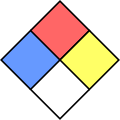
| NFPA 704 (fire diamond) | |
| Lethal dose or concentration (LD, LC): | |
LD50 (median dose)
|
2750 mg/kg (rat, oral)3 |
LC50 (median concentration)
|
>4.5 mg/L (rat, 4h, inhalation)3 |
| Related compounds | |
Other anions
|
|
Other cations
|
|
Except where otherwise noted, data are given for materials in their standard state (at 25 °C [77 °F], 100 kPa).
| |


Strontium nitrate is an inorganic compound composed of the elements strontium, nitrogen and oxygen with the formula Sr(NO3)2. This colorless solid is used as a red colorant and oxidizer in pyrotechnics.
Preparation
Strontium nitrate is typically generated by the reaction of nitric acid with strontium carbonate.6
- 2 HNO3 + SrCO3 → Sr(NO3)2 + H2O + CO2

Uses
Pyrotechnics
Like many other strontium salts, strontium nitrate is used to produce a rich red flame in fireworks and road flares. Unlike most other commonly used color-producing compounds,a strontium emits light in almost the same range from their hydroxides and oxides as their chlorides, with the chlorides emitting a slightly deeper red. Oxidizers break down into their oxides and hydroxides upon combustion of a pyrotechnic mixture, generally speaking.8 Combined with strontium nitrate's high strength as an oxidizer, extremely pure colors in the orange-red to red color range are attainable with simple compositions using it as both oxidizer and colorant and without chlorine donors.910
Experimental medicine
Strontium nitrate can aid in eliminating and lessening skin irritations. When mixed with glycolic acid, strontium nitrate reduces the sensation of skin irritation significantly better than using glycolic acid alone.11
Biochemistry
As a divalent ion with an ionic radius similar to that of Ca2+ (1.13 and 0.99 Å respectively), Sr2+ ions mimic calcium's ability to traverse calcium-selective ion channels and trigger neurotransmitter release from nerve endings. It is thus used in electrophysiology experiments.
Notes
Notes
- See copper in particular, which can produce any of red, green, or blue / blue-violet depending on the active emitter in a flame.7
References
References
- Patnaik P (2003). Handbook of inorganic chemicals. New York, NY: McGraw-Hill. ISBN 0-07-049439-8.
- Sigma-Aldrich Co., Strontium Nitrate. Retrieved on 1 January 2026.
- "Strontium Nitrate Anhydrous (Crystalline/Certified ACS), Fisher Chemical 100 g | Fisher Scientific". www.fishersci.com. ThermoFisher Scientific. 18 December 2025. Retrieved 2 January 2026.
- "Strontium nitrate - Materials Explorer". next-gen.materialsproject.org. The Materials Project. mp-4157. Retrieved 3 May 2026.
- Haynes WM, ed. (2016). CRC Handbook of Chemistry and Physics (97th ed.). Boca Raton, Florida: CRC Press. pp. 4–130, 5–36, 6–161. ISBN 9781498754293.
- Ward, R., Osterheld, R. K., Rosenstein, R. D. "Strontium Sulfide and Selenide Phosphors". Inorganic Syntheses. Inorganic Syntheses. Vol. 3. pp. 11–23. doi:10.1002/9780470132340.ch4. ISBN 978-0-470-13234-0.
- Meyerriecks W, Kosanke K (2003). "Color Values and Spectra of the Principal Emitters in Colored Flames" (PDF). Journal of Pyrotechnics (18): 15. Retrieved 2 January 2026.
- Ding D, Tabata D, Yoshida T (19 October 2009). "Characteristics of the Red Colored Flame of Firework Compositions" (PDF). Journal of Pyrotechnics (28): 51–60. 0079. Retrieved 2 January 2026.
- MacMillan JP, Park JW, Gerstenberg R, Wagner H, Köhler K, Wallbrecht P. ""Strontium and Strontium Compounds"". Ullmann's Encyclopedia of Industrial Chemistry. Weinheim: Wiley-VCH. doi:10.1002/14356007.a25_321. ISBN 978-3-527-30673-2.
- Juknelevicius D, Mikoliunaite L, Sakirzanovas S, Kubilius R, Ramanavicius A (October 2014). "A Spectrophotometric Study of Red Pyrotechnic Flame Properties Using Three Classical Oxidizers: Ammonium Perchlorate, Potassium Perchlorate, Potassium Chlorate". Zeitschrift für anorganische und allgemeine Chemie. 640 (12–13): 2560–2565. doi:10.1002/zaac.201400299.
- Zhai H, Hannon W, Hahn GS, Pelosi A, Harper RA, Maibach HI (2000). "Strontium nitrate suppresses chemically-induced sensory irritation in humans". Contact Dermatitis. 42 (2): 98–100. doi:10.1034/j.1600-0536.2000.042002098.x. PMID 10703633. S2CID 25910851.