Stio | |
|---|---|
| Comune di Stio | |
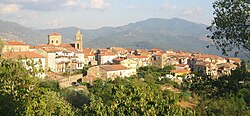 | |
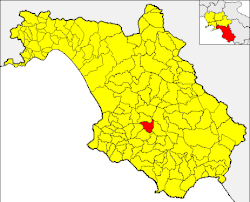 Stio within the Province of Salerno | |
Stio Location of Stio in Italy Show map of ItalyStio Stio (Campania) Show map of Campania | |
| Coordinates: 40°18′35.32″N 15°15′7.21″E / 40.3098111°N 15.2520028°E / 40.3098111; 15.2520028 | |
| Country | Italy |
| Region | Campania |
| Province | Salerno (SA) |
| Frazioni | Gorga |
| Government | |
| • Mayor | Giancarlo Trotta |
| Area | |
• Total | 24 km2 (9.3 sq mi) |
| Elevation | 675 m (2,215 ft) |
| Population (2016)2 | |
• Total | 872 |
| • Density | 36/km2 (94/sq mi) |
| Demonym | Stiesi |
| Time zone | UTC+1 (CET) |
| • Summer (DST) | UTC+2 (CEST) |
| Postal code | 84075 |
| Dialing code | 0974 |
| ISTAT code | 065145 |
| Patron saint | St. Paschal Baylon |
| Saint day | 17 May |
| Website | Official website |
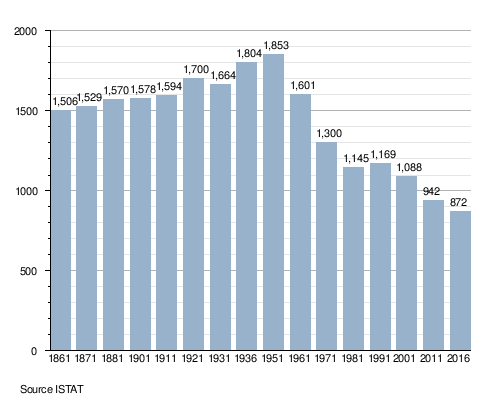
Stio is a town and comune in the province of Salerno in the Campania region of south-western Italy. As of 2016, its population was 872.2
History
The village was founded in the beginnings of the 11th century. The origin of the name is debated, and it has been supposed it could derive from the Latin word Ostium ("entrance"), or others.3
Geography
Located in the middle of Cilento, and part of its national park, Stio is a hilltown near the springs of Alento river and the forest area of Pruno. The municipality borders with Campora, Gioi, Laurino, Magliano Vetere and Orria.4 It counts a single hamlet (frazione), that is the village of Gorga, 3 km far from it and with a population of 160.5
The town is composed by the medieval old town and spans, along the national highway SR 488, with two more recent areas: Via Amendola in the west, and Via Mazzini in the east. The upper area, named Piano del Rosario and composed by some scattered houses surrounded by a forest, is located above the village of Gorga.
Demographics
Main sights
- St. Paschal Church (18th century), located in the middle of the town6
- The ancient St. Peter and Paul Church (11th century), located south of the old town.
- The Mill Valley (Italian: Valle dei Mulini), located outside the town.7
Personalities
- Raffaele Lettieri (1881–1957), politician and academic, born in Gorga8
- Antonino Maria Stromillo (1786–1858), Catholic bishop, first one of the Diocese of Caltanissetta, born in Gorga9
Gallery
-
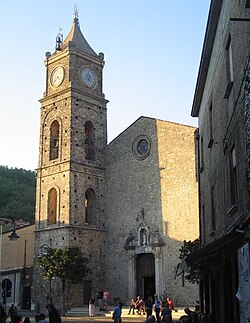 The central St. Paschal Church
 -
 Rests of the ancient St. Peter and Paul Church
 -
 View of the frazione Gorga with (above) Piano del Rosario
Twin towns

References
References
- "Superficie di Comuni Province e Regioni italiane al 9 ottobre 2011". Italian National Institute of Statistics. Retrieved 16 March 2019.
- (in Italian) Source: Istat 2016
- History of Stio
- 40428 Stio on OpenStreetMap
- (in Italian) Gorga on italia.indettaglio.it
- (in Italian) Churches of Stio
- (in Italian) Valle dei Mulini on parks.it
- See it:Raffaele Lettieri
- See it:Antonino Maria Stromillo
External links
External links
- (in Italian) Stio official website
- (in Italian) Stio Tipica: history, sights, traditions