| Stephanorhinus Temporal range: Late Pliocene to Late Pleistocene
| |
|---|---|
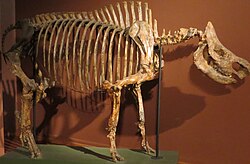
| |
| Stephanorhinus etruscus skeleton | |
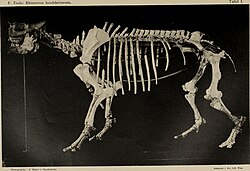
| |
| Stephanorhinus hundsheimensis skeleton | |
Scientific classification 
| |
| Kingdom: | Animalia |
| Phylum: | Chordata |
| Class: | Mammalia |
| Infraclass: | Placentalia |
| Order: | Perissodactyla |
| Family: | Rhinocerotidae |
| Tribe: | Dicerorhinini |
| Genus: | †Stephanorhinus Kretzoi, 1942 |
| Type species | |
| †Rhinoceros etruscus Falconer, 1868
| |
| Species | |
| |
| Synonyms | |
| |
Stephanorhinus is an extinct genus of two-horned rhinoceros native to Eurasia and North Africa that lived from the Late Pliocene until their extinction in the Late Pleistocene. Species of Stephanorhinus were the predominant and often only species of rhinoceros in much of temperate Eurasia, especially Europe, for most of the Pleistocene. The last two species of Stephanorhinus – Merck's rhinoceros (S. kirchbergensis) and the narrow-nosed rhinoceros (S. hemitoechus) – went extinct during the latter half of the last glacial period.
Taxonomy
The taxonomic history of Stephanorhinus is long and convoluted, as many species are known by numerous synonyms and different genera – typically placed in Rhinoceros and Dicerorhinus – for the 19th and most of the early 20th century.1 The genus was named by Miklós Kretzoi in 1942.2 The first part of the name, Stephano-, honours Stephen I, the first king of Hungary (the describer, Kretzoi, was Hungarian).3 The second part is from rhinos (Greek for "nose"), a typical suffix of rhinoceros genus names.2 Genomes obtained from Stephanorhinus kirchbergensis suggests that Stephanorhinus is more closely related to Dicerorhinus (which contains the living Sumatran rhinoceros) and Coelodonta (which contains the woolly rhinoceros), than it is to other living rhinoceroses, and is more closely related to Coelodonta than to Dicerorhinus, with the date of divergence between Coelodonta and Stephanorhinus estimated at around 5.5 million years ago, with the estimated split between their last common ancestor and Dicerorhinus estimated at around 9.4 million years ago.4 The genus is also closely related to the fossil rhinoceros genera Dihoplus and Pliorhinus, known from the Late Miocene and Pliocene of Eurasia, which may be ancestral to Stephanorhinus.5 Although a 2019 study based on dental proteomes suggested that the genus was paraphyletic with respect to Coelodonta,6 later studies have consistently recovered Stephanorhinus as monophyletic.578
Truncated cladogram of Rhinocerotinae, showing the position of Stephanorhinus relative to living and Pleistocene rhinocerotine species based on morphological and genetic data, after Borrani et al. 2025.7
| Rhinocerotinae |
| ||||||||||||||||||||||||||||||||||||||||||||||||||||||||||||||||||||||||
Description
Species of Stephanorhinus were large-sized rhinoceroses, with body masses estimated between 1,500–3,000 kilograms (3,300–6,600 lb).9 Stephanorhinus species have proportionally long (dolichocephalic) skulls. They had two horns, a frontal and a nasal horn. The nasal septum was partially ossified (turned to bone), which connected the nasal bones with the premaxillary bones. The incisors were either lost completely or very heavily reduced in size.1 Species of Stephanorhinus differ from each other in skull shape and angle of the skull held relative to the ground, in the morphology of the teeth, and in the length and shape of the limb bones.1
-
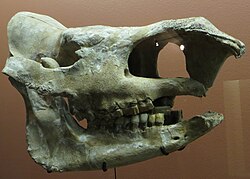 Skull of Stephanorhinus jeanvireti
 -
 Skull of Stephanorhinus etruscus
 -
 Skull of Stephanorhinus hundsheimensis
 -
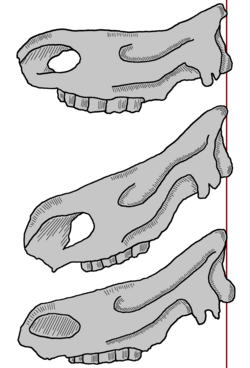 Skulls from top to bottom. Merck's rhinoceros S. kirchbergensis, the narrow-nosed rhinoceros S. hemitoechus and the woolly rhinoceros, showing the difference in head angle
 -
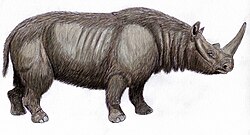 Drawing of Stephanorhinus hemitoechus
Species and evolution
The oldest unambiguous known species of the genus are from the Pliocene of Europe.10 The former species "S." pikermiensis is currently considered to belong to Dihoplus.111213 "S." megarhinus (known from the Late Miocene-Pliocene of Europe, Anatolia, and Transbaikalia,1415 spanning from around 6.7-3.5 million years ago.16 ) and "S." miguelcrusafonti from the Early Pliocene of Western Europe were assigned to the new genus Pliorhinus in 2021,13 but their placement as a separate genus has been disputed, with other authors supporting their placement in Stephanorhinus.8
The position of Stephanorhinus? africanus from the Middle Pliocene of Tunisia and Chad is uncertain.17 Some authors have suggested that Stephanorhinus likely originated from members of the genus Pliorhinus.5
Stephanorhinus jeanvireti, also known as S. elatus18 is known from the Late Pliocene and Early Pleistocene of Europe. Its remains are relatively rare in comparison to other Stephanorhinus species. Specimens are known from the Late Pliocene of Germany,19 France, Italy,20 Slovakia21 and Greece,22 and the Early Pleistocene of Romania,23 with its temporal span being around 3.4 to 2 million years ago (Ma).5
Stephanorhinus etruscus first appears in the latest Pliocene in the Iberian Peninsula, around 3.3 Ma at Las Higueruelas in Spain and before 3 Ma at Piedrabuena, and during the latest Pliocene at Villafranca d'Asti and Castelnuovo di Berardenga in Italy and is abundant during most of the Villafranchian period in Europe, and is the sole rhinoceros species in Europe between 2.5 and around 1.3 Ma. A specimen is known from the Early Pleistocene (1.6-1.2 Ma) Ubeidiya locality in Israel. During the late Early Pleistocene, it is largely replaced by S. hundsheimensis. The last known records of the species are from the latest Early Pleistocene of the Iberian peninsula, around 0.9-0.8 Ma.24
Remains of Stephanorhinus not assigned to species have been reported from the Dmanisi site in the Caucasus (Georgia), dating to around 1.8 Ma. The remains appear to belong to two morphotypes, which may represent distinct species.25 Some of these remains may be closely related to the later species Stephanorhinus hundsheimensis.26
Stephanorhinus hundsheimensis first definitively appears in the fossil record in Europe and Anatolia at around 1.2 Ma, with possible records in Iberia around 1.6 Ma and 1.4-1.3 Ma. The earliest confirmed appearance in Italy around 1 Ma.27 Stephanorhinus hundsheimensis is typically suggested to have gone extinct at around 0.5 Ma,5 though a 2023 study suggested that the species may have persisted as recently as the latest Middle Pleistocene-earliest Late Pleistocene around 130,000 years ago, based on fossils found in Spain.28
Stephanorhinus migrated from its origin in western Eurasia into eastern Eurasia during the Early Pleistocene,5 with remains of Stephanorhinus including those of S. etruscus being known from the Early Pleistocene of Kazakhstan and Tajikistan in Central Asia, with the earliest remains of the genus in China dating to around 1.6 Ma.26 Stephanorhinus yunchuchenensis is known from a single specimen in probably late Early Pleistocene aged deposits in Yushe, Shaanxi, China, while Stephanorhinus lantianensis is also known from a single specimen from late Early Pleistocene (1.15 Ma) deposits in Lantian, also in Shaanxi.29 These may be synonymous with other named Stephanorhinus species, with a 2022 study suggesting that they were likely synonyms of S. kirchbergensis and S. etruscus respectively.26
The first definitive record of Stephanorhinus kirchbergensis (Merck's rhinoceros) is in China at Zhoukoudian (Choukoutien; near Beijing), around the Early–Mid-Pleistocene transition at 0.8 Ma.29
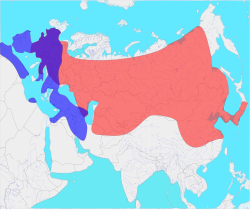
S. kirchbergensis appeared in Europe between 0.7-6 Ma with S. hemitoechus (the narrow-nosed rhinoceros) first appearing in Europe around 0.6-0.5 Ma.30 S. kirchbergensis was broadly distributed over northern Eurasia from Western Europe to East Asia, while S. hemitoechus was generally confined to the western Palearctic, including Europe, West Asia, and North Africa.313217
In Europe, the timing of the extinction of S. kirchbergensis is uncertain, though it is sometime after 115,000 years ago.33 The latest records of S. hemitoechus in Europe are known from the Iberian Peninsula, where they survived until at least 34,000 years ago,34 with the species possibly surviving as late as 15,500 years ago in the Levant.3536 In the Altai region, S. kirchbergensis survived until at least 40,000 years ago.37 In South China, the species may have survived into Marine Isotope Stage 2 (~29-14,000 years ago).38
Ecology and behaviour
Stephanorhinus etruscus is thought to have had a browsing based diet.39 The diet of S. hundsheimensis was flexible, with two different early Middle Pleistocene populations under different climatic regimes having tooth wear analyses suggesting contrasting browsing and grazing habits.40 S. kirchbergensis and S. hemitoechus are typically interpreted mixed feeders tending towards browsing and grazing, respectively. The evolution of more specialized diets is possibly due to the change to the 100 Kyr cycle after the Mid-Pleistocene Transition, which resulted in environmental stability allowing the development of more specialized forms.30 Stephanorhinus species likely had similar social behaviour to living rhinoceroses, with the size of the home ranges and the territoriality of males possibly varying between Stephanorhinus species.41 Species of Stephanorhinus may have also seasonally migrated between different feeding grounds.42 Males of Stephanorhinus species likely engaged in confrontations against other males over females, which may have been ritualized, or in some species sometimes broken out into full-blown direct combat.41 Injuries found in some S. hemitoechus and S. kirchbergensis indivduals may be evidence of such fighting.439
Relationship with humans

Remains of Stephanorhinus species have been found in sites across Europe with break or cut marks indicating that they were butchered by archaic humans.444546474849 The earliest such site is Vallonnet Cave in France dating to around 1.2 to 1.1 million years ago, where remains of S. hundsheimensis have been reported with cut marks.46 Another early site is the Boxgrove locality in England, dating to around 500,000 years ago, where an indeterminate species of Stephanorhinus, probably S. hundsheimensis, was found with cut marks thought to have been created by "Boxgrove Man", possibly Homo heidelbergensis.5051 The youngest sites are known from the late Middle Paleolithic (around 130-40,000 years ago), indicating the butchering of the narrow-nosed and Merck's rhinoceros by Neanderthals.47 At some sites hunting is suggested to be the more likely than scavenging based on mortality profiles.46 Neanderthals likely used Stephanorhinus teeth as tools for stoneworking.52
An astragalus attributed to Stephanorhinus was discovered in the Southwest Quarter of Mycenae, along with a collection of other artifacts. Its placement there was dated to the thirteenth century B.C.E, long after the extinction of Stephanorhinus. This is suggested to represent one of the earliest examples of fossil collecting.53
References
References
- Giaourtsakis, Ioannis X. (2022), "The Fossil Record of Rhinocerotids (Mammalia: Perissodactyla: Rhinocerotidae) in Greece", in Vlachos, Evangelos (ed.), Fossil Vertebrates of Greece Vol. 2, Cham: Springer International Publishing, pp. 409–500, doi:10.1007/978-3-030-68442-6_14, ISBN 978-3-030-68441-9, S2CID 239883886, retrieved 2023-11-19
- Miklós Kretzoi: Bemerkungen zur System der Nachmiozänen Nashorn-Gattungen (Comments on the system of the post Miocene rhinoceros genera) Földtani Közlöni, Budapest 72 (4-12), 1942, S. 309–318
- Tong, HaoWen; Wu, XianZhu (April 2010). "Stephanorhinus kirchbergensis (Rhinocerotidae, Mammalia) from the Rhino Cave in Shennongjia, Hubei". Chinese Science Bulletin. 55 (12): 1157–1168. Bibcode:2010ChSBu..55.1157T. doi:10.1007/s11434-010-0050-5. ISSN 1001-6538. S2CID 67828905.
- Liu, Shanlin; Westbury, Michael V.; Dussex, Nicolas; Mitchell, Kieren J.; Sinding, Mikkel-Holger S.; Heintzman, Peter D.; Duchêne, David A.; Kapp, Joshua D.; von Seth, Johanna; Heiniger, Holly; Sánchez-Barreiro, Fátima (August 2021). "Ancient and modern genomes unravel the evolutionary history of the rhinoceros family". Cell. 184 (19): 4874–4885.e16. Bibcode:2021Cell..184.4874L. doi:10.1016/j.cell.2021.07.032. hdl:10230/48693. ISSN 0092-8674. PMID 34433011. S2CID 237273079.
- Pandolfi, Luca (19 January 2023). "Reassessing the phylogeny of Quaternary Eurasian Rhinocerotidae". Journal of Quaternary Science. 38 (3): 291–294. Bibcode:2023JQS....38..291P. doi:10.1002/jqs.3496. hdl:11563/163194. ISSN 0267-8179.
- Cappellini, Enrico; Welker, Frido; Pandolfi, Luca; Ramos-Madrigal, Jazmín; Samodova, Diana; Rüther, Patrick L.; Fotakis, Anna K.; Lyon, David; Moreno-Mayar, J. Víctor; Bukhsianidze, Maia; Rakownikow Jersie-Christensen, Rosa; Mackie, Meaghan; Ginolhac, Aurélien; Ferring, Reid; Tappen, Martha (2019-09-11). "Early Pleistocene enamel proteome from Dmanisi resolves Stephanorhinus phylogeny". Nature. 574 (7776): 103–107. Bibcode:2019Natur.574..103C. doi:10.1038/s41586-019-1555-y. ISSN 0028-0836. PMC 6894936. PMID 31511700.
- Borrani, Antonio; Mackiewicz, Paweł; Kovalchuk, Oleksandr; Barkaszi, Zoltán; Capalbo, Chiara; Dubikovska, Anastasiia; Ratajczak-Skrzatek, Urszula; Sinitsa, Maxim; Stefaniak, Krzysztof; Mazza, Paul P.A. (2025-10-26). "The evolutionary history of Rhinocerotidae: phylogenetic insights, climate influences and conservation implications". Cladistics. 42 (1): 46–62. doi:10.1111/cla.70015. hdl:2158/1444059. ISSN 0748-3007. PMID 41139836.
- Kovalchuk, Oleksandr; Borrani, Antonio; Mackiewicz, Paweł; Barkaszi, Zoltán; Capalbo, Chiara; Davydenko, Svitozar; Dubikovska, Anastasiia; Ratajczak-Skrzatek, Urszula; Sinitsa, Maxim; Stefaniak, Krzysztof; Krajcarz, Maciej T.; Mazza, Paul P. A. (2026-06-14). "Scythicorhinus vekuai gen. nov. et comb. nov. (Mammalia, Rhinocerotidae) from the Pliocene of Georgia and its implications for the early evolution of Coelodonta and Stephanorhinus". Scientific Reports. doi:10.1038/s41598-026-57113-0. ISSN 2045-2322. PMID 42289561.
- Jan van der Made und René Grube: The rhinoceroses from Neumark-Nord and their nutrition. In: Harald Meller (Hrsg.): Elefantenreich – Eine Fossilwelt in Europa. Halle/Saale 2010, S. 382–394
- Ballatore, Manuel; Breda, Marzia (March 2019). "Revision of the rhinoceros remains (Rhinocerotidae, Mammalia) from the late Pliocene of Etouaires (Auvergne, France) and the morphological distinction between the postcranial bones of Stephanorhinus elatus and S. etruscus". Comptes Rendus Palevol. 18 (2): 191–208. Bibcode:2019CRPal..18..191B. doi:10.1016/j.crpv.2018.06.003. Retrieved 5 November 2024 – via Elsevier Science Direct.
- Pandolfi, Luca; Rivals, Florent; Rabinovich, Rivka (January 2020). "A new species of rhinoceros from the site of Bethlehem: 'Dihoplus' bethlehemsis sp. nov. (Mammalia, Rhinocerotidae)". Quaternary International. 537: 48–60. Bibcode:2020QuInt.537...48P. doi:10.1016/j.quaint.2020.01.011. S2CID 213080180.
- Pandolfi, Luca; Sendra, Joaquín; Reolid, Matías; Rook, Lorenzo (June 2022). "New Pliocene Rhinocerotidae findings from the Iberian Peninsula and the revision of the Spanish Pliocene records". PalZ. 96 (2): 343–354. Bibcode:2022PalZ...96..343P. doi:10.1007/s12542-022-00607-9. hdl:2158/1254352. ISSN 0031-0220.
- Pandolfi, Luca; Pierre-Olivier, Antoine; Bukhsianidze, Maia; Lordkipanidze, David; Rook, Lorenzo (2021-08-03). "Northern Eurasian rhinocerotines (Mammalia, Perissodactyla) by the Pliocene–Pleistocene transition: phylogeny and historical biogeography". Journal of Systematic Palaeontology. 19 (15): 1031–1057. Bibcode:2021JSPal..19.1031P. doi:10.1080/14772019.2021.1995907. hdl:11568/1271903. ISSN 1477-2019. S2CID 244762077.
- Pandolfi, Luca; Gasparik, Mihály; Piras, Paolo (2015). "Earliest occurrence of "Dihoplus" megarhinus (Mammalia, Rhinocerotidae) in Europe (Late Miocene, Pannonian Basin, Hungary): Palaeobiogeographical and biochronological implications". Annales de Paléontologie. 101 (4): 325–339. Bibcode:2015AnPal.101..325P. doi:10.1016/j.annpal.2015.09.001.
- Pandolfi, Luca; Rivals, Florent; Rabinovich, Rivka (January 2020). "A new species of rhinoceros from the site of Bethlehem: 'Dihoplus' bethlehemsis sp. nov. (Mammalia, Rhinocerotidae)". Quaternary International. 537: 48–60. Bibcode:2020QuInt.537...48P. doi:10.1016/j.quaint.2020.01.011. S2CID 213080180.
- Pandolfi, Luca; Collareta, Alberto; Nowakowski, Dariusz; Bianucci, Giovanni; Rook, Lorenzo (July 2024). "New early Pliocene Rhinocerotidae findings from Tuscany (Italy) and the Pliocene rhinocerotine record in Italy". Geobios. 88–89: 197–204. doi:10.1016/j.geobios.2023.12.012. hdl:2158/1419592.
- Pandolfi, Luca (2018), "Evolutionary history of Rhinocerotina (Mammalia, Perissodactyla)", Fossilia - Reports in Palaeontology, Saverio Bartolini Lucenti, pp. 27–32, doi:10.32774/fosreppal.20.1810.102732, ISBN 979-12-200-3408-1
- Ballatore, Manuel; Breda, Marzia (December 2016). "Stephanorhinus elatus (Rhinocerotidae, Mammalia): proposal for the conservation of the earlier specific name and designation of a lectotype". Geodiversitas. 38 (4): 579–594. Bibcode:2016Geodv..38..579B. doi:10.5252/g2016n4a7. ISSN 1280-9659. S2CID 90370988.
- Lacombat, Frédéric; Mörs, Thomas (2008-08-01). "The northernmost occurrence of the rare Late Pliocene rhinoceros Stephanorhinus jeanvireti (Mammalia, Perissodactyla)". Neues Jahrbuch für Geologie und Paläontologie - Abhandlungen. 249 (2): 157–165. Bibcode:2008NJGPA.249..157L. doi:10.1127/0077-7749/2008/0249-0157.
- Pandolfi, Luca (October 2013). "New and revised occurrences of Dihoplus megarhinus (Mammalia, Rhinocerotidae) in the Pliocene of Italy". Swiss Journal of Palaeontology. 132 (2): 239–255. Bibcode:2013SwJP..132..239P. doi:10.1007/s13358-013-0056-0. ISSN 1664-2376. S2CID 140547755.
- Šujan, M., Rybár, S., Šarinová, K., Kováč, M., Vlačiky, M., Zervanová, J., 2013. Uppermost Miocene to Quaternary accumulation history at the Danube Basin eastern flanks, in: Fodor, L., Kövér, Sz. (eds.), 11th Meeting of the Central European Tectonic Studies Group (CETeG). Abstract book, Geol. Geophys. Inst. of Hungary, Budapest, pp. 66-68.
- Guérin, Claude; Tsoukala, Evangelia (June 2013). "The Tapiridae, Rhinocerotidae and Suidae (Mammalia) of the Early Villafranchian site of Milia (Grevena, Macedonia, Greece)". Geodiversitas. 35 (2): 447–489. Bibcode:2013Geodv..35..447G. doi:10.5252/g2013n2a7. ISSN 1280-9659. S2CID 129164720.
- Pandolfi, Luca; Codrea, Vlad A.; Popescu, Aurelian (December 2019). "Stephanorhinus jeanvireti (Mammalia, Rhinocerotidae) from the early Pleistocene of Colțești (southwestern Romania)". Comptes Rendus Palevol. 18 (8): 1041–1056. Bibcode:2019CRPal..18.1041P. doi:10.1016/j.crpv.2019.07.004.
- Pandolfi, Luca; Cerdeño, Esperanza; Codrea, Vlad; Kotsakis, Tassos (September 2017). "Biogeography and chronology of the Eurasian extinct rhinoceros Stephanorhinus etruscus (Mammalia, Rhinocerotidae)". Comptes Rendus Palevol. 16 (7): 762–773. Bibcode:2017CRPal..16..762P. doi:10.1016/j.crpv.2017.06.004. hdl:11336/57305.
- Pandolfi, Luca; Bartolini-Lucenti, Saverio; Cirilli, Omar; Bukhsianidze, Maia; Lordkipanidze, David; Rook, Lorenzo (July 2021). "Paleoecology, biochronology, and paleobiogeography of Eurasian Rhinocerotidae during the Early Pleistocene: The contribution of the fossil material from Dmanisi (Georgia, Southern Caucasus)". Journal of Human Evolution. 156 103013. Bibcode:2021JHumE.15603013P. doi:10.1016/j.jhevol.2021.103013. PMID 34030060.
- Pandolfi, Luca (December 2022). "A critical overview on Early Pleistocene Eurasian Stephanorhinus (Mammalia, Rhinocerotidae): Implications for taxonomy and paleobiogeography". Quaternary International. 674–675: 109–120. doi:10.1016/j.quaint.2022.11.008. S2CID 254391781.
- Pandolfi, Luca; Erten, Hüseyin (January 2017). "Stephanorhinus hundsheimensis (Mammalia, Rhinocerotidae) from the late early Pleistocene deposits of the Denizli Basin (Anatolia, Turkey)". Geobios. 50 (1): 65–73. Bibcode:2017Geobi..50...65P. doi:10.1016/j.geobios.2016.10.002.
- García-Fernández, David; Cerdeño, Esperanza; Sanz, Montserrat; Daura, Joan (December 2023). "The Latest Occurrence of Stephanorhinus hundsheimensis (Rhinocerotidae) in Europe: The Skeletons from the Cova del Rinoceront Site (Castelldefels, Barcelona)". Quaternary. 6 (4): 60. Bibcode:2023Quat....6...60G. doi:10.3390/quat6040060. hdl:2445/207033. ISSN 2571-550X.
- Tong, Hao-wen (November 2012). "Evolution of the non-Coelodonta dicerorhine lineage in China". Comptes Rendus Palevol. 11 (8): 555–562. Bibcode:2012CRPal..11..555T. doi:10.1016/j.crpv.2012.06.002.
- van Asperen, Eline N.; Kahlke, Ralf-Dietrich (January 2015). "Dietary variation and overlap in Central and Northwest European Stephanorhinus kirchbergensis and S. hemitoechus (Rhinocerotidae, Mammalia) influenced by habitat diversity" (PDF). Quaternary Science Reviews. 107: 47–61. doi:10.1016/j.quascirev.2014.10.001. S2CID 83801422.
- Diana Pushkina: The Pleistocene easternmost distribution in Eurasia of the species associated with the Eemian Palaeoloxodon antiquus assemblage. Mammal Review, 2007. Volume 37 Issue 3, Pages 224 - 245
- Pierre Olivier Antoine: Pleistocene and holocene rhinocerotids (Mammalia, Perissodactyla) from the Indochinese Peninsula. In: Comptes Rendus Palevol. 2011, S. 1–10.
- Stefaniak, Krzysztof; Kotowski, Adam; Badura, Janusz; Sobczyk, Artur; Borówka, Ryszard K.; Stachowicz-Rybka, Renata; Moskal-del Hoyo, Magdalena; Hrynowiecka, Anna; Tomkowiak, Julita; Sławińska, Joanna; Przybylski, Bogusław; Ciszek, Dariusz; Alexandrowicz, Witold Paweł; Skoczylas-Śniaz, Sylwia; Ratajczak-Skrzatek, Urszula (2023-05-09). "A skeleton of peat-trapped forest rhinoceros Stephanorhinus kirchbergensis (Jäger, 1839) from Gorzów Wielkopolski, Northwestern Poland: a record of life and death of the Eemian large mammals". Neues Jahrbuch für Geologie und Paläontologie - Abhandlungen. 308 (1): 45–77. Bibcode:2023NJGPA.308...45S. doi:10.1127/njgpa/2023/1129. ISSN 0077-7749.
- Sala, Nohemi; Pablos, Adrián; Rodríguez-Hidalgo, Antonio; Arriolabengoa, Martin; Alcaraz-Castaño, Manuel; Cubas, Miriam; Posth, Cosimo; Nägele, Kathrin; Pantoja-Pérez, Ana; Arlegi, Mikel; Rodríguez-Almagro, Manuel; Conde-Valverde, Mercedes; Cuenca-Bescós, Gloria; Arribas, Alfonso; Gómez-Olivencia, Asier (February 2021). "Cueva de los Torrejones revisited. New insights on the paleoecology of inland Iberia during the Late Pleistocene". Quaternary Science Reviews. 253 106765. Bibcode:2021QSRv..25306765S. doi:10.1016/j.quascirev.2020.106765.
- Dembitzer, Jacob; Barkai, Ran; Ben-Dor, Miki; Meiri, Shai (January 2022). "Levantine overkill: 1.5 million years of hunting down the body size distribution". Quaternary Science Reviews. 276 107316. Bibcode:2022QSRv..27607316D. doi:10.1016/j.quascirev.2021.107316.
- Marom, Nimrod; Lazagabaster, Ignacio A.; Shafir, Roee; Natalio, Filipe; Eisenmann, Vera; Horwitz, Liora Kolska (May 2022). "The Late Middle Pleistocene mammalian fauna of Oumm Qatafa Cave, Judean Desert: taxonomy, taphonomy and palaeoenvironment". Journal of Quaternary Science. 37 (4): 612–638. Bibcode:2022JQS....37..612M. doi:10.1002/jqs.3414. ISSN 0267-8179. PMC 9314136. PMID 35915614.
- Kirillova, I. V.; Vershinina, A. O.; Zazovskaya, E. P.; Zanina, O. G.; Cutler, S.; Kosintsev, P. A.; Lapteva, E. G.; Chernova, O. F.; Shapiro, B. (December 2021). "On Time and Environment of Stephanorhinus kirchbergensis Jäger 1839 (Mammalia, Rhinoceratidae) in Altai and Northeastern Russia". Biology Bulletin. 48 (9): 1674–1687. Bibcode:2021BioBu..48.1674K. doi:10.1134/S1062359021090077. ISSN 1062-3590.
- Pang, Libo; Chen, Shaokun; Huang, Wanbo; Wu, Yan; Wei, Guangbiao (April 2017). "Paleoenvironmental and chronological analysis of the mammalian fauna from Migong Cave in the Three Gorges Area, China". Quaternary International. 434: 25–31. Bibcode:2017QuInt.434...25P. doi:10.1016/j.quaint.2014.11.039.
- Pandolfi, Luca; Bartolini-Lucenti, Saverio; Cirilli, Omar; Bukhsianidze, Maia; Lordkipanidze, David; Rook, Lorenzo (July 2021). "Paleoecology, biochronology, and paleobiogeography of Eurasian Rhinocerotidae during the Early Pleistocene: The contribution of the fossil material from Dmanisi (Georgia, Southern Caucasus)". Journal of Human Evolution. 156 103013. Bibcode:2021JHumE.15603013P. doi:10.1016/j.jhevol.2021.103013. PMID 34030060. S2CID 235199139.
- Kahlke, Ralf-Dietrich; Kaiser, Thomas M. (August 2011). "Generalism as a subsistence strategy: advantages and limitations of the highly flexible feeding traits of Pleistocene Stephanorhinus hundsheimensis (Rhinocerotidae, Mammalia)". Quaternary Science Reviews. 30 (17–18): 2250–2261. Bibcode:2011QSRv...30.2250K. doi:10.1016/j.quascirev.2009.12.012.
- P. Mazza "Ethological inferences on Pleistocene rhinoceroses of Europe" Rend. Lincei Cl. Sci. Fis. Mat. Nat. Accad. Naz., 9 (1993), pp. 127-137
- Lugli, Federico; Cipriani, Anna; Peretto, Carlo; Mazzucchelli, Maurizio; Brunelli, Daniele (January 2017). "In situ high spatial resolution 87 Sr/ 86 Sr ratio determination of two Middle Pleistocene (c.a. 580 ka) Stephanorhinus hundsheimensis teeth by LA–MC–ICP–MS". International Journal of Mass Spectrometry. 412: 38–48. doi:10.1016/j.ijms.2016.12.012. hdl:11380/1121710.
- Ponomarev, D. V.; Puzachenko, A. Yu.; Bondarev, A. A.; Isakov, V. A.; van Kolfschoten, T.; van der Plicht, J. (February 2026). "The Northernmost Discovery of Merck's Rhinoceros Stephanorhinus kirchbergensis (Jäger, 1839) in Europe (Vazhgort, Komi Republic, Russia)". Paleontological Journal. 60 (1): 101–114. Bibcode:2026PalJ...60..101P. doi:10.1134/S0031030125601306. ISSN 0031-0301.
- Bratlund, B. 1999. Taubach revisited. Jahrbuch des Römisch-Germanischen Zentralmuseums Mainz 46: 61-174.
- Berruti, Gabriele Luigi Francesco; Arzarello, Marta; Ceresa, Allison; Muttillo, Brunella; Peretto, Carlo (December 2020). "Use-Wear Analysis of the Lithic Industry of the Lower Palaeolithic Site of Guado San Nicola (Isernia, Central Italy)". Journal of Paleolithic Archaeology. 3 (4): 794–815. Bibcode:2020JPalA...3..794B. doi:10.1007/s41982-020-00056-3. ISSN 2520-8217. S2CID 257091241.
- Chen, Xi; Moigne, Anne-Marie (November 2018). "Rhinoceros ( Stephanorhinus hemitoechus ) exploitation in Level F at the Caune de l'Arago (Tautavel, Pyrénéés-Orientales, France) during MIS 12". International Journal of Osteoarchaeology. 28 (6): 669–680. doi:10.1002/oa.2682. S2CID 80923883.
- Baquedano, Enrique; Arsuaga, Juan L.; Pérez-González, Alfredo; Laplana, César; Márquez, Belén; Huguet, Rosa; Gómez-Soler, Sandra; Villaescusa, Lucía; Galindo-Pellicena, M. Ángeles; Rodríguez, Laura; García-González, Rebeca; Ortega, M.-Cruz; Martín-Perea, David M.; Ortega, Ana I.; Hernández-Vivanco, Lucía (March 2023). "A symbolic Neanderthal accumulation of large herbivore crania". Nature Human Behaviour. 7 (3): 342–352. doi:10.1038/s41562-022-01503-7. ISSN 2397-3374. PMC 10038806. PMID 36702939.
- Smith, Geoff M. (October 2013). "Taphonomic resolution and hominin subsistence behaviour in the Lower Palaeolithic: differing data scales and interpretive frameworks at Boxgrove and Swanscombe (UK)". Journal of Archaeological Science. 40 (10): 3754–3767. Bibcode:2013JArSc..40.3754S. doi:10.1016/j.jas.2013.05.002.
- Carrión, José S.; Walker, Michael J. (August 2019). "Background to Neanderthal presence in Western Mediterranean Europe". Quaternary Science Reviews. 217: 7–44. Bibcode:2019QSRv..217....7C. doi:10.1016/j.quascirev.2018.10.011.
- Bello, Silvia M.; Parfitt, Simon A.; Stringer, Chris (September 2009). "Quantitative micromorphological analyses of cut marks produced by ancient and modern handaxes". Journal of Archaeological Science. 36 (9): 1869–1880. Bibcode:2009JArSc..36.1869B. doi:10.1016/j.jas.2009.04.014.
- Roberts, Mark (1999). Boxgrove: a Middle Pleistocene hominid site at Eartham Quarry, Boxgrove, West Sussex. London: English Heritage. ISBN 978-1-85074-670-6.
- Sanz-Royo, Alicia; Marín, Juan; Vettese, Delphine; Uzunidis, Antigone; Mathias, Cyrielle; Pleurdeau, David; Fabre, Magali; Falguères, Christophe; Hatté, Christine; Shao, Qingfeng; Daujeard, Camille (May 2026). "Elucidating the use of rhinoceros teeth by Neanderthals: Between experiments and the fossil record". Journal of Human Evolution. 214 103829. Bibcode:2026JHumE.21403829S. doi:10.1016/j.jhevol.2026.103829. PMID 41980330.
- Meier, Jacqueline S.; Pliatsika, Vassiliki; Shelton, Kim (2024-08-19). "The earliest evidence of large animal fossil collecting in mainland Greece at Bronze Age Mycenae". Scientific Reports. 14 (1): 19158. Bibcode:2024NatSR..1419158M. doi:10.1038/s41598-024-68778-w. ISSN 2045-2322. PMC 11333489. PMID 39160219.