| Squatiniformes Temporal range:
| |
|---|---|
| |
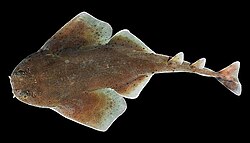
| Squatina dumeril | |
| |
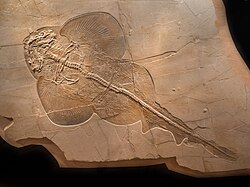
| Fossil of Pseudorhina from the Late Jurassic of Germany | |
Scientific classification 
| |
| Kingdom: | Animalia |
| Phylum: | Chordata |
| Class: | Chondrichthyes |
| Subclass: | Elasmobranchii |
| Division: | Selachii |
| Superorder: | Squalomorphi |
| Series: | Squatinida |
| Order: | Squatiniformes Compagno, 1973 |
| Families | |
| |
Squatiniformes is an order of sharks belonging to Squalomorphi. It contains only a single living genus Squatina, commonly known as angelsharks. The oldest genus of the order, Pseudorhina is known from the Late Jurassic of Europe.1 Three other genera, Cretasquatina, Cretascyllium and Parasquatina are known from Cretaceous fossils from North America and Europe,23 though the placement of Parasquatina in the order has been questioned.1 All living and extinct members of the order share a similar body morphology2 with a highly flattened body with enlarged pectoral and pelvic fins suggestive of a bottom-dwelling ambush predator ecology.4 Teeth have been assigned to the modern genus from the Late Jurassic onwards, but the actual genus assignment of many of these species is unclear.2 The earliest records that can be assigned with confidence to the modern genus are known from the Early Cretaceous (Aptian) of England.1
References
References
- Klug, Stefanie; Kriwet, Jürgen (2013). "Node age estimations and the origin of angel sharks, Squatiniformes (Neoselachii, Squalomorphii)". Journal of Systematic Palaeontology. 11 (1): 91–110. Bibcode:2013JSPal..11...91K. doi:10.1080/14772019.2012.674066. ISSN 1477-2019.
- Maisey, John G.; Ehret, Dana J.; Denton, John S.S. (2020-06-16). "A New Genus of Late Cretaceous Angel Shark (Elasmobranchii; Squatinidae), with Comments on Squatinid Phylogeny". American Museum Novitates (3954): 1–29. doi:10.1206/3954.1. ISSN 0003-0082. S2CID 219700378.
- Guinot, Guillaume; Underwood, Charlie J.; Cappetta, Henri; Ward, David J. (2012-05-11). "Squatiniformes (Chondrichthyes, Neoselachii) from the Late Cretaceous of southern England and northern France with redescription of the holotype of Squatina cranei Woodward, 1888". Palaeontology. 55 (3): 529–551. Bibcode:2012Palgy..55..529G. doi:10.1111/j.1475-4983.2012.01140.x. ISSN 0031-0239. S2CID 129829100.
- López-Romero, Faviel A.; Stumpf, Sebastian; Pfaff, Cathrin; Marramà, Giuseppe; Johanson, Zerina; Kriwet, Jürgen (2020-07-28). "Evolutionary trends of the conserved neurocranium shape in angel sharks (Squatiniformes, Elasmobranchii)". Scientific Reports. 10 (1): 12582. Bibcode:2020NatSR..1012582L. doi:10.1038/s41598-020-69525-7. ISSN 2045-2322. PMC 7387474. PMID 32724124.