 The height of an equilateral triangle with sides of length 2 equals the square root of 3. | |
| Representations | |
|---|---|
| Decimal | 1.7320508075688772935... |
| Continued fraction | |
The square root of 3 is the positive real number that, when multiplied by itself, gives the number 3. It is denoted mathematically as or . It is more precisely called the principal square root of 3 to distinguish it from the negative number with the same property. The square root of 3 is an irrational number. It is also known as Theodorus's constant, after Theodorus of Cyrene, who proved its irrationality.1
In 2013, its numerical value in decimal notation was computed to ten billion digits.2 Its decimal expansion, written here to 60 decimal places, is given by OEIS: A002194:
- 1.732050807568877293527446341505872366942805253810380628055806
Archimedes reported a range for its value: .3
The upper limit is an accurate approximation for to (six decimal places, relative error ) and the lower limit to (four decimal places, relative error ).
Rational approximations
The square root of 3 is an irrational number, meaning it can not be exactly represented as a fraction where and are integers. However, it can be approximated arbitrarily closely by such rational numbers.
Particularly good approximations are the integer solutions of Pell's equations,
which can be algebraically rearranged into the form
The first several solutions are given below:
| | | | | | | | | | | |
|---|---|---|---|---|---|---|---|---|---|---|
| |
(sequence A001075 in the OEIS)
These approximations also appear among the convergents of its continued fraction.
Geometry and trigonometry
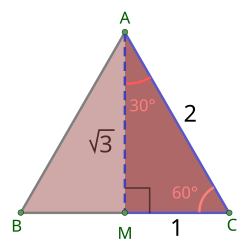

The square root of 3 can be found as the leg length of an equilateral triangle that encompasses a circle with a diameter of 1.
If an equilateral triangle with sides of length 1 is cut into two equal halves, by bisecting an internal angle across to make a right angle with one side, the right angle triangle's hypotenuse is length one, and the sides are of length and . From this, , , and .
The square root of 3 also appears in algebraic expressions for various other trigonometric constants, including4 the sines of other angles. For example, and .
It is the distance between parallel sides of a regular hexagon with sides of length 1. It is also the length of the longest side of a triangle formed from two adjacent sides of a regular hexagon; following from the law of cosines:
Since each angle of a regular hexagon is 120°, we can substitute 120° for in the equation above.
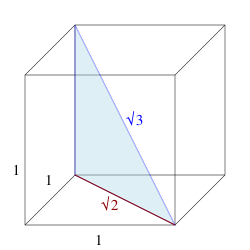
It is the length of the space diagonal of a unit cube.

The vesica piscis has a major axis to minor axis ratio equal to . This can be shown by constructing two equilateral triangles within it.
Applications
Electrical engineering
The square root of 3 plays a pivotal role in studies of three-phase electric power. 56
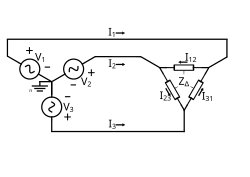
In the delta circuit, loads are connected across the lines, and so loads see line-to-line voltages:7
(Φv1 is the phase shift for the first voltage, commonly taken to be 0°; in this case, Φv2 = −120° and Φv3 = −240° or 120°.)
References
References
- "square root of 3". planetmath.org. Retrieved 2025-07-23.
- Komsta, Łukasz (December 2013). "Computations | Łukasz Komsta". komsta.net. WordPress. Archived from the original on 2023-10-02. Retrieved September 24, 2016.
- Knorr, Wilbur R. (June 1976). "Archimedes and the measurement of the circle: a new interpretation". Archive for History of Exact Sciences. 15 (2): 115–140. doi:10.1007/bf00348496. JSTOR 41133444. MR 0497462. S2CID 120954547. Retrieved November 15, 2022 – via SpringerLink.
- Wiseman, Julian D. A. (June 2008). "Sin and Cos in Surds". JDAWiseman.com. Retrieved November 15, 2022.
- "The Complete Guide to the Square Root of Three in Power Calculations". Relay Training.
- "Why the √3?". Schnackel.
- Cite error: The named reference
GloverSarma2011was invoked but never defined (see the help page).
Further reading
Further reading
- Podestá, Ricardo A. (2023). "Geometric proofs that , and are irrational". Mathematics Magazine. 96 (1): 34–39. arXiv:2003.06627. doi:10.1080/0025570X.2023.2168436. MR 4556102.
- Wells, D. (1997). The Penguin Dictionary of Curious and Interesting Numbers (Revised ed.). London: Penguin Group. p. 23.
External links
External links
- Theodorus' Constant at MathWorld
- Kevin Brown, Archimedes and the Square Root of 3