| Spitting spiders Temporal range:
| |
|---|---|
| |
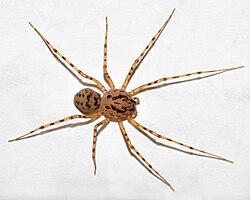
| Scytodes thoracica | |
| Dictis striatipes spitting | |
Scientific classification 
| |
| Kingdom: | Animalia |
| Phylum: | Arthropoda |
| Subphylum: | Chelicerata |
| Class: | Arachnida |
| Order: | Araneae |
| Infraorder: | Araneomorphae |
| Family: | Scytodidae Blackwall, 1864 |
| Diversity1 | |
| 4 genera, 253 species | |
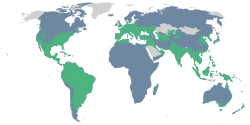
| |
| blue: reported countries (WSC) green: observation hotspots (iNaturalist) | |
Spitting spiders are a family of araneomorph spiders, the family Scytodidae, first described by John Blackwall in 1864.2 It contains over 250 species in four genera,1 of which Scytodes is the best-known.
Description
Scytodidae spiders are haplogyne, meaning they lack hardened female genitalia. They have six eyes, like most spiders in this group, arranged in three pairs. They possess long legs and a dome-shaped cephalothorax, and are usually yellow or light brown with black spots or marks.34
Hunting technique
Scytodidae catch their prey by spitting a fluid that congeals on contact into a venomous and sticky mass. The fluid contains both venom and spider silk in liquid form, though it is produced in venom glands in the chelicerae. The venom-laced silk both immobilizes and envenoms prey such as silverfish. In high-speed footage the spiders can be observed swaying from side to side as they "spit", catching the prey in a criss-crossed "Z" pattern; it is criss-crossed because each of the chelicerae emits half of the pattern. The spider usually strikes from a distance of 10 to 20 millimetres (0.39 to 0.79 in) and the entire attack sequence only lasts 1/700th of a second.5 After making the capture, the spider typically bites the prey with venomous effect, and wraps it in the normal spider fashion with silk from the spinnerets.6
Pre social behaviour
Some species exhibit presocial behaviour, in which mature spiders live together and assist the young with food.7
Habitat and lifestyle
They are ground and plant dwellers, free-running and nocturnal spiders. They are found throughout the region in all biomes, usually collected from vegetation and from under stones and dark places on the soil surface.8
Genera
-
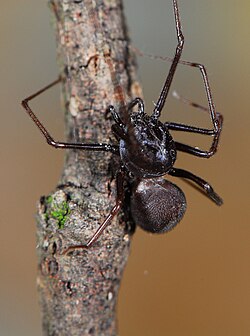 female Scytodes elizabethae
 -
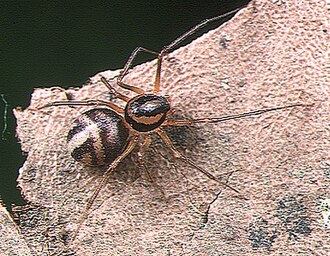 female Scytodes fusca
 -

As of January 2026, this family includes four genera and 253 species:1
- Dictis L. Koch, 1872 – Seychelles, Asia, Pacific Isles, tropical Asia. Introduced to Mexico, United States
- Scyloxes Dunin, 1992 – Tajikistan, Malaysia, Thailand
- Scytodes Latreille, 1804 – Africa, Asia, southern Europe, North to South America, Australia, New Guinea. Introduced worldwide
- Stedocys Ono, 1995 – China, Japan, Malaysia, Thailand
References
References
- "Family: Scytodidae Blackwall, 1852". World Spider Catalog. doi:10.24436/2. Retrieved 2026-01-18.
- Blackwall, J. (1864). A history of the spiders of Great Britain and Ireland. Ray Society, London. pp. 175–384.
- "SCYTODIDAE Spitting spiders". Arachne.org.au. Retrieved 25 April 2024.
- "Spitting spider". Illinois Department of Natural Resources. Retrieved 25 April 2024.
- Piper, Ross (2007). Extraordinary Animals: An Encyclopedia of Curious and Unusual Animals. Westport, Conn.: Greenwood Press. ISBN 978-0-313-33922-6.
- Gilbert, C.; Rayor, L.S. (1985). "Predatory behavior of spitting spiders (Araneae, Scytodidae) and the evolution of prey wrapping". Journal of Arachnology. 13 (2): 231–241. JSTOR 3705028.
- Miller, Jeremy (2010). "Taxon page for Scytodes socialis Miller, 2006". Archived from the original on 2012-03-31.
- Dippernaar-Schoeman, Ansie (2014). Field Guide to the Spiders of South Africa (1st ed.). LAPA Publishers. ISBN 978-0-7993-6018-9.