In mathematics, a solid Klein bottle is a three-dimensional topological space (a 3-manifold) whose boundary is the Klein bottle.1
It is homeomorphic to the quotient space obtained by gluing the top disk of a cylinder to the bottom disk by a reflection across a diameter of the disk.
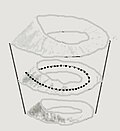
Alternatively, one can visualize the solid Klein bottle as the trivial product , of the möbius strip and an interval . In this model one can see that the core central curve at 1/2 has a regular neighbourhood which is again a trivial cartesian product: and whose boundary is a Klein bottle.
4D Visualization Through a Cylindrical Transformation
One approach to conceptualizing the solid klein bottle in four-dimensional space involves imagining a cylinder, which appears flat to a hypothetical four-dimensional observer. The cylinder possesses distinct "top" and "bottom" two-dimensional surfaces. By introducing a half-twist along the fourth dimension and subsequently connecting the ends, the cylinder undergoes a transformation. While the total volume of the object remains unchanged, the resulting structure is a continuous three-dimensional manifold - analogous to the way a Möbius strip is one continuous two-dimensional surface in three-dimensional space - and has the usual 2 dimensional Klein bottle manifold as its boundary.
References
References
- Carter, J. Scott (1995), How Surfaces Intersect in Space: An Introduction to Topology, K & E series on knots and everything, vol. 2, World Scientific, p. 169, ISBN 9789810220662.