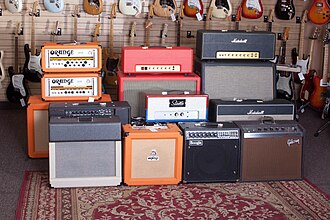
A guitar amplifier (or amp) is an instrument amplifier designed for use with an electric guitar, bass guitar, or acoustic-electric guitar. An amplifier receives an electric guitar's pickup-generated signal and shapes that signal's tone through a preamplifier and amplifies it through a power amplifier; it is then projected through loudspeakers. When the preamp and power amp circuits are combined with one or more loudspeakers in a single enclosure, it is known as a combo. When the preamp and power amp are housed together for use with an external speaker cabinet, it is known as a head.
There is a wide range of sizes and power ratings for guitar amplifiers, from small, low-wattage practice combos to heavy, 100-watt (or greater) heads that are usually paired with large external cabinets. The components chosen for an amp's circuit have a significant impact on its tonal character, which can be further sculpted by emphasizing or de-emphasizing certain frequencies using equalizer controls and through producing distortion (also known as overdrive). Reverb is a common built-in effect.
Commercially available guitar amplifiers were first released in 1928 but did not become widely used until the introduction of mass-produced solid-body electric guitars and basses in the 1950s. Notable brands include Fender, Marshall, Vox, and Mesa/Boogie. For players, their choice of amp and the settings they use are a key part of their tone or sound. Historically, guitar amplifiers have been designed around vacuum tubes, but solid-state electronics and digital signal processing are also used. Guitarists often use external effects pedals to alter their tone before the signal reaches the amplifier.
History
1920s–1940s: Early models
High-powered audio amplifiers were first developed for use as public address systems and in movie theaters. While initially bulky and expensive, technological developments in the 1920s allowed for smaller, portable models that became popular among musicians playing a variety of instruments, especially lap steel guitars.1 The first commercially available guitar amplifiers were released in 1928 by the companies Stromberg-Voisinet and Vega, although at the time there was little difference between these early amplifiers and portable PA systems. Models released through the mid-1930s typically used a thin, wooden cabinet, a metal chassis with no control panel, a single volume control, and one or two inputs. Power amp sections typically used output transformers built into their field coil speakers and generated under 10 watts of power, while their speakers were small, usually under 10 inches.1 Electro String Instruments released its first amplifier in 1932. Their design—using a small, rectangular wooden box with a cutout for a speaker and a handle on top—would serve as a template for other, pre-WWII models. An early pioneer of electric guitar, Alvino Rey used his Electro amp on hundreds of gigs and recordings at the time. In 1933, Dobro released its own amp model to compete with Electro's, whose amp would be updated with metal corners and a different grill cloth and released in 1934 under the Rickenbacker label.1 In 1935, Electro/Rickenbacher sold more amps and electric guitars than all the amps and electrified or electric guitars that had been made from 1928 through the end of 1934. Gibson also developed prototype amps around this time, but never released them.1
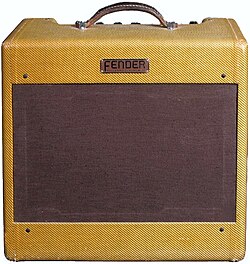
In the mid-1940s, K&F Manufacturing released their first amplifiers, low-wattage combos with steel casings and no covering. The K&F partnership was short-lived, however, with co-founder Leo Fender starting his own namesake brand, Fender, to continue producing amplifiers, as well as electric guitars and basses. Fender's first amps had wooden enclosures and were characterized by wide control panels that made them resemble television sets of the time.2 Like pickup models of that era, these early amplifiers were not loud enough for use on stage: when players turned their amps up all the way, the signal clipped, losing high and low frequencies but gaining compression, harmonics, and a "musical type of distortion". While an unintended technical shortcoming, players embraced it and amp distortion would go on to become closely associated with the electric guitar.3 One such amp known to distort at high volumes, the Fender Deluxe of 1948, became regarded as one of the earliest amp designs to achieve iconic status.4 Like other Fender amp models in the 1940s and 1950s, the Deluxe came in a Tweed-covered cabinet.
1950s–1960s: Rock and roll

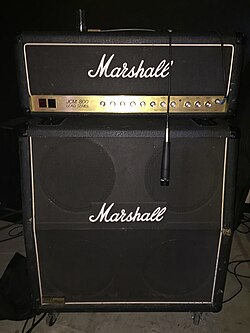
In 1950, Fender debuted its first mass-produced, solid-body electric guitars, the Esquire and Telecaster (then known as the Broadcaster). Using a solid-body design eliminated the unwanted feedback caused by pickups on acoustic jazz guitars when they were amplified.3 Fender released the Twin in 1950 and followed in 1952 with the bass-oriented Bassman. While the Twin excelled at clean tones, the Bassman's distortion at loud volumes became popular among both bassists and guitarists. The Bassman later served as inspiration for Marshall's debut amp model, the JTM45.2 Vox released its AC30 combo in 1958 and then updated the amp in 1960 as a three-channel model that became famous for its jangly tone and widespread use during the British Invasion.4 In response to players like Pete Townshend of The Who who wanted more power, Marshall released the 100-watt 1959 Super Lead in 1965. The JTM45 and Super Lead were heads, which combined the preamp and power amp in a dedicated enclosure that was paired with an external speaker cabinet. Pairing the Super Lead with one or more 4x12 cabinets became known as the "Marshall stack". The combination has been used by many notable guitarists of the era and played a major role in shaping the sound of rock and roll.4
Throughout the 1960s, Fender continued updating the circuits and cosmetics of their amplifiers. Fender's Twin Reverb of the mid-1960s became a standard amp model for "clean", undistorted tones.2 Hiwatt's DR103 was similarly highly regarded as a loud, clean amplifier and has frequently been associated with David Gilmour.4 In 1965, Peavey released its first amp models, which used transistors rather than the standard vacuum tubes, which had been replaced by solid-state technology in most industries following WWII. By the 1970s, Fender, Vox, Marshall, and others had all released transistor-based amplifiers, with the most successful being the Roland Jazz Chorus, which became a popular alternative to the Fender Twin for clean tones.5
1970s–1980s: Master volume amplifiers
As rock music evolved, so too did the need among guitarists for greater amounts of distortion. Amps like Marshall's Super Lead could produce distortion but did so by a player pushing the power section into saturation by playing it at high volume levels that were not always practical.6 Many players turned to effects pedals like the Maestro Fuzz-Tone and Arbiter Fuzz Face as a solution, the former notably being used by Keith Richards on the Rolling Stones' hit "(I Can't Get No) Satisfaction".7
By the early 1970s, it had become popular for technicians to "hot rod" Fender amplifiers to achieve more distortion through methods like adding a "master volume" circuit,8 which used two volume controls, one to control how much the preamp tubes distorted and another to control overall output.9 One such technician was Mesa/Boogie founder Randall Smith, whose modified Fenders evolved into the brand's Mark series, which used a series of variable gain stages that "cascaded" into each other to create more distortion than any previous amplifier could.8 In doing so, Smith pioneered "high-gain" amps.10 Howard Dumble used a similar cascading gain design with his Overdrive Special, which gave players a foot-switchable "lead" mode with extra gain stages.11
While early Mesas and Dumbles were popular among guitarists like Carlos Santana, the heavier guitar tones of Black Sabbath's Tony Iommi using a Laney Supergroup amplifier and a modified Dallas Rangemaster treble booster inspired players in the growing heavy metal genre to pursue more aggressive tones.6 Marshall looked to meet this demand with the 1981 release of the JCM800 2203, which was initially a close copy of the brand's first master volume-equipped amp, the JMP 2203, released in 1975, but underwent several circuit changes in the next few years.12 Throughout the 1980s, Mesa/Boogie continued revising its Mark series, pioneering new features with their Mark II iterations like channel-switching and effects loops. Smith and his company's most significant revision produced the Mark IIC+ variant, which had a tighter, more aggressive tone that was popularized by Metallica.6 The JCM800 and Mark series marked a transition from "vintage"-style amplifiers to modern designs.6
Technicians in the 1980s continued pushing modded amplifiers into higher-gain territory, and some became successful enough to launch their own companies, including Soldano, Bogner, and Rivera. Soldano's SLO-100 helped establish the high-end, high-gain amplifier market and inspired later German brands like ENGL, Hughes & Kettner, and Diezel.6 Toward the end of the decade, many professional guitarists adopted complex rackmount setups, often consisting of multiple preamps, power amps, and studio-grade effects, all operated with a custom pedal controller. Popular rackmount preamps included the A/DA MP-1, Mesa/Boogie Triaxis, Marshall JMP-1, and Soldano X88-R.13
1990s–present: Boutique brands and digital modeling
While rackmount setups were widely used by pros, they were expensive, and by the time affordable rackmount options came to the market in the early 1990s grunge had inspired a return to standalone amplifiers, vintage-style effects pedals, and a less processed sound.1314 The 1990s also experienced a new wave of boutique amplifier builders. The old Fender and Marshall amps previous techs had modded were by then too valuable to alter, so many instead founded companies that built new amps inspired by vintage designs. A notable example was Matchless and their Vox AC30-inspired DC-30 combo.14 Other companies continued to push the boundaries of high-gain, with Mesa/Boogie's Dual Rectifier becoming the decade's quintessential high-gain amplifier.6 Peavey's 5150, co-designed with Eddie Van Halen, became another frequently-used amplifier among metal guitarists.4
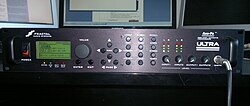
Modeling technology advanced significantly during this time. Tech 21 had released its analog SansAmp amplifier modeler in 1989 but it became popular in the 1990s as a direct recording solution.14 Line 6 released its first digital modeling amplifier, the AxSys, in 1996, followed by the bean-shaped desktop POD processor two years later. Early modelers were regarded as home practice tools6 until the 2006 arrival of Fractal Audio's Axe-FX, the first modeler considered sufficient for professional use.15 The Kemper Profiler followed in 2011, pioneering "profiling", also known as "capturing", a technology that allows users to create and use digital versions of their own physical gear.16 The success of digital modeling in an otherwise analog landscape has led to a long-running debate over the merits of tube amplifiers compared to modelers.17 Tube amp players often appreciate the nostalgia of the technology and argue analog amps and cabinets have a "soul" that cannot be replicated; modeler users value their portability, consistency, and reliability.17
Many tube amp manufacturers have responded by implementing digital technology into their products, especially impulse responses (IRs), which are digital emulations of speaker cabinets and microphones. IRs allow for easier home recording, letting players skip the use of physical cabinet setups while still using a tube amplifier.6 Alongside the development of modelers, smaller "lunchbox" amplifiers—amp heads that use metal cases and a low-output power stage—have become popular following the success of the 15-watt Orange Tiny Terror, released in 2006.18 Boss debuted its Katana line of analog-digital hybrid amplifiers in 2016, and it became the industry's bestselling amp line.19
As digital signal processing technology has progressed, modelers have become more compact and inexpensive, with budget offerings from brands like Mooer, NUX, and Joyo. Many brands now incorporate AI and machine learning into their products and design process.17 One such company, Neural DSP, established itself through audio plug-ins that create computer-based virtual amplifier and effects modelling suites. Neural released their first piece of hardware, the Quad Cortex, in 2020.20
Structure
Format
Fundamentally, guitar amplifiers function by taking the signal generated by an electric guitar's pickup(s) and feed it through an electronic circuit in which the tone is shaped and amplified before being projected through one or more loudspeakers.21 An amplifier in which this entire process happens inside a single enclosure is referred to as a combo. When the tone-shaping and amplification occur inside a dedicated unit that requires a separate speaker cabinet, it is known as a head.21 Most amplifiers utilize a tone stack that consists of controls to individually adjust bass, midrange, and treble frequency levels. Reverb is a commonly included effect. For models that use vacuum tubes, the specific tube types used and the number of them have a significant impact on the amp's tone and ability to create distortion.21 Many amps are designed with two or more selectable channels which allow for different volume, distortion, and equalization settings.
Control layout
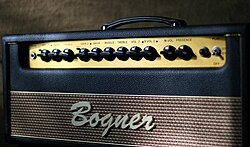
Control knobs and buttons are typically located on the front or rear of an amp's chassis. Common front panel controls include those for preamp volume or gain; bass, middle, and treble frequency adjustments; and master volume. Amps with more complex feature sets can also include presence and resonance controls or even a graphic equalizer, as in the Mesa/Boogie Mark Series.
Back panel features include connections for the external speaker cabinets and optional features like an effects loop, power attenuation, headphone use, and direct recording. Guitars are connected to the amp via one or more 1/4" jacks.
Preamp and power amp
The electronic circuit of a guitar amplifier can be divided into two sections. The preamp, or preamplifier, receives the initial input signal from the guitar and is responsible for the amp's tone-shaping and equalization controls.22 The amount of amplification applied to the incoming signal, known as gain, affects the amp's volume but to a greater extent affects its preamp distortion. The power amp then receives the processed signal and amplifies it to the player's desired output level via the loudspeakers. Wattage is used as a measurement of how much power an amp can produce.22
For the first several decades of their use, guitar amplifiers almost exclusively used vacuum tubes in both the preamp and power amp sections. The 12AX7 is the most common preamp tube, while power amps utilize EL34, EL84, 6L6, or 6V6 tubes, among others. Tubes are also sometimes used for rectification, which convert AC power to DC and impart their own tonal character. Solid-state amplifiers replace these tubes with diodes and transistors.22
Power output
The relationship between power output in watts and perceived volume is nuanced. Generally speaking, more wattage equates to more volume, but there can be a significant difference in perceived volume depending on the nature of the power amp. Tube-based power amps, for example, will seem louder than their solid-state counterparts at a given wattage, with a 10- to 15-watt tube amp being roughly equivalent in volume to a 50-watt solid-state amp.22 Among tube amps, however, there is not a significant difference in maximum volume based on wattage. As measured in dBs, a 100-watt tube amp is not significantly louder than a 15-watt tube amp; the major difference is instead in headroom, or how loud an amp can be set before it starts to distort, with the 100-watt amp being able to stay cleaner at much louder volumes than the 15-watt amp.23 For many players though, the output level setting is chosen not purely for reasons of volume, but also for the perception that tube amps often sound their best at specific volume settings that strike a balance between driving the preamp and power amp while preserving the dynamics of a guitarist's playing.23
Distortion
Distortion (or "overdrive") is an important characteristic of most guitar amplifiers. Distortion can be produced in either the preamp or power amp, or both. Early amplifiers like the 100-watt Marshall Super Lead used a single volume control to control the amp's overall output volume. Distortion was produced by increasing that volume control to overload the amp's power amp tubes, which often required extremely high volumes—the more volume, the more distortion. Generally, distortion is more associated with tube amps, which have less headroom than solid-state amps and are considered to have a more pleasing overdriven character.23
Most modern amplifiers use two volume controls: an initial volume control (often labeled "preamp" or "gain") that affects the level of the input signal and then a master volume control placed at the end of the circuit (after the power amp tubes), allowing for level attenuation before the signal is sent to the loudspeakers. A master volume allows distortion to be produced by pushing the preamp and/or power amp into distortion before the output level is then set to the player's desired overall volume. Conversely, amps like the Soldano SLO-100 produce distortion solely in its preamp, allowing for significant levels of distortion at any volume.24 Preamp gain is often preferred for its added compression and harmonic overtones.23
High-gain
Amplifiers designed to produce heavy amounts of distortion for genres like hard rock and metal are often referred to as high-gain. Early amps like the Super Lead could produce distortion and saturation but proved unsatisfactory as much of rock music became more aggressive into the 1980s and beyond. Master volumes were an important factor in the development of high-gain tones, as was Mesa/Boogie's pioneering of "cascading" preamp designs, in which multiple gain stages arranged in series would spill over one into the next as the preamp/gain control is increased, allowing for unprecedented amounts of distortion.25 High-gain abilities are now considered a definitive quality of modern amplifiers.6
In popular culture
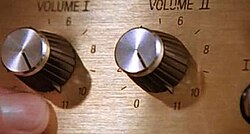
Volume control gradations are typically numbered from zero to ten. In the 1984 film This Is Spinal Tap, guitarist Nigel Tufnel demonstrates an amplifier with volume knobs marked from zero to eleven, believing that this numbering increases the highest volume of the amp. He explains, "It's one louder, isn't it?" This misunderstanding of the underlying operating principles led to the idiom "Up to eleven", also phrased as "These go to eleven". As a consequence of the film, real bands and musicians started buying equipment whose knobs went up to eleven or twelve.
Cabinet design
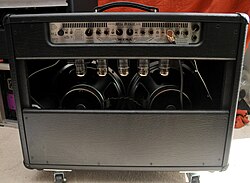
Combos and external speaker cabinets required for use with heads come in a variety of configurations. Combos often use one or two 12" speakers, or between one and four 10" speakers. Smaller practice amps often use even smaller speakers. Standalone cabinets paired with heads typically use up to four 10" or 12" speakers.
Several different designs can used, including an "open back" design, a "closed back" design (essentially a sealed box), and the less-common bass reflex design, which uses a closed back with a vent or port cut into the cabinet.26 With guitar amps, most open back amp cabinets are not fully open; part of the back is instead enclosed with panels. Combo amp cabinets and standalone speaker cabinets are typically made of plywood. Some are made of MDF or particle board—especially in low-budget models.26 Cabinet size and depth, material types, assembly methods, type and thickness of the baffle material (the wood panel that holds the speaker), and the way the baffle attaches to the cabinet all affect tone.26
When two or more speakers are used in the same cabinet, or when two cabinets are used together, the speakers can be wired in parallel or in series, or in a combination of the two (e.g., two 2x10" cabinets, with the two speakers wired in series, can be connected together in parallel). Whether speakers are wired in parallel or in series affects the impedance of the system. Two 8 ohm speakers wired in parallel have 4-ohm impedance. Guitarists who connect multiple cabinets to an amplifier must consider the amp's minimum impedance. Parallel vs. series also affects tone and sound. Speakers wired in parallel slightly dampen[s] and restrain[s] them, giving what some describe as tighter response and smoother breakup. Some describe speakers wired in series (usually no more than two) as sounding "...looser, giving a slightly more raw, open and edgy sound."26
Stacks
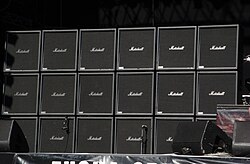
When an amp head is placed atop a speaker cabinet, it is sometimes referred to as a stack. A head placed atop a single speaker enclosure is called a half stack; when two speaker cabinets are used, it is known as a full stack. In the case of full stacks, the upper cabinet often uses a partially angled front, while the lower cabinet uses a straight front.
Stacks were popularized by Marshall in the 1960s. The brand initially paired their amp heads with a single cabinet consisting of eight 12" speakers, but these were unwieldy and quickly replaced with two cabinets, each using four 12" speakers and placed—or stacked—on top of each other.
Some touring metal and rock bands have used large arrays of guitar speaker cabinets to create an impressive appearance. Some of these arrangements include only the fronts of speaker cabinets mounted on a large frame.27
Types
Vacuum tube
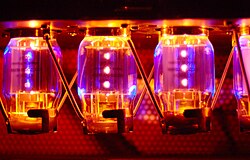
Vacuum tubes (called valves in British English) were by far the dominant active electronic components in most instrument amplifier applications until the 1970s when solid-state semiconductors (transistors) started taking over. Transistor amplifiers are less expensive to build and maintain, reduce the weight and heat of an amplifier, and tend to be more reliable and more shock-resistant. Tubes are fragile and they must be replaced and maintained periodically. As well, serious problems with the tubes can render an amplifier inoperable until the issue is resolved.
While tube-based circuitry is technologically outdated, tube amps remain popular since many guitarists prefer their sound.28 Tube enthusiasts believe that tube amps produce a warmer sound and a more natural "overdrive" sound.
Solid-state
Most inexpensive and mid-priced guitar amplifiers are based on transistor or semiconductor (solid-state) circuits, which are cheaper to produce and more reliable, and usually much lighter than tube amplifiers.28 Solid-state amps are less fragile than tube amps.
High-end solid-state amplifiers are less common, since many professional guitarists favor vacuum tubes. Some jazz guitarists favor the cleaner sound of solid-state amplifiers. Only a few solid-state amps have enduring attraction, such as the Roland Jazz Chorus.282930 Solid-state amplifiers vary in output power, functionality, size, price, and sound quality in a wide range, from practice amplifiers to combos suitable for gigging to professional models intended for session musicians who do studio recording work.
Hybrid
A hybrid amplifier involves one of two combinations of tube and solid-state amplification. It may have a tube power amp fed by a solid-state pre-amp circuit, as in most of the original MusicMan amplifiers.
Alternatively, a tube preamplifier can feed a solid-state output stage, as in models from Kustom, Hartke, SWR, and Vox. This approach dispenses with the need for an output transformer and easily achieves modern power levels.28
Acoustic
Acoustic amplifiers are intended for acoustic guitars and other acoustic instruments, especially for the way these instruments are used in relatively quiet genres such as folk and bluegrass. They are similar to keyboard amplifiers, in that they have a relatively flat frequency response with minimal coloration. To produce this relatively clean sound, these amplifiers often have powerful amplifiers (providing up to 800 watts RMS), to provide additional headroom and prevent unwanted distortion. Since an 800-watt amplifier built with standard Class AB technology is heavy, some acoustic amplifier manufacturers use lightweight Class D amplifiers, which are also called switching amplifiers.
Acoustic amplifiers produce an uncolored, acoustic sound when used with acoustic instruments with built-in transducers, pickups or microphones. The amplifiers often come with a simple mixer, so that the signals from a pickup and a condenser microphone can be blended. Since the early 2000s, it has become increasingly common for acoustic amplifiers to provide a range of digital effects, such as reverb and compression. As well, these amplifiers often contain feedback-suppressing devices, such as notch filters or parametric equalizers.
Modeling
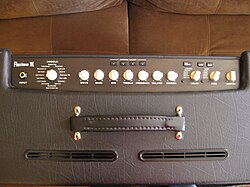
Microprocessor technology allows the use of digital onboard effects in guitar amps to create numerous different sounds and tones that simulate the sound of a range of tube amplifiers and different sized speaker cabinets, all using the same amplifier and speaker. These are known as modeling amplifiers, and can be programmed with simulated characteristic tones of different existing amplifier models (and speaker cabinets—even microphone type or placement), or dialed in to the user's taste. Many amps of this type are also programmable by way of USB connection to a home computer or laptop.28 Line 6 is generally credited with bringing modeling amplification to the market.3132 Modeling amplifiers and stompbox pedals, rackmount units, and software that models specific amplifiers, speakers cabinets, and microphones can provide a large number of sounds and tones. Players can get a reasonable facsimile of the sound of tube amplifiers, vintage combo amplifiers, and huge 8x10” speaker stacks without bringing all that heavy equipment to the studio or stage.
The use of full range, flat response (FRFR) amplification systems by electric guitarists has received an extra impetus from modeling amplifiers. Before widespread availability of modeling, guitarists did not commonly plug electric guitars straight into PA systems or powered speakers because most genres relied on the tonal coloration of a regular guitar amplifier setup—from the preamplifier, equalization filters, power amp, guitar speakers, and cabinet design. The FRFR approach assumes the tone is shaped by sound processors in the signal chain before the amplifier and speaker stage, so it strives to not add further coloration33 or dedicated combo-style amplifiers with a broad frequency range.34 Such processors can be traditional guitar effects, a modeling amplifier (without power amplifier), or a computer running tone-shaping software.33 Using a modeling amp or a multi-effects pedal used with line level output, a guitarist can plug in the guitar into a flat response mic input or into a keyboard amplifier.
Pedal
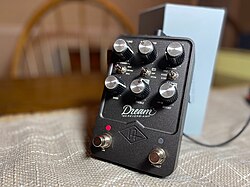
A pedal amplifier is a compact amplifier placed at a player's feet, often as part of—or used in tandem with—a pedalboard. Pedal amps are effectively amp heads in pedal format, containing preamp and power amp circuits but not speakers.35 Pedal amps became popular in the 2020s as amplification technology continued to shrink in size, since they proved ideal options for a small, portable rig or for use as an emergency backup for a conventional amplifier.35 Pedal amps generally use solid-state technology but some models include tube preamps in a hybrid approach. Digital modelers often come in pedal amp format, but lack power amp functionality. In such cases, preamp-only pedal amps typically include speaker emulation to mimic the sound of a full amplifier setup and send it to a powered speaker, PA system, or recording system.35
References
References
- Teagle, John (September 5, 2002). "Antique Guitar Amps 1928-1934".
- Stoner, Brandon. "A brief history of Fender amps". guitar.com. Guitar Magazine. Retrieved 28 December 2025.
- Bekhrad, Joobin (8 March 2019). "The electric spark that changed the guitar forever". bbc.com. BBC. Retrieved 28 December 2025.
- Fanelli, Damian (24 April 2020). "The 10 most iconic guitar amps of all time". guitarworld.com. Guitar World. Retrieved 28 December 2025.
- Guppy, Nick (8 April 2022). "Charting the evolution of solid-state and digital guitar amps – and the future of tubes". guitarworld.com. Guitar World. Retrieved 28 December 2025.
- Kobylensky, Paul. "The Loud History of High-Gain Amplification". premierguitar.com. Premier Guitar. Retrieved 27 December 2025.
- Tolinski, Brad (2 March 2023). "The 50 greatest moments in electric guitar history". guitarworld.com. Guitar World. Retrieved 28 December 2025.
- Pittman, Aspen (September 2003). The Tube Amp Book. Bloomsbury Academic. ISBN 9780879307677. Retrieved 29 December 2025.
- Tarquin, Brian (November 2016). Guitar Amplifier Encyclopedia. Skyhorse Publishing. ISBN 9781621535010. Retrieved 29 December 2025.
- Stoner, Brandon. "A brief history of Mesa/Boogie". guitar.com. Guitar Magazine. Retrieved 28 December 2025.
- Hunter, Dave (22 April 2021). "Examining a '77 Dumble Overdrive Special 1x12". guitarplayer.com. Guitar Player. Retrieved 2 November 2025.
- Gill, Chris (10 November 2022). "Why the Marshall JCM800 2203 was the amp head of choice for a generation of rock and metal guitar players". guitarworld.com. Guitar World. Retrieved 29 December 2025.
- McDonough, Mac (2 September 2022). "The Rise and Fall of Guitar Rack Effects". sweetwater.com. Sweetwater. Retrieved 30 December 2025.
- Gill, Chris (22 November 2023). "The '90s was a watershed era for gear, and set the template for the future of the electric guitar – these are the retro designs, digital innovations and misfit toys that defined a decade and beyond". guitarworld.com. Guitar World. Retrieved 30 December 2025.
- Hodgson, Peter (26 October 2023). "Fractal Audio's Stage-Ready, Penguin-Friendly Tech". mixdownmag.com. Mixdown Magazine. Retrieved 29 May 2024.
- "Kemper Profiler Head Review". guitar.com. Guitar Magazine. Retrieved 26 February 2025.
- Sehat, Putro; Soldir, Keket. "Beyond Emulation: Amp Sims, AI, and the Coming Saturation Point". premierguitar.com. Premier Guitar. Retrieved 10 January 2026.
- "When small became big: a brief history of lunchbox guitar amps". musicradar.com. Music Radar. 16 March 2016. Retrieved 27 December 2025.
- Holder, Ross (18 October 2024). ""A masterclass in versatility, seamlessly bridging the gap between practice and performance": Boss Katana Head Gen 3 review". guitarworld.com. Guitar World. Retrieved 9 June 2025.
- Vinnicombe, Chris. "Neural DSP Quad Cortex review: is this the game-changing guitar product of the decade so far?". guitar.com. Guitar Magazine. Retrieved 1 June 2024.
- Corfield, Chris. "Everything you need to know about guitar amps". guitarworld.com. Guitar World. Retrieved 25 May 2026.
- Corfield, Chris. "Best guitar amps 2026: tube, solid-state, and modeling amplifiers for all levels and budgets". guitarworld.com. Guitar World. Retrieved 25 May 2026.
- Breathnach, Cillian. "How much headroom do you need? Pedal platform amplifiers explained". guitar.com. Guitar Magazine. Retrieved 25 May 2026.
- Beaujour, Tom. "Soldano Super Lead Overdrive 30 Review". guitarplayer.com. Guitar Player. Retrieved 15 May 2025.
- Hunter, Dave (2005). The Guitar Amp Handbook. Bloomsbury Academic. p. 45. ISBN 9780879308636. Retrieved 24 March 2026.
- "All About Speaker Cabinets | GuitarPlayer". Archived from the original on 2016-12-24. Retrieved 2016-12-24.
- Golijan, Rosa (22 September 2010). "The Concert Speakers Are A Lie". Gizmodo. Retrieved 16 January 2011.
- Gallagher, Mitch (2012). Guitar Tone: Pursuing the Ultimate Guitar Sound. Cengage Learning. pp. 85–86. ISBN 978-1-4354-5621-1.
- Pinksterboer, Hugo (2009). Tipbook Amplifiers and Effects: The Complete Guide. Hal Leonard. p. 270. ISBN 978-1-4234-6277-4.
- Madsen, Pete (2006). Funk Guitar and Bass: Know the Players, Play the Music. Hal Leonard. p. 81. ISBN 978-0-87930-894-0.
- Chappell, Jon (2011). Blues Guitar For Dummies. John Wiley & Sons. p. 282. ISBN 978-1-118-05082-8.
- Coelho, Victor (2003). The Cambridge Companion to the Guitar. Cambridge Companions to Music. Cambridge UP. p. 145. ISBN 978-0-521-00040-6.
- Anderton, Craig (April 2014). "Is Full Range Flat Response Amplification In Your Future?". Guitar Player. p. 148.
- Turner, Bryan (December 2014). "Mission Engineering Gemini 1". pp. 114–17.
- Schwarten, Chris. "Best pedal amps: big sounds in a small package". guitarworld.com. Guitar World. Retrieved 26 May 2026.
Further reading
Further reading
- Fliegler, Ritchie. The Complete Guide to Guitar and Amp Maintenance. Hal Leonard Corporation, 1994.
- Fliegler, Ritchie and Eiche, Jon F. Amps!: The Other Half of Rock 'n' Roll. Hal Leonard Corporation, 1993.
- Hunter, Dave. Amped: The Illustrated History of the World's Greatest Amplifiers. Voyageur Press, 2012.
- Pittman, Aspen. The Tube Amp Book. Backbeat, 2003.
- Tarquin, Brian. Guitar Amplifier Encyclopedia. Skyhorse Publishing, Inc., 2016.
- Weber, Gerald, "A Desktop Reference of Hip Vintage Guitar Amps", Hal Leonard Corporation, 1994. ISBN 0-9641060-0-0