Siniloan
Guiling-guiling | |
|---|---|
| Municipality of Siniloan | |
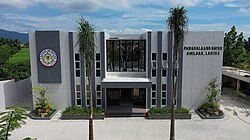 | |
 Flag  Seal | |
| Nickname: A Waterfall Sanctuary | |
| Motto: Siniloan, GO with me! | |
 Map of Laguna with Siniloan highlighted | |
 Interactive map of Siniloan | |
Siniloan Location within the Philippines | |
| Coordinates: 14°25′N 121°27′E / 14.42°N 121.45°E / 14.42; 121.45 | |
| Country | Philippines |
| Region | Calabarzon |
| Province | Laguna |
| District | 4th district |
| Founded | June 29, 1583 |
| Barangays | 20 (see Barangays) |
| Government | |
| • Type | Sangguniang Bayan |
| • Mayor | Patrick Ellis Z. Go |
| • Vice Mayor | Joseph Metzler D. Masacupan |
| • Representative | Benjamin Cueto "Benjie" Agarao Jr. |
| • Municipal Council | Members
|
| • Electorate | 26,242 voters (2025) |
| Area | |
• Total | 64.51 km2 (24.91 sq mi) |
| Elevation | 225 m (738 ft) |
| Highest elevation | 630 m (2,070 ft) |
| Lowest elevation | 0 m (0 ft) |
| Population (2024 census)3 | |
• Total | 42,533 |
| • Density | 659.3/km2 (1,708/sq mi) |
| • Households | 9,564 |
| Demonym | Siniloeño |
| Economy | |
| • Income class | 2nd municipal income class |
| • Poverty incidence | 24.36 |
| • Revenue | ₱ 256.4 million (2024) |
| • Assets | ₱ 566.4 million (2024) |
| • Expenditure | ₱ 113 million (2024) |
| • Liabilities | ₱ 225.6 million (2024) |
| Service provider | |
| • Electricity | First Laguna Electric Cooperative (FLECO) |
| • Water | Siniloan Water District (SIWADI) |
| Time zone | UTC+8 (PST) |
| ZIP code | 4019 |
| PSGC | |
| IDD : area code | +63 (0)49 |
| Native languages | Tagalog |
| Patron saint | Saint Peter and Saint Paul |
| Website | siniloan |
Siniloan, officially the Municipality of Siniloan (Tagalog: Bayan ng Siniloan), is a 2nd-class municipality in the province of Laguna, Philippines. According to the 2024 census by the Philippine Statistics Authority (PSA), it has a population of 42,533 people, with a population density of approximately 660 persons per square kilometer.5
Siniloan lies between the plains of the Sierra Madre Mountains and Laguna de Bay, bounded between Mabitac on the west, Pangil on the east, Real, Quezon on the north, and Laguna de Bay on the south. A river named Rio Romelo runs through the center of the town and is used for fishing ground and irrigation purposes. It is 26 kilometres (16 mi) from the provincial capital, Santa Cruz, 113 kilometres (70 mi) from Manila via the South Luzon Expressway, and 74 kilometres (46 mi) from Lucena.
it is strategically positioned as a center of education, commerce, and transportation, acting as a hub for nearby towns in eastern Laguna as well as select areas in the provinces of Quezon and Rizal. The municipality features active business and trade activities, supported by its role as a commercial center with retail shops, markets, and services catering to residents and visitors from surrounding communities.
Etymology
From the early period of Spanish colonialisation, some female inhabitants of the place were milling their palay in their fields. While they were working, some Spaniards (Spanish Colonizers), came and asked them, "Como se llama esta pueblo?" The natives, not knowing Spanish thought that they were asked what they were doing and one of them answered, "camí po ay gumiguiling". The Spaniards repeated, "Guiling-Guiling", to which the natives nodded. The area was then referred to as "Guiling-Guiling" from 1583 to 1604.
Another story has it that during the later part of the year 1604, three brothers, namely, Juan Puno, Juan Pili, and Juan Puhuwan, migrated into this community. They selected a lot adjacent to the river Río Romelo and divided it equally among themselves. When the parish priest saw the ingenuity of the three brothers in equally dividing the land, he asked the natives how equally was expressed in Tagalog. The natives gave him the expression "Sinloan". Right then and there, the name Guiling-Guiling was changed to Siniloang which meant justice, equality and fairness. The word travelled from mouth to mouth with sound variations. Because of the difficulty of some Spaniards in pronouncing Siniloang, the name Siniloan struck and became the official name of this town.
The name Siniloan is also believed to have been taken from a legendary story about Luis and Ana, a married couple who chased a wild boar from a place called Luisiana. They ran after that big boar from Luisiana to Cavinti (kapit sa Binti). The people along the way who saw Luis and Ana chasing the boar took pity on them and helped them to catch it. The people chased the boar through the towns of Lumbán, Kalayaan, Loñgos, Paéte, Paquil, and Pañguil until they finally caught the boar in this town by means of the lassoed captivity or Siniloan.
History
Spanish colonial period (16th-19th centuries)
Before the arrival of the Spaniards, the area was populated by indigenous Tagalog communities. Siniloan is one of the oldest towns in Laguna. It was established as a reducción by Franciscan missionaries Friar Juan de Plasencia and Friar Diego de Orpesa around 1579 to 1583. On June 29, 1583, Sinilóan formally came to be as a town when Don Juan de Salcedo arrived and the parish was established jointly by Friar Diégo de Orpesa and Friar Juan de Plasencia.
The first church (initially of nipa and bamboo) was dedicated to Our Lady of Purification. A stone church was built starting in 1733 by a Franciscan Friar, Fr. Melchor de San Antonio and later placed under patronage of Saints Peter and Paul. Several barrios were separated over time:
- Santa Maria (formerly Barrio Caboan) was officially separated 1602.
- Mabitac was officially separated in 1613.6
- Famy (formerly Barrio Calumpang) and Pangil was officially separated in 1910.78
During the Spanish era, Siniloan was known for its rice fields and natural resources. It played a minor role in the broader colonial evangelization of Laguna.
19th century to Philippine Revolution and American period
During the American colonial period, the town of Siniloan underwent territorial expansions and followed contractions due to administrative reorganization policies implemented and made by the United States government. On October 12, 1903, the Philippine Commission enacted Act No. 939, which was designed to reduce the number of municipalities in the Province of La Laguna from thirty down to nineteen for more centralized administration (And to lessen administrative costs). Under Section 1, Paragraph 2 of this statute, the independent municipalities of Famy and Pangil were formally consolidated and absorbed into the territory of Siniloan, with Siniloan designated as the centralized seat of the municipal government.9
The consolidated arrangement, however proved to be temporary as local administrative requirements shifted over the next decade. The collective barrios and territories were eventually restored to their independent statuses. Famy was officially separated from Siniloan to re-establish its status as a distinct municipality through Executive Order No. 72, series of 1909, an administrative directive that took full effect in 1910. Around this same historical juncture, Pangil was likewise segregated from Siniloan, restoring the original jurisdictional boundaries of the respective northern Laguna towns.10

During the Philippine-American War, Siniloan served as a strategic military base and garrison town for the United States Army in northeastern Laguna. On September 17, 1900, U.S. troops from the 15th and 37th Infantry Regiments, advancing from their garrison in Siniloan, launched a major offensive to attack Filipino forces entrenched in the neighboring town of Mabitac. Following the tactical victory of Filipino General Juan Cailles at the Battle of Mabitac, the defeated American forces retreated back to their staging area in Siniloan.11
World War II and Japanese occupation (1942-1945)

Like much of Laguna, Siniloan suffered during the Japanese occupation. The town had a local guerrilla unit, the "Siniloan Volunteer Corps", led by figures such as Delfin Redor, which supported American and Filipino forces against the Japanese. The Arch of Freedom in Plaza Delfin Redor commemorates local WWII heroes and sacrifices.12
The broader Laguna guerrilla campaign was active, with multiple resistance groups operating in the province.12
Post-war and independent Philippines (1946-present)
During the administration of President Diosdado Macapagal, the municipality of Siniloan was recognized for its local governance. On August 25, 1963, the municipal council, led by Mayor Inocencio Adrias and 1st Councilor Jose Crisostomo, received a special presidential award for excellence in public service, presented alongside Laguna Governor Felicisimo San Luis.13

The old Municipal Police Station near the plaza was demolished and its entire police force relocated. It paved the way for more economic development of commercial services, It was replaced by a franchise of Robinson's EasyMart.1415
Sinilóan is politically subdivided into 20 barangays, as indicated in the matrix below. 16 Each barangay consists of puroks and some have sitios.
Currently, there are 13 barangays which are classified as urban and the rest are rural.
| PSGC | Barangay | Population | ±% p.a. | |||
|---|---|---|---|---|---|---|
| 202417 | 201018 | |||||
| 043429001 | Acevida | 3.0% | 1,294 | 1,406 | ▾ | −0.59% |
| 043429002 | Bagong Pag-asa (Poblacion) | 1.5% | 636 | 559 | ▴ | 0.92% |
| 043429003 | Bagumbarangay (Poblacion) | 0.3% | 118 | 213 | ▾ | −4.09% |
| 043429004 | Buhay | 2.6% | 1,110 | 1,089 | ▴ | 0.14% |
| 043429005 | G. Redor (Poblacion) | 0.6% | 239 | 674 | ▾ | −7.08% |
| 043429006 | Gen. Luna | 3.0% | 1,294 | 1,360 | ▾ | −0.35% |
| 043429007 | Halayhayin | 11.4% | 4,847 | 3,923 | ▴ | 1.51% |
| 043429008 | J. Rizal | 1.0% | 418 | 458 | ▾ | −0.64% |
| 043429009 | Kapatalan | 3.8% | 1,630 | 2,525 | ▾ | −3.05% |
| 043429010 | Laguio | 1.9% | 797 | 549 | ▴ | 2.67% |
| 043429011 | Liyang | 1.4% | 601 | 618 | ▾ | −0.20% |
| 043429012 | Llavac | 3.4% | 1,428 | 1,943 | ▾ | −2.16% |
| 043429013 | Macatad | 7.1% | 3,034 | 2,161 | ▴ | 2.43% |
| 043429014 | Magsaysay | 5.6% | 2,375 | 1,611 | ▴ | 2.79% |
| 043429015 | Mayatba | 1.0% | 405 | 419 | ▾ | −0.24% |
| 043429016 | Mendiola | 14.1% | 5,978 | 5,091 | ▴ | 1.14% |
| 043429017 | P. Burgos | 11.3% | 4,805 | 2,599 | ▴ | 4.45% |
| 043429018 | Pandeno | 8.2% | 3,474 | 3,379 | ▴ | 0.20% |
| 043429019 | Salubungan | 4.6% | 1,947 | 1,739 | ▴ | 0.80% |
| 043429020 | Wawa | 7.1% | 3,030 | 3,044 | ▾ | −0.03% |
| Total | 42,533 | 35,345 | ▴ | 1.32% | ||
Climate
| Climate data for Siniloan, Laguna | |||||||||||||
|---|---|---|---|---|---|---|---|---|---|---|---|---|---|
| Month | Jan | Feb | Mar | Apr | May | Jun | Jul | Aug | Sep | Oct | Nov | Dec | Year |
| Mean daily maximum °C (°F) | 26 (79) |
27 (81) |
29 (84) |
31 (88) |
31 (88) |
30 (86) |
29 (84) |
29 (84) |
29 (84) |
29 (84) |
28 (82) |
26 (79) |
29 (84) |
| Mean daily minimum °C (°F) | 22 (72) |
22 (72) |
22 (72) |
23 (73) |
24 (75) |
25 (77) |
24 (75) |
24 (75) |
24 (75) |
24 (75) |
24 (75) |
23 (73) |
23 (74) |
| Average precipitation mm (inches) | 58 (2.3) |
41 (1.6) |
32 (1.3) |
29 (1.1) |
91 (3.6) |
143 (5.6) |
181 (7.1) |
162 (6.4) |
172 (6.8) |
164 (6.5) |
113 (4.4) |
121 (4.8) |
1,307 (51.5) |
| Average rainy days | 13.4 | 9.3 | 9.1 | 9.8 | 19.1 | 22.9 | 26.6 | 24.9 | 25.0 | 21.4 | 16.5 | 16.5 | 214.5 |
| Source: Meteoblue19 | |||||||||||||
Demographics
| Year | Pop. | ±% p.a. |
|---|---|---|
| 1903 | 3,675 | — |
| 1918 | 3,913 | +0.42% |
| 1939 | 4,692 | +0.87% |
| 1948 | 5,450 | +1.68% |
| 1960 | 9,149 | +4.41% |
| 1970 | 12,413 | +3.09% |
| 1975 | 14,386 | +3.00% |
| 1980 | 17,220 | +3.66% |
| 1990 | 22,759 | +2.83% |
| 1995 | 26,914 | +3.19% |
| 2000 | 29,902 | +2.28% |
| 2007 | 34,877 | +2.15% |
| 2010 | 35,363 | +0.50% |
| 2015 | 38,067 | +1.41% |
| 2020 | 39,460 | +0.76% |
| 2024 | 42,533 | +1.82% |
| Source: Philippine Statistics Authority201721182223 | ||
In the 2024 census, the population of Siniloan was 42,533 people,24 with a density of 660 inhabitants per square kilometre or 1,700 inhabitants per square mile.
Religion
Religion in Siniloan is predominantly Roman Catholic, accounting for about 90% of the population. Approximately 7% adhere to Protestant and other Christian denominations, while around 3% are Muslim. The town’s patron saints are Saint Peter and Saint Paul (San Pedro y San Pablo), along with the Black Nazarene (Nazareno Negro or Cristo Negro). The annual town fiesta is celebrated on June 29.
Economy
Poverty incidence of Siniloan
30.86
18.63
9.50
11.39
11.04
8.58
2.97
24.36
Source: Philippine Statistics Authority2526272829303132
Tourism

- Saints Peter and Paul Parish Church also Parroquía de San Pablo y San Pedro is the first and only Roman Catholic church in Sinilóan since 1604. Built it as stone church from 1733 to 1739 by Fr. Melchor de San Antonio, but destroyed during the 18 July 1880 earthquake. Rebuilt in 1890 to 1898 and was again damaged during the August 20, 1937 earthquake. The church was reconstructed, modernized and remodel as twice the size of the previous structure for its quadricentennial anniversary on 2004.
- Holy Cross Orthodox Church is an Orthodox Christian community located in Siniloan, Laguna. Originally established in 1980, the parish historically operated under the spiritual jurisdiction of the Orthodox Metropolitanate of Hong Kong and Southeast Asia, an exarchate of the Ecumenical Patriarchate of Constantinople. In 2020, the parish shifted its canonical affiliation and came under the jurisdiction of the Russian Orthodox Church (Moscow Patriarchate).3334

source ↗
- Buruwisan Falls is a natural tourist attraction waterfall in Siniloan, Laguna. Located on the slopes of Mount Romelo (also known as Mount Romel).
Education
The Siniloan Schools District Office governs all educational institutions within the municipality. It oversees the management and operations of all private and public, from primary to secondary schools.35
Primary and elementary schools
- Angela Ong Javier Elementary School
- Antonio Adricula Memorial Elementary School
- Bernbelle Pre-School Learning Center
- Bridgewater School
- Buhay Elementary School
- Camelean Academy
- Halayhayin Elementary School
- Solid Foundation Christian Academy
- Kapatalan Elementary School
- Kapatalan National High School
- Siniloan Elementary School
Secondary schools
- Colegio Santa Isabel of Laguna
- Siniloan Integrated National High School
Higher educational institutions
- Laguna State Polytechnic University
- Laguna Northwestern College San Lorenzo Ruiz Montessori Center
Healthcare
Siniloan Pioneer General Hospital is the first hospital to be established in Siniloan. A Level 1 General Hospital located at L. De Leon Street, Barangay M. Acevida, it provides essential medical services to the residents of Siniloan and neighboring municipalities. The facility is complemented by the government-operated Siniloan Infirmary Hospital. It Offers general medicine, clinical chemistry, clinical microscopy, hematology, ECG, and other basic to intermediate hospital services. It also has a hemodialysis unit and maintains an active emergency and outpatient department.36
Utility services
Siniloan Water District (SIWADI)
First Laguna Electric Cooperative, Inc. (FLECO)
Notable personalities
- Celso Adolfo Castillo – film director and screenwriter.
- Yllana Marie Aduana – Miss Philippines Earth 2023, Miss Earth Air 2023
- Dion Ignacio - actor and musician
References
References
- Municipality of Siniloan | (DILG)
- "2015 Census of Population, Report No. 3 – Population, Land Area, and Population Density" (PDF). Philippine Statistics Authority. Quezon City, Philippines. August 2016. ISSN 0117-1453. Archived (PDF) from the original on May 25, 2021. Retrieved July 16, 2021.
- "2024 Census of Population (POPCEN) Population Counts Declared Official by the President". Philippine Statistics Authority. 17 July 2025. Retrieved 18 July 2025.
- "PSA Releases the 2021 City and Municipal Level Poverty Estimates". Philippine Statistics Authority. 2 April 2024. Retrieved 28 April 2024.
- "2024 Census of Population (POPCEN) Population Counts Declared Official by the President". Philippine Statistics Authority. 17 July 2025. Retrieved 18 July 2025.
- "Church of Mabitac | Registry". Retrieved 2026-06-06.
- Violanta, Phillip Panaglima (2017-11-21). "Siniloan". Life,Love, Family and History. Retrieved 2026-06-06.
- "Executive Order". Senate of the Philippines: Legislative Digital Resources. Retrieved 2026-06-06.
- "Act No. 939". lawphil.net. Retrieved 2026-06-06.
- "MUNICIPALITY OF FAMY, LAGUNA, PETITIONER, VS. MUNICIPALITY OF SINILOAN, LAGUNA, RESPONDENT". Supreme Court E-Library. February 10, 2020.
- "On September 17, 1900, Filipino forces clashed against American forces in Mabitac, Laguna as part of the Philippine-American War. The Filipinos emerged victorious in this battle". Project Vinta. September 17, 2021. p. 1. Retrieved 2026-06-06.
- Macapinlac, Marcelino (May 2025). "In Unity There is Strength: Guerrilla Interactions in Laguna with Fellow Guerrillas, Civilians, the Americans, and the Japanese Collaborators" (PDF). UNITAS. 98 (1) – via De La Salle University.
- https://www.facebook.com/becky.crisostomo/posts/tbt-former-pres-diosdado-macapagal-a-filipino-lawyer-poet-politician-who-served-/8902636196421202/
- https://www.facebook.com/100069546038059/posts/in-line-to-the-ground-breaking-ceremony-of-the-construction-of-new-pnp-building-/713333670994828/
- https://www.facebook.com/PIO.CALABARZON/posts/pbgen-paul-kenneth-t-lucas-regional-director-for-calabarzon-police-joined-and-wi/1049485377213795/
- "Province:". PSGC Interactive. Quezon City, Philippines: Philippine Statistics Authority. Retrieved 25 August 2025.
- Census of Population (2020). "Region IV-A (Calabarzon)". Total Population by Province, City, Municipality and Barangay. Philippine Statistics Authority. Retrieved 8 July 2021.
- Census of Population and Housing (2010). "Region IV-A (Calabarzon)" (PDF). Total Population by Province, City, Municipality and Barangay. National Statistics Office. Retrieved 29 June 2016.
- "Siniloan: Average Temperatures and Rainfall". Meteoblue. Retrieved 11 May 2020.
- "2024 Census of Population (POPCEN) Population Counts Declared Official by the President". Philippine Statistics Authority. 17 July 2025. Retrieved 18 July 2025.
- Census of Population (2015). "Region IV-A (Calabarzon)". Total Population by Province, City, Municipality and Barangay. Philippine Statistics Authority. Retrieved 20 June 2016.
- Censuses of Population (1903–2007). "Region IV-A (Calabarzon)". Table 1. Population Enumerated in Various Censuses by Province/Highly Urbanized City: 1903 to 2007. National Statistics Office.
- "Province of". Municipality Population Data. Local Water Utilities Administration Research Division. Retrieved 17 December 2016.
- "2024 Census of Population (POPCEN) Population Counts Declared Official by the President". Philippine Statistics Authority. 17 July 2025. Retrieved 18 July 2025.
- "Poverty incidence (PI):". Philippine Statistics Authority. Retrieved December 28, 2020.
- "Estimation of Local Poverty in the Philippines" (PDF). Philippine Statistics Authority. 29 November 2005.
- "2003 City and Municipal Level Poverty Estimates" (PDF). Philippine Statistics Authority. 23 March 2009.
- "City and Municipal Level Poverty Estimates; 2006 and 2009" (PDF). Philippine Statistics Authority. 3 August 2012.
- "2012 Municipal and City Level Poverty Estimates" (PDF). Philippine Statistics Authority. 31 May 2016.
- "Municipal and City Level Small Area Poverty Estimates; 2009, 2012 and 2015". Philippine Statistics Authority. 10 July 2019.
- "PSA Releases the 2018 Municipal and City Level Poverty Estimates". Philippine Statistics Authority. 15 December 2021. Retrieved 22 January 2022.
- "PSA Releases the 2021 City and Municipal Level Poverty Estimates". Philippine Statistics Authority. 2 April 2024. Retrieved 28 April 2024.
- "Cross for the dome of the church in Siniloan is consecrated on the feast day of the Exaltation of the Cross". The Russian Orthodox Church. Department for External Church Relations. Retrieved 2026-06-06.
- "Communique regarding false pastors deceiving people – OMHKSEA". Retrieved 2026-06-06.
- "Masterlist of Schools" (PDF). Department of Education. January 15, 2021. Retrieved October 10, 2025.
- HealthSpace. "Siniloan Pioneer General Hospital, Inc. - Hospitals | HealthSpace Philippines". healthspace.ph. Retrieved 2026-06-06.