 | |
 | |
| Names | |
|---|---|
| IUPAC name
Silver nitrate
| |
| Systematic IUPAC name
Silver(I) nitrate | |
| Other names
Nitric acid silver(1+) salt
Lapis infernalis Argentous nitrate | |
| Identifiers | |
3D model (JSmol)
|
|
| ChEBI | |
| ChEMBL | |
| ChemSpider |
|
| ECHA InfoCard | 100.028.958 |
| EC Number |
|
PubChem CID
|
|
| RTECS number |
|
| UNII | |
| UN number | 1493 |
CompTox Dashboard (EPA)
|
|
| |
| |
| Properties | |
| AgNO3 | |
| Molar mass | 169.872 g·mol−1 |
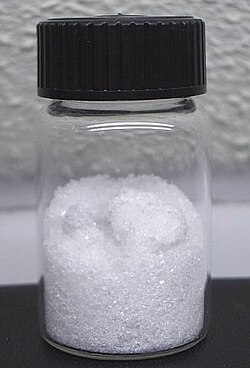
| Appearance | colorless crystalline solid |
| Odor | Odorless |
| Density | 4.35 g/cm3 (24 °C) 3.97 g/cm3 (210 °C)1 |
| Melting point | 209.7 °C (409.5 °F; 482.8 K)13 |
| Boiling point | 440 °C (824 °F; 713 K) decomposes1 |
| 122 g/100 mL (0 °C) 170 g/100 mL (10 °C) 256 g/100 mL (25 °C) 373 g/100 mL (40 °C) 912 g/100 mL (100 °C)2 | |
| Solubility | Soluble in acetone,1 ammonia, ether, glycerol |
| Solubility in acetic acid | 0.776 g/kg (30 °C) 1.244 g/kg (40 °C) 5.503 g/kg (93 °C)3 |
| Solubility in acetone | 0.35 g/100 g (14 °C) 0.44 g/100 g (18 °C)2 |
| Solubility in benzene | 0.22 g/kg (35 °C) 0.44 g/kg (40.5 °C)2 |
| Solubility in ethanol | 3.1 g/100 g (19 °C)2 |
| Solubility in ethyl acetate | 2.7 g/100 g (20 °C)3 |
| log P | 0.19 |
| −45.7·10−6 cm3/mol | |
Refractive index (nD)
|
1.744 |
| Viscosity | 3.77 cP (244 °C) 3.04 cP (275 °C)3 |
| Structure | |
| Orthorhombic, oP564 | |
| P212121, No. 194 | |
| 2224 | |
a = 6.992(2) Å, b = 7.335(2) Å, c = 10.125(2) Å4 α = 90°, β = 90°, γ = 90°
| |
| Thermochemistry | |
Heat capacity (C)
|
93.1 J/mol·K1 |
Std molar
entropy (S⦵298) |
140.9 J/mol·K1 |
Std enthalpy of
formation (ΔfH⦵298) |
−124.4 kJ/mol1 |
Gibbs free energy (ΔfG⦵)
|
−33.4 kJ/mol1 |
| Pharmacology | |
| D08AL01 (WHO) | |
| Hazards | |
| Occupational safety and health (OHS/OSH): | |
Main hazards
|
Reacts explosively with ethanol. Toxic. Corrosive. |
| GHS labelling: | |
   5 5
| |
| Danger | |
| H272, H314, H4105 | |
| P220, P273, P280, P305+P351+P338, P310, P5015 | |
| NFPA 704 (fire diamond) | |
| Lethal dose or concentration (LD, LC): | |
LDLo (lowest published)
|
800 mg/kg (rabbit, oral) 20 mg/kg (dog, oral)6 |
Except where otherwise noted, data are given for materials in their standard state (at 25 °C [77 °F], 100 kPa).
| |


Silver nitrate is an inorganic compound with chemical formula AgNO
3. It is highly water soluble colorless solid that is a precursor to many other silver compounds. Silver nitrate is highly soluble in water but is poorly soluble in most organic solvents, except acetonitrile (111.8 g/100 g, 25 °C).7
Silver nitrate is the least expensive salt of silver; it offers several other advantages as well. It is non-hygroscopic (in contrast to silver fluoroborate and silver perchlorate). In addition, it is relatively stable to light, and it dissolves in numerous solvents, including water. The nitrate can be easily replaced by other ligands.
Synthesis
Albertus Magnus, in the 13th century, documented the ability of nitric acid to separate gold and silver by dissolving the silver.8 It was once called lunar caustic because silver was called luna by ancient alchemists who associated silver with the moon.9Indeed silver nitrate can be prepared by dissolving silver in nitric acid followed by evaporation of the solution. The stoichiometry of the reaction depends upon the concentration of nitric acid.
- 3 Ag + 4 HNO3 (cold and diluted) → 3 AgNO3 + 2 H2O + NO
- Ag + 2 HNO3 (hot and concentrated) → AgNO3 + H2O + NO2
Structure
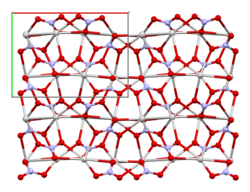
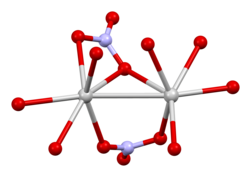
Solid silver nitrate is a coordination polymer. The structure of silver nitrate has been examined by X-ray crystallography several times. In the common orthorhombic form stable at ordinary temperature and pressure, the silver atoms form pairs with Ag---Ag contacts of 3.227 Å. Each Ag+ center is bonded to six oxygen centers of both uni- and bidentate nitrate ligands. The Ag-O distances range from 2.384 to 2.702 Å.4 Because of range of Ag-O distances the coordination geometry about the Ag+ centers is ambiguous. The nitrate groups bridge between four Ag+ sites.4
Reactions
Thermal properties
Solid silver nitrate is robust and melts to give a dense (4.1 g/cm3), stable liquid above its 198 °C melting point.10 At temperatures around 250 °C it decomposes to release metallic silver and red-brown fumes of nitrogen dioxide. Full decomposition occurs at 440 °C.11
- 2 AgNO3 → 2 Ag + O2 + 2NO2
Most metal nitrates thermally decompose to the respective oxides. This may be the case for silver nitrate. Unlike most metal oxides, however, silver oxide readily degrades to the elemental silver.
Salt metathesis
Silver nitrate is a precursor for the laboratory-scale synthesis of many silver compounds. These include the dark brown oxide, yellow iodide, pale yellow bromide, and white chloride. Among the oxyanion derivatives, the following compounds can be produced by precipitation from aqueous silver nitrate: the white sulfate, white sulfite, pale yellow nitrite, and pale yellow carbonate.12 When making photographic film, silver nitrate is treated with halide salts of sodium or potassium to form insoluble silver halide in situ in photographic gelatin, which is then applied to strips of tri-acetate or polyester. Similarly, silver nitrate is used to prepare some silver-based explosives, such as the fulminate, azide, or acetylide, through a precipitation reaction.
Redox
Silver(I) salts are mild oxidants, as implicated by their role in silver-based photography and the staining of skin by silver metal upon contact with silver nitrate solutions. Characteristically, silver nitrate reacts with pieces of copper to form hairlike crystals of silver metal and a blue solution of copper nitrate:
- 2 AgNO3 + Cu → Cu(NO3)2 + 2 Ag
Uses
Halide analysis
The silver cation, Ag+
, reacts quickly with halide sources to produce the insoluble silver halide. This reaction is used in analytical chemistry to confirm the presence of chloride, bromide, or iodide. The same reaction was used on steamships in order to determine whether or not boiler feedwater had been contaminated with seawater. It is still used to determine if moisture on formerly dry cargo is a result of condensation from humid air, or from seawater leaking through the hull.13
Organic synthesis
Silver nitrate finds some use in organic synthesis, e.g. for deprotection and oxidations.14
- 2 AgNO3 + 2 NaOH → Ag2O + 2 NaNO3 + H2O
Argentation chromatography
Ag+
binds alkenes reversibly, and silver nitrate has been used to separate mixtures of alkenes by selective absorption. This phenomenon is the basis of argentation chromatography.
In some cases, alkene complexes can be isolated. The alkene can be liberated with ammonia.15
Biology
In histology, silver nitrate is used for silver staining, for demonstrating reticular fibers, proteins and nucleic acids. For this reason it is also used to demonstrate proteins in polyacrylamide gel electrophoresis (PAGE) gels. It can be used as a stain in scanning electron microscopy.16
Cut flower stems can be placed in a silver nitrate solution, which prevents the production of ethylene. This delays ageing of the flower.17
Indelible ink

Silver nitrate produces long-lasting stain when applied to skin and is one of indelible ink's ingredients. An electoral stain makes use of this to mark a finger of people who have voted in an election, allowing easy identification to prevent double-voting.1819
In addition to staining skin, silver nitrate has a history of use in stained glass. In the 14th century, artists began using a "silver stain" (also known as a yellow stain) made from silver nitrate to create a yellow effect on clear glass. The stain would produce a stable color that could range from pale lemon to deep orange or gold. Silver stain was often used with glass paint, and was applied to the opposite side of the glass as the paint. It was also used to create a mosaic effect by reducing the number of pieces of glass in a window. Despite the age of the technique, this process of creating stained glass remains almost entirely unchanged.20
Medicine
Silver salts have antiseptic properties. In 1881 Credé introduced a method known as Credé's prophylaxis, which used of dilute (2%) solutions of silver nitrate in newborn babies' eyes at birth to prevent contraction of gonorrhea from the mother, which could cause blindness via ophthalmia neonatorum. (Modern antibiotics are now used instead).21222324
Fused silver nitrate, shaped into sticks, was traditionally called "lunar caustic". It is used as a cauterizing agent, for example to remove granulation tissue around a stoma. General Sir James Abbott noted in his journals that in India in 1827 it was infused by a British surgeon into wounds in his arm resulting from the bite of a mad dog to cauterize the wounds and prevent the onset of rabies.25
Silver nitrate is used to cauterize superficial blood vessels in the nose to help prevent nosebleeds.
Dentists sometimes use silver nitrate-infused swabs to heal oral ulcers. Silver nitrate is used by some podiatrists to kill cells located in the nail bed.
The Canadian physician C. A. Douglas Ringrose researched the use of silver nitrate for sterilization procedures, believing that silver nitrate could be used to block and corrode the fallopian tubes.26 The technique was ineffective.27
Disinfection
Much research has been done in evaluating the ability of the silver ion at inactivating Escherichia coli, a microorganism commonly used as an indicator for fecal contamination and as a surrogate for pathogens in drinking water treatment. Concentrations of silver nitrate evaluated in inactivation experiments range from 10–200 micrograms per liter as Ag+. Silver's antimicrobial activity saw many applications prior to the discovery of modern antibiotics, when it fell into near disuse. Its association with argyria made consumers wary and led them to turn away from it when given an alternative.
Against warts
Repeated daily application of silver nitrate can induce adequate destruction of cutaneous warts, but occasionally pigmented scars may develop. In a placebo-controlled study of 70 patients, silver nitrate given over nine days resulted in clearance of all warts in 43% and improvement in warts in 26% one month after treatment compared to 11% and 14%, respectively, in the placebo group.28
Safety
As an oxidant, silver nitrate should be properly stored away from organic compounds. It reacts explosively with ethanol.29 Despite its common usage in extremely low concentrations to prevent gonorrhea and control nosebleeds, silver nitrate is still very toxic and corrosive.30 Brief exposure will not produce any immediate side effects other than the purple, brown or black stains on the skin, but upon constant exposure to high concentrations, side effects will be noticeable, which include burns. Long-term exposure may cause eye damage. Silver nitrate is known to be a skin and eye irritant. Silver nitrate has not been thoroughly investigated for potential carcinogenic effect.31
Further reading
Further reading
- "Silver Compounds." Encyclopedia of Chemical Technology. Vol. 22. Fourth Ed. Excec. Ed. Jaqueline I. Kroschwitz. New York: John Wiley and Sons, 1997.
References
References
- Lide, David R., ed. (2009). CRC Handbook of Chemistry and Physics (90th ed.). Boca Raton, Florida: CRC Press. ISBN 978-1-4200-9084-0.
- Seidell, Atherton; Linke, William F. (1919). Solubilities of Inorganic and Organic Compounds (2nd ed.). New York City: D. Van Nostrand Company. pp. 617–619.
- Kiper, Ruslan Anatolievich. "silver nitrate". Chemister.ru. Retrieved 2014-07-20.
- Lindley, P. F.; Woodward, P. (1966). "An X-ray investigation of silver nitrate: A unique metal nitrate structure". Journal of the Chemical Society A: Inorganic, Physical, Theoretical: 123. doi:10.1039/J19660000123.
- Sigma-Aldrich Co., Silver nitrate. Retrieved on 2014-07-20.
- "Silver (metal dust and soluble compounds, as Ag)". Immediately Dangerous to Life or Health Concentrations. National Institute for Occupational Safety and Health.
- "silver nitrate". chemister.ru. Retrieved 2019-04-04.
- Szabadváry, Ferenc (1992). History of analytical chemistry. Taylor & Francis. p. 17. ISBN 978-2-88124-569-5.
- "Definition of Lunar Caustic". dictionary.die.net. Archived from the original on 2012-01-31.
- P. W. Schenk; G. Brauer (1963). "Preparative Methods". In G. Brauer (ed.). Handbook of Preparative Inorganic Chemistry, 2nd Ed. Vol. 2. NY, NY: Academic Press. p. 100.
- Stern, K. H. (1972). "High Temperature Properties and Decomposition of Inorganic Salts Part 3, Nitrates and Nitrites". Journal of Physical and Chemical Reference Data. 1 (3): 747–772. Bibcode:1972JPCRD...1..747S. doi:10.1063/1.3253104. S2CID 95532988.
- O. Glemser; R. Sauer (1963). "Copper, Silver, Gold". In G. Brauer (ed.). Handbook of Preparative Inorganic Chemistry, 2nd Ed. Vol. 2. NY,NY: Academic Press. p. 1003.
- "Silver nitrate method". Transport Information Service. Gesamtverband der Deutschen Versicherungswirtschaf. Retrieved 22 June 2015.
- Campaigne, E.; LeSuer, W. M. (1963). "3-Thiophenecarboxylic (Thenoic) Acid". Organic Syntheses
{{cite journal}}: CS1 maint: multiple names: authors list (link); Collected Volumes, vol. 4, p. 919. (preparation of Ag2O, used in oxidation of an aldehyde) - Cope, A. C.; Bach, R. D. (1973). "trans-Cyclooctene". Organic Syntheses
{{cite journal}}: CS1 maint: multiple names: authors list (link); Collected Volumes, vol. 5, p. 315. - Geissinger HD (2011). "The use of silver nitrate as a stain for scanning electron microscopy of arterial intima and paraffin sections of kidney". Journal of Microscopy. 95 (3): 471–481. doi:10.1111/j.1365-2818.1972.tb01051.x. PMID 4114959. S2CID 38335416.
- "Silver Nitrate (072503) Fact Sheet" (PDF). epa.gov. Retrieved 3 October 2024.
- Dhillon, Amrit (2023-06-17). "The ink with a 'secret formula' that powers the world's biggest democratic exercise | India | The Guardian". The Guardian. Archived from the original on 2023-06-17. Retrieved 2024-04-17.
- Dhillon, Amrit (2019-03-28). "The ink with a 'secret formula' that powers the world's biggest democratic exercise". The Guardian. ISSN 0261-3077. Retrieved 2024-04-17.
- "Khan Academy". www.khanacademy.org. Retrieved 2024-10-29.
- Matejcek, A; Goldman, RD (November 2013). "Treatment and prevention of ophthalmia neonatorum". Canadian Family Physician. 59 (11): 1187–90. PMC 3828094. PMID 24235191.
- Peter.H (2000). "Dr Carl Credé (1819–1892) and the prevention of ophthalmia neonatorum". Arch Dis Child Fetal Neonatal Ed. 83 (2): F158–F159. doi:10.1136/fn.83.2.F158. PMC 1721147. PMID 10952715.
- Credé C. S. E. (1881). "Die Verhürtung der Augenentzündung der Neugeborenen". Archiv für Gynäkologie. 17 (1): 50–53. doi:10.1007/BF01977793. S2CID 10053605.
- Schaller, Ulrich C. & Klauss, Volker (2001). "Is Credés prophylaxis for ophthalmia neonatorum still valid?". Bulletin of the World Health Organization. 79 (3): 262–266. PMC 2566367. PMID 11285676.
- British Library, India Office Records, European Manuscripts, MSS EUR F171/33/3, page 109.
- Ringrose CA. (1973). "Office tubal sterilization". Obstetrics and Gynecology. 42 (1): 151–5. PMID 4720201.
- Cryderman v. Ringrose (1978), 89 D.L.R. (3d) 32 (Alta S.C.) and Zimmer et al. v. Ringrose (1981) 4 W.W.R. 75 (Alta C.A.).
- Sterling, J. C.; Handfield-Jones, S.; Hudson, P. M.; British Association of Dermatologists (2001). "Guidelines for the management of cutaneous warts" (PDF). British Journal of Dermatology. 144 (1): 4–11. doi:10.1046/j.1365-2133.2001.04066.x. PMID 11167676. S2CID 20179474. Archived from the original (PDF) on 2012-03-03.
- Perrin, D. D.; Armarego, W. L. F.; Perrin, D. R. (November 1986). "Silver nitrate + ethanol = explosion". Journal of Chemical Education. 63 (11): 1016. Bibcode:1986JChEd..63.1016P. doi:10.1021/ed063p1016.1. ISSN 0021-9584.
- "Safety data for silver nitrate (MSDS)". Oxford University Chemistry department. Archived from the original on 2011-12-02. Retrieved 2008-03-25.
- "New Jersey Right-To-Know-Act Hazardous Substance Fact Sheet - Silver Nitrate" (PDF).
External links
External links
- International Chemical Safety Card 1116
- NIOSH Pocket Guide to Chemical Hazards
- History of Kodak: About Film and Imaging
https://www.cofesilver.com/en/silver_bar :silver bar explanation. pricing investing