| Silphium asteriscus | |
|---|---|
| |
| Silphium asteriscus var. asteriscus | |
Scientific classification 
| |
| Kingdom: | Plantae |
| Clade: | Embryophytes |
| Clade: | Tracheophytes |
| Clade: | Spermatophytes |
| Clade: | Angiosperms |
| Clade: | Eudicots |
| Clade: | Asterids |
| Order: | Asterales |
| Family: | Asteraceae |
| Tribe: | Heliantheae |
| Genus: | Silphium |
| Species: | S. asteriscus
|
| Binomial name | |
| Silphium asteriscus | |
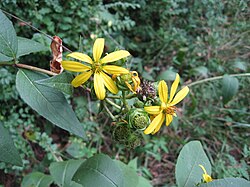
Silphium asteriscus, commonly called starry rosinweed,2 is an herbaceous plant in the family Asteraceae. It is native to the eastern United States, from Oklahoma and Texas east to Florida and Pennsylvania.3 It is a widespread species found in a variety of open habitats, such as prairies, woodlands, and flatwoods.45
Taxonomy
Additional research is needed to better understand the taxonomy of this species. It remains perhaps the most poorly-understood Silphium in eastern North America.6 It appears to show a high level of local variability throughout its range, which has been interpreted as either a species complex, a single highly variable species, or some combination of both. Due to conflicting information about the best circumscription of the varieties, the taxonomy of this species remains unsettled.78
The most recent treatment from 2020 ranked Silphium asperrimum, Silphium dentatum and Silphium simpsonii at species status.8 If adopted, this leaves S. asteriscus with three remaining varieties. They are:
- Silphium asteriscus var. asteriscus - Appalachian and eastward; with a congested, hispid inflorescence
- Silphium asteriscus var. laitoflium - south and west of the Appalachians; with broad, opposite leaves and a spreading glabrous inflorescence
- Silphium asteriscus var. trifoliatum - widespread; similar to the above but with narrow whorled leaves8
Ecology
Silphium asteriscus is insect pollinated and is recorded to have been visited in northern Florida by Agapostemon virescens, Augochloropsis sumptuosa,Ceratina, Halictus poeyi/ligatus, Lasioglossum apopkense, Lasioglossum pectorale, Lasioglossum reticulatum, Megachile albitarsis, Megachile georgica, Megachile mendica, Megachile petulans, Megachile texana, Melissodes tepaneca, Svastra aegis, and Svastra atripes. 9
-
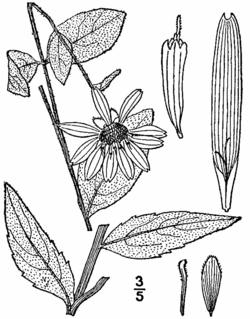 Line drawing of Silphium asteriscus
References
References
- "Silphium". Index Nominum Genericorum. International Association for Plant Taxonomy. 9 February 1996. Retrieved 24 June 2008.
- NRCS. "Silphium asteriscus". PLANTS Database. United States Department of Agriculture (USDA). Retrieved 18 January 2017.
- Kartesz, John T. (2014). "Silphium asteriscus". County-level distribution map from the North American Plant Atlas (NAPA). Biota of North America Program (BONAP). Retrieved 18 January 2017.
- Flora of North America
- Florida State University Robert K. Godfrey Herbarium database. URL: http://herbarium.bio.fsu.edu. Last accessed: July 2015. Collectors: Andre F. Clewell, Steve L. Orzell, Robert K. Godfrey, R. A. Norris, R. Komarek, Loran C. Anderson, Wilbur H Duncan, George R. Cooley, Richard J. Eaton, James D. Ray, Jr., R L Lazor, Gary R. Knight, C. Jackson, K. Craddock Burks, Richard S. Mitchell, A. H. Curtiss, R. Kral, Paul L. Redfearn, Jr. States and Counties: Florida: Bay, Dixie, Franklin, Gadsden, Jackson, Jefferson, Leon, Liberty, Levy, Okaloosa, Taylor, Wakulla. Georgia: Brooks, Grady, Hall, Thomas.
- Chester, Edward (2015). Guide to the Vascular Plants of Tennessee.
- Flora of Missouri
- "Flora of the Southern and Mid-Atlantic States". Archived from the original on 6 October 2018. Retrieved 18 January 2017.
- Ulyshen, M. D., K. Robertson, S. Horn, and C. Dixon. 2024. Characterization of the bee community and pollination network in a southeastern U.S. pine savanna. Frontiers in Ecology and Evolution 12:1403602.
External links
External links
- Media related to Silphium asteriscus at Wikimedia Commons
- Data related to Silphium asteriscus at Wikispecies