| Silko | |
|---|---|
| King of Nobatia and all Aethiopia | |
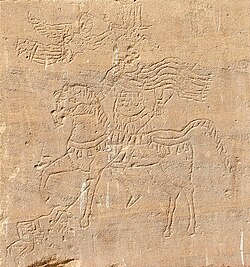 Graffito from the Temple of Kalabsha (Talmis), depicting king Silko on horse back spearing an enemy | |
| King of Nobatia | |
| Reign | c. 5th century |
| Successor | Aburni |
| Born | Faras |
| Religion | Coptic Orthodox Christianity |
Silko (Ancient Greek: Σιλκω) was ruler of the Nubian kingdom of Nobatia. He is known for uniting Nobatia and being the first Nubian king to adopt Christianity.1
During Silko's reign Nobatia defeated the Blemmyes to the North, and an inscription by Silko at the Temple of Kalabsha claims to have driven the Blemmyes into the Eastern Desert.234 The inscription on the temple was made in Greek suggesting that he was influenced by Byzantine culture.5 He established Pakhoras (modern Faras) as the Capital of the Kingdom. Nobatia officially converted to Coptic Orthodox Christianity under his reign.678.
It is believed he was buried in Ballana.9
References
References
- Hägg T. (2002) ‘Silko’s Language: a Retrospect’ In Tamás A.Bács (Ed.) A Tribute to Excellence-Studia Aegyptiaca XVII, Budapest, 289-300
- "Silko Inscription". homepage.univie.ac.at.
- Obluski A. The Rise of Nobadia. Social Changes in Northern Nubia in Late Antiquity p28-30 https://www.academia.edu/462120/The_Rise_of_Nobadia_Social_Changes_in_Northern_Nubia_in_Late_Antiquity
- Hägg T. (2002) ‘Silko’s Language: a Retrospect’ In Tamás A.Bács (Ed.) A Tribute to Excellence-Studia Aegyptiaca XVII, Budapest, 289-300
- Burstein S. (1995) Greaco-Africana: Studies in the History of Greek Relations with Egypt and Nubia, Aristide D p221 Caratzas Publisher, New Rochelle, Athens &Moscow
- Oakes, p.209
- Hobson, p.185
- "Der Antike Sudan" (PDF). www.sag-online.de. 2018. Retrieved 2020-12-10.
- Zacharopoulou, Effie (2014). "THE EMERGENCE OF THE STATE OF NOBADIA AND THE BYZANTINE POLICY". Graeco-Africana et Afro- Byzantina Proceedings of the International Conference on Graeco-African and Afro-Byzantine Studies at the University of Johannesburg: 423. Retrieved 13 January 2026.