| Shenyang Mandarin | |
|---|---|
| 瀋陽話 / 沈阳话 Shěnyánghuà | |
| Native to | China |
| Region | Shenyang |
Sino-Tibetan
| |
| Language codes | |
| ISO 639-3 | – |
cmn-she | |
| Glottolog | shen1252 |
Shenyang Mandarin (Chinese: 沈阳话) is a dialect of Chinese language used by people in and around Shenyang, the capital of Liaoning province and the largest city in Northeast China. Like other Northeastern Mandarin dialects, it is very close to Standard Chinese but has notably distinctive tones, pronunciations and lexicon, although some people consider it as merely having a strong accent rather than being a distinct dialect. Due to its similarity to Standard Chinese, its pronunciations can be phonetically transcribed readily with pinyin or using character wordplay. Although Standard Chinese is taught in schools and officially promoted as the formal lingua franca, Shenyang Mandarin remains the main variety of Chinese used in local daily usages, and is widely imitated in popular culture and comedy as the stereotypical Northeastern broad accent.
Phonology
Shenyang dialect has 19 initial consonants, as opposed to the 21 in Standard Mandarin. Notably, the retroflex consonants [ʈ͡ʂ], [ʈ͡ʂʰ] and [ʂ] in Standard Mandarin are pronounced as [t͡s], [t͡sʰ] and [s], respectively, while [ɻ] is omitted. While lost in Standard Mandarin, Middle Chinese retroflex nasal [ɳ] is preserved in the Shenyang dialect. [v] also exists in the Shenyang dialect.1
| Labial | Alveolar | Dental sibilants | Palatal | Velar | ||
|---|---|---|---|---|---|---|
| Stops | unaspirated | p | t | t͡s | t͡ɕ | k |
| aspirated | pʰ | tʰ | t͡sʰ | t͡ɕʰ | kʰ | |
| Nasals | m | n | ɳ | |||
| Fricatives | f | v | s | ɕ | x | |
| Approximants | l | |||||
Standard Mandarin diphthongs tend to be pronounced as monophthongs in the Shenyang dialect. For example, [ai] becomes [æ], and [au] becomes [ɔ].1
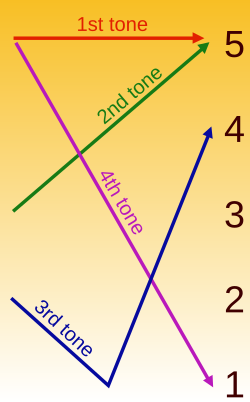
The most distinctive aspect of the Shenyang dialect is the much lower pitch of the first tone than in Standard Mandarin. It would be positioned at 2, rather than 5, on the chart shown (right). As a result, it can sound rather like the third tone.
Like the Beijing dialect, the Shenyang dialect is characterized by erhua or r-coloring, though with a significant lack of rhotic consonants (known colloquially as "speaking with the tongue straightened").
Vocabulary
Some of the words in the Shenyang dialect come from other languages like the Manchu language. One example is 旮旯儿 gālár 'corner'.
Examples of words in various Northeastern dialects (not necessarily specific to Shenyang) include:
| Northeastern Mandarin | pinyin | Standard Mandarin | pinyin | Translation |
|---|---|---|---|---|
| 不赶趟儿 | bù gǎntàngr | 来不及 | lái bù jí | too late |
| 波楞盖儿 | bōlingàr | 膝盖 | xīgài | kneecap |
| 疙瘩、圪塔 | gāda | 地方 | dìfang | place (noun) |
| 得瑟 | dèse | 卖弄 | màinòng | to show off |
| 老鼻子(了) | lǎobízi(le) | 很多 | hěnduō | a lot |
| 埋汰 | máitai | 脏 | zāng | dirty, filthy |
| 嘎哈 | gàhá | 干什么 、干嘛 | gànshénme, gànmá | What are you doing? |
| 砢碜 | kēchen, kēzhen | 丑、难看 | chǒu, nánkàn | ugly, hideous |
| 老 | lǎo | 很 | hěn | very |
| 贼 | zéi | 特别 | tèbié | exceedingly |
| 毙 | bì | 棒 | bàng | good, excellent |
| 蚂蛉 | māling | 蜻蜓 | qīngtíng | dragonfly |
| 嘎赌 | gàdu | 打赌 | dǎdǔ | to bet |
References
References
- Meng, Xiangyu 孟祥宇 (2011). "Shěnyáng fāngyán yīn xì gàishuō" 沈阳方言音系概说. Yǔwén xuékān 语文学刊. 2011 (2): 31–33.