| Sharpfin houndshark | |
|---|---|
Scientific classification 
| |
| Kingdom: | Animalia |
| Phylum: | Chordata |
| Class: | Chondrichthyes |
| Subclass: | Elasmobranchii |
| Division: | Selachii |
| Order: | Carcharhiniformes |
| Family: | Triakidae |
| Genus: | Triakis |
| Species: | T. acutipinna
|
| Binomial name | |
| Triakis acutipinna Kato, 1968
| |

| |
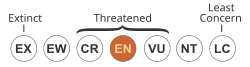
The sharpfin houndshark (Triakis acutipinna) is a rare species of houndshark in the family Triakidae. It is known from only a small number of individuals collected in the coastal waters of Ecuador, the longest one being 1.02 m in length. The reproduction of this houndshark is ovoviviparous.2Due to its small known population and range, it is currently classified as endangered by the International Union for Conservation of Nature (IUCN).
Description
The sharpfin houndshark is a small costal shark species, with known individuals reaching just over 1 m in total length.3 Females grow slightly larger than males, with females reaching approximately 100 cm and males around 90 cm.3 It has a slender body and well-developed dorsal fins. Due to the limited number of known individuals, detailed morphology about the species is not well known or documented.
Habitat
The sharpfin houndshark is known only from the eastern Pacific Ocean, specifically costal waters of Ecuador.4 It has been recorded near areas such as Isla de la Plata and surrounding regions.3 The species was found in shallow marine environments and can be associated with a variety of habitats, including coral reefs, rocky areas, sandy bottoms, and gravel areas.3
Ecology
Little is known about the ecology of Triakis acutipinna. Some evidence suggests that it feeds on benthic organisms, such as crustaceans (including shrimp and crabs) and small bony fishes. 3Its habitat indicates that it likely stays near the seafloor in costal environments.
Reproduction
The sharpfin houndshark is ovoviviparous, meaning the embryos develop inside eggs that stay in the mother's body until they hatch.4
Conservation
The sharpfin houndshark is classified as endangered by the IUCN Red list.4 The global population is estimated to include fewer than 2,500 mature individuals, and the population trend is decreasing.4 The species is likely threatened by incidental capture in costal fisheries and habitat degradation within its limited range, increasing risk of extinction.4
References
References
- Compagno, L.J.V.; Kyne, P.M. & Domingo, A. (2009). "Triakis acutipinna". The IUCN Red List of Threatened Species. 2009. IUCN: e.T39361A10216173. doi:10.2305/IUCN.UK.2009-2.RLTS.T39361A10216173.en. Retrieved 13 December 2017.
- Froese, Rainer; Pauly, Daniel (eds.). "Triakis acutipinna". FishBase. July 2006 version.
- Kyne, P.M.; Domingo, A (2009). "ICUN Red List of Threatened Species".
- Cevallos-Garcías, A (2020). "Investigating the status of Ecuador's lost shark, the Sharpfin Houndshark Triakis acutipinna".